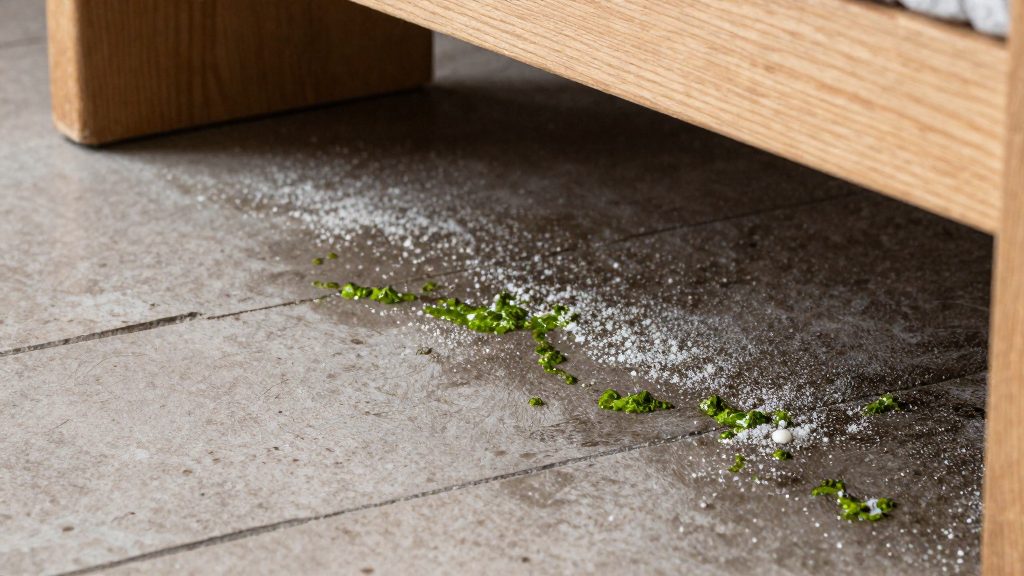
Crawl spaces develop mould when moisture stays in the air and on surfaces long enough to support growth. According to PuroClean Canada (2026), mould grows easily when relative humidity in a crawl space is above 70%, while its recommended target range is 30 to 50%. Readings between those two figures call for monitoring. The moisture usually comes from water entering from outside, leaks inside the building, or air that is not exchanged with the outdoors.
Why do crawl spaces get covered in mould?
A crawl space is a shallow, enclosed void between the ground and the floor above. Moisture that enters it has fewer routes out, so it tends to accumulate. Mould then grows on wood, insulation and the soil surface.
Sources of moisture
Common entry points for moisture include:
| Source | Problem it creates | Cited by |
|---|---|---|
| Gutters and downspouts that do not direct water away from the foundation | Water collects against the foundation | PuroClean Canada (2026) |
| Cracks in foundation walls | Water and humid air enter the space | PuroClean Canada (2026) |
| Leaks from HVAC ducts and plumbing | Water is released inside the space | PuroClean Canada (2026) |
| Plumbing or foundation leaks | Water reaches the structure and the ground | Groundworks (2026) |
| Uncontrolled ground moisture | Water vapour rises from bare soil | Groundworks (2026) |
Groundworks (2026) says prevention rests on controlling moisture and ensuring proper ventilation. Its measures include a ground vapour barrier placed over the soil, foundation drainage, prompt repair of plumbing or foundation leaks, and vents or a dehumidifier.
Why ventilation depends on size
Vents do not drain moisture on their own. PuroClean Canada (2026) recommends a ventilation area of 0.10 m² for every 15 m² of crawl space. For a 30 m² crawl space, the calculation is 30 m² ÷ 15 m² × 0.10 m² = 0.20 m² of vent area. The same source states that a professional should decide whether vents should stay closed and which alternatives suit the building, because open vents can admit humid outdoor air in some conditions.
Ventilation has to be matched to the space and the moisture load. A space with an unsealed soil surface, a leak or an exhaust source can stay above the 70% threshold even when the vent area meets the ratio. Check local building guidance for how to adjust vent area in different climates.
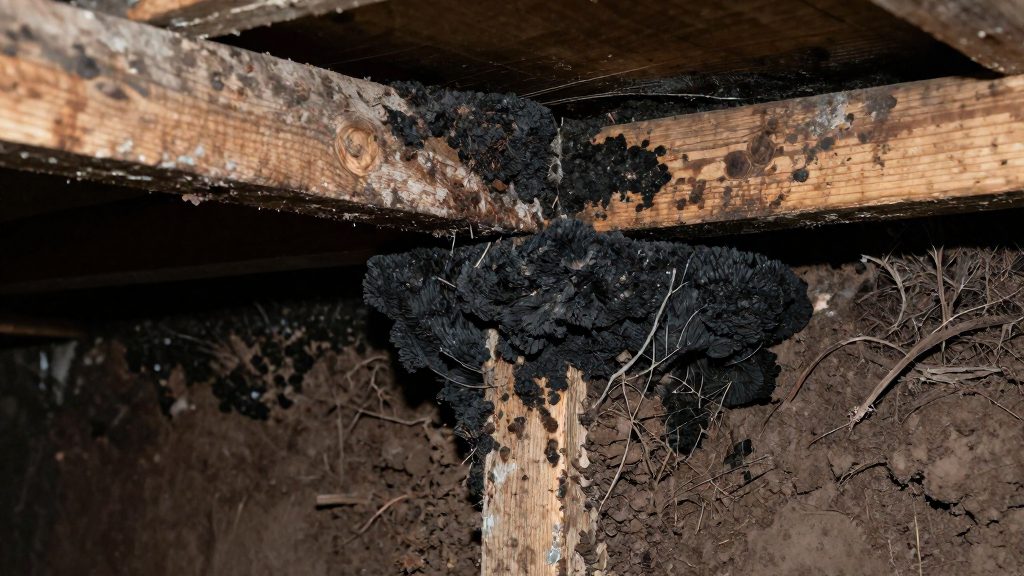
What humidity level should you target in a crawl space?
For a crawl space, PuroClean Canada (2026) gives a target relative humidity of 30 to 50%. The same source states that mould grows easily when humidity is above 70%. Keeping readings inside the 30 to 50% band keeps the space well below that mould threshold, and the level should be checked over time rather than read once.
Reference values
| Relative humidity | Status according to PuroClean Canada (2026) |
|---|---|
| 30 to 50% | Target range for a crawl space |
| Above 70% | Mould grows easily |
Treat readings between 50% and 70% as a range to watch rather than a verified threshold.
How to check the level
- Place a hygrometer on the crawl space floor, away from vents, the access hatch and any standing water.
- Record readings at several times of day over a period of days, since humidity changes with outdoor weather.
- Compare the logged values with the 30 to 50% band. Consistent readings above 50% indicate that moisture control needs attention.
- Schedule the check alongside the insulation inspection that PuroClean Canada (2026) recommends once or twice a year.
What pushes the level up
Groundworks (2026) describes moisture control as the basis of prevention. Across both sources, three moisture sources recur:
- Ground moisture, which rises through an unsealed floor. PuroClean Canada (2026) recommends plastic vapour barriers on the floor and foundation walls.
- Water entering from outside, through gutters or downspouts that drain toward the foundation, or through foundation cracks.
- Leaks inside the building, from HVAC ducts or plumbing. PuroClean Canada (2026) advises checking for these.
Controlling water sources and drainage
Water entering a crawl space is one of several moisture sources that can feed mould, alongside ground moisture and internal leaks. PuroClean Canada (2026) gives a target relative humidity of 30 to 50% for a crawl space and states that mould grows easily when humidity is above 70%. Groundworks (2026) describes prevention as resting on controlling moisture and ensuring proper ventilation. Controlling water at its source reduces the moisture load that ventilation or dehumidification would otherwise have to handle.
Directing surface water away from the foundation
Rainwater that runs off the roof and collects around the base of the house is a frequent route into the crawl space. PuroClean Canada (2026) recommends gutters and downspouts that direct water away from the foundation. Groundworks (2026) lists foundation drainage as a separate measure, so the two are complementary: gutters reduce the volume of water reaching the soil, and drainage handles what still reaches the foundation.
Blocking ground moisture
Moisture rising from the soil is a separate input from surface water. Groundworks (2026) recommends a ground vapour barrier. PuroClean Canada (2026) specifies plastic vapour barriers on the floor and foundation walls.
Finding and repairing leaks
Leaks from plumbing, HVAC ducts and foundation cracks add water that no outdoor measure can prevent. The table below summarises the checks and actions.
| Water source | Check or action | Source |
|---|---|---|
| Gutters and downspouts | Direct water away from the foundation | PuroClean Canada (2026) |
| Foundation cracks | Check for cracks and repair them | PuroClean Canada (2026) |
| HVAC ducts and plumbing | Check for leaks; repair plumbing or foundation leaks promptly | PuroClean Canada (2026); Groundworks (2026) |
| Soil moisture | Install a ground vapour barrier | Groundworks (2026); PuroClean Canada (2026) |
| Foundation drainage | Provide drainage at the foundation | Groundworks (2026) |
Vapour barrier and insulation: what to choose?
A vapour barrier and insulation do different jobs and are not interchangeable. The barrier limits moisture rising from the ground into the crawl space air, while insulation reduces heat transfer. PuroClean Canada (2026) recommends plastic vapour barriers on the floor and foundation walls as a core measure, and Groundworks (2026) lists a ground vapour barrier among its prevention measures. Insulation should be inspected regularly. Check with a building professional which insulation type suits a crawl space.
Ground vapour barrier first
The ground vapour barrier is the common recommendation of both sources. It covers the soil floor and controls how much moisture enters the air above it. Since PuroClean Canada (2026) gives a target relative humidity of 30 to 50% in a crawl space, and states that mould grows easily above 70%, the barrier is the measure that most directly supports that range. Follow the installer’s or manufacturer’s instructions for thickness, overlap and fixing method.
Foundation walls
PuroClean Canada (2026) also recommends plastic vapour barriers on foundation walls. This addresses moisture that moves through masonry or concrete rather than from the soil surface. A wall barrier does not replace repairs: PuroClean Canada (2026) advises checking foundation cracks, and Groundworks (2026) advises prompt repair of plumbing or foundation leaks. Fix those first, then seal the surfaces.
Insulation inspection
PuroClean Canada (2026) recommends inspecting insulation once or twice a year. The inspection checks its condition after each season, since damaged or displaced insulation no longer works as intended. Confirm the result against a hygrometer reading. If humidity stays above the 30 to 50% target, look for a moisture source before adding more insulation.
Practical sequence
- Measure relative humidity with a hygrometer to establish a baseline.
- Repair leaks and foundation cracks identified during inspection.
- Install the ground vapour barrier, then the foundation wall barrier where recommended.
- Inspect insulation once or twice a year and recheck humidity afterward.
| Component | Location | Source |
|---|---|---|
| Ground vapour barrier | Soil floor | PuroClean Canada (2026); Groundworks (2026) |
| Plastic vapour barrier | Foundation walls | PuroClean Canada (2026) |
| Insulation inspection | Crawl space insulation | PuroClean Canada (2026): once or twice a year |
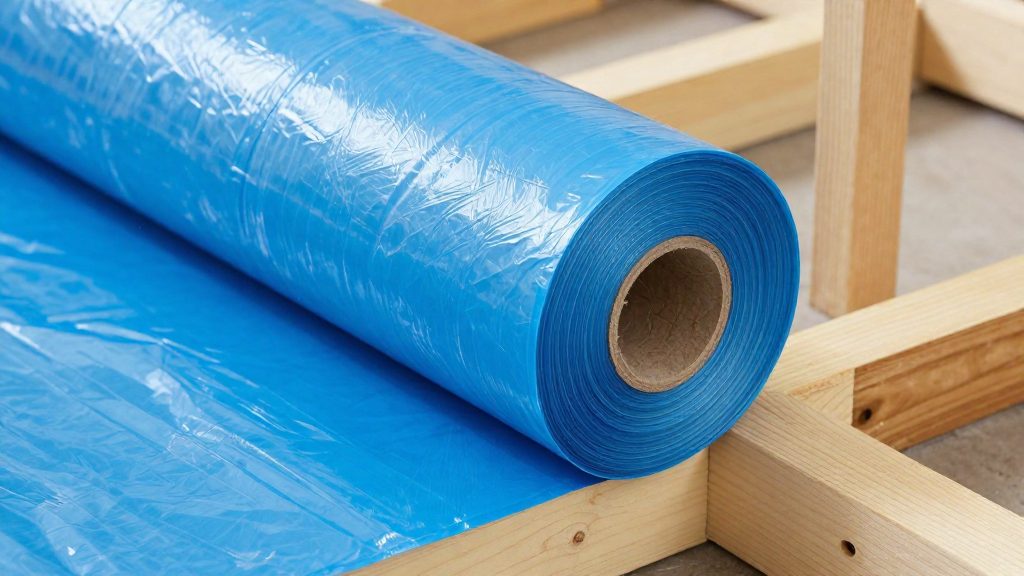
Ventilate or Close the Crawl Space?
Keeping vents open or closed is not a default choice. PuroClean Canada (2026) says a professional should advise, and the right option depends on measured moisture. According to PuroClean Canada (2026), the target relative humidity in a crawl space is 30 to 50%, and mould grows easily when humidity is above 70%. Ventilation is one way to stay within that range, but it is not the only one.
Sizing passive vents
PuroClean Canada (2026) recommends a vent area of 0.10 m² for every 15 m² of crawl space. To calculate the requirement, use this method:
- Measure the crawl space floor area in m².
- Divide the area by 15, then multiply by 0.10.
- The result is the minimum vent area in m².
For example, a 150 m² crawl space requires 150 ÷ 15 × 0.10 = 1.0 m² of vent area.
When vents should stay closed
PuroClean Canada (2026) states that a professional should advise whether vents should stay closed and which alternatives apply. Closing vents without that assessment is not a default step, because the decision depends on the specific conditions of the space.
Dehumidifier as an alternative
Groundworks (2026) lists “vents or a dehumidifier” as moisture-control measures, presenting them as options alongside a ground vapour barrier, foundation drainage, and prompt repair of leaks. Check dehumidifier capacity and sizing against the crawl space area with a professional.
| Option | Source | Key figure or condition |
|---|---|---|
| Passive vents | PuroClean Canada (2026) | 0.10 m² per 15 m² of crawl space |
| Dehumidifier | Groundworks (2026) | Listed as an alternative to vents |
| Vents closed | PuroClean Canada (2026) | Only after professional advice |
Dehumidifier and hygrometer: when to use them?
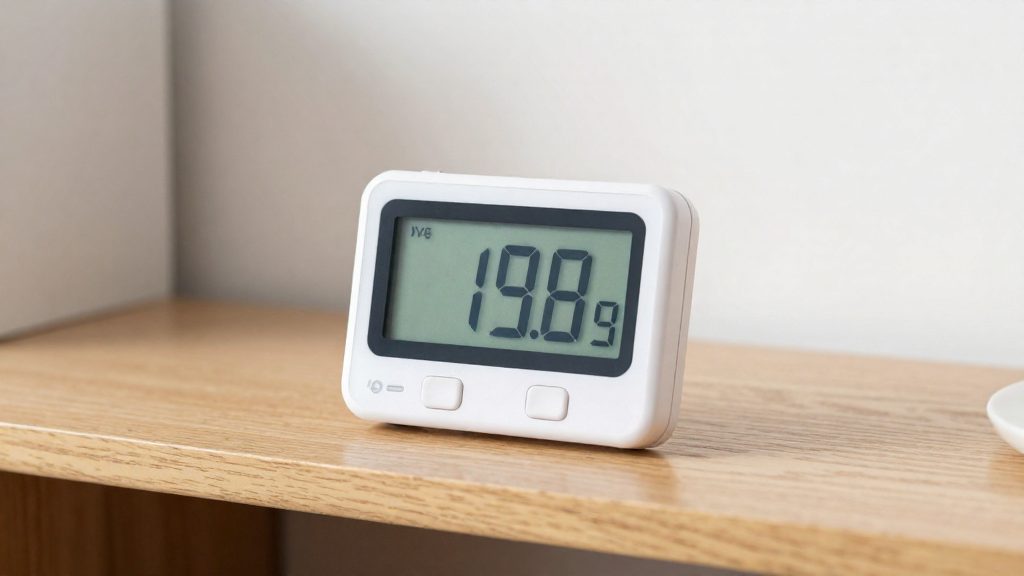
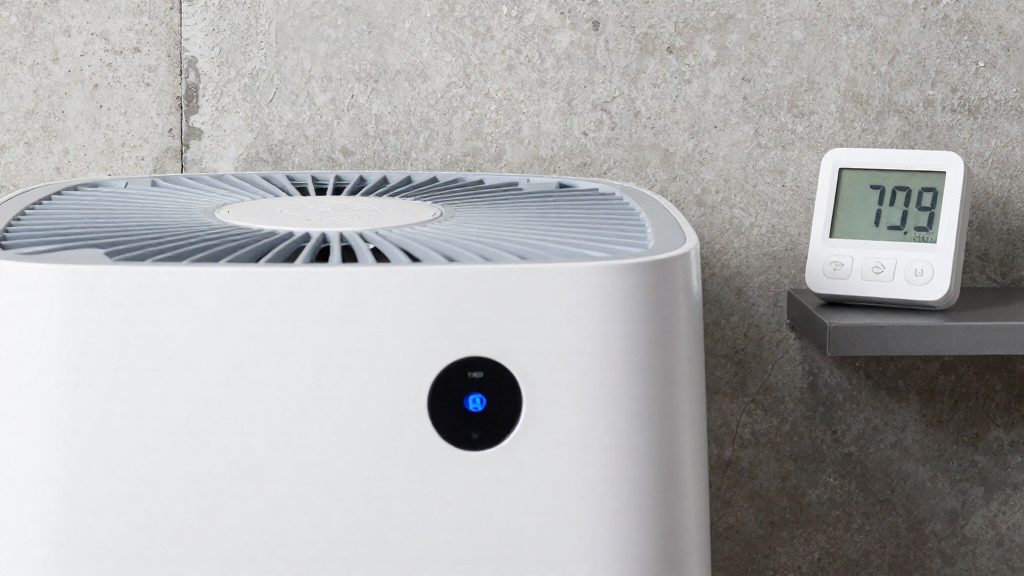
A hygrometer shows whether a crawl space is within the range where mould can develop, and a dehumidifier is one way to bring it back. According to PuroClean Canada (2026), the target relative humidity in a crawl space is 30 to 50%, and mould grows easily above 70%. Measuring first shows where the space sits against those thresholds, so the choice between a dehumidifier, ventilation and moisture repairs rests on readings rather than smell or visible stains.
Measure over time, not once
Place the hygrometer in the crawl space and log readings over several days, since a single reading can reflect a dry or wet spell outside. Compare the results with the thresholds:
| Relative humidity | Position against the thresholds | Action |
|---|---|---|
| 30 to 50% | Within PuroClean Canada’s target range | Keep moisture controls in place and recheck periodically |
| Above 50%, up to 70% | Above target, below the mould threshold | Locate the moisture source before adding equipment |
| Above 70% | Mould grows easily (PuroClean Canada, 2026) | Address the source and consider a dehumidifier or vents |
When a dehumidifier is the right tool
Groundworks (2026) lists vents or a dehumidifier among its measures for controlling moisture and ensuring proper ventilation. A dehumidifier is most useful once the water entry points are dealt with. Groundworks’ other measures are a ground vapour barrier, foundation drainage, and prompt repair of plumbing or foundation leaks. Without them, a dehumidifier removes moisture from the air but does not stop water from entering.
Vents or dehumidifier: who decides
PuroClean Canada (2026) recommends a ventilation area of 0.10 m² per 15 m² of crawl space. For a 60 m² crawl space, that is 0.40 m² of vent area. The same source states that a professional should decide whether vents should stay closed and which alternatives apply, so closing vents without that assessment is not advised.
How to Monitor Crawl Space Humidity Year-Round
Monitoring a crawl space means measuring its relative humidity on a regular schedule and inspecting the components that add moisture to it. PuroClean Canada (2026) gives a target relative humidity of 30 to 50% for a crawl space and warns that mould grows easily above 70%. Readings inside the target band indicate control, while readings that climb toward 70% point to a moisture source that needs investigation.
Reference Values for Routine Checks
| Check | Reference | Source |
|---|---|---|
| Relative humidity reading | Target 30 to 50% | PuroClean Canada (2026) |
| Insulation inspection | Once or twice a year | PuroClean Canada (2026) |
| Vent area | 0.10 m² per 15 m² of crawl space | PuroClean Canada (2026) |
Seasonal Inspection Routine
Use the following steps for each inspection:
- Log humidity readings with a hygrometer placed at the same point in the crawl space each time, so results remain comparable across seasons.
- Inspect the foundation for cracks, and confirm that gutters and downspouts direct water away from the foundation (PuroClean Canada, 2026).
- Check HVAC ducts and plumbing for leaks, since a leak is a moisture source that humidity readings alone cannot identify.
- Review the plastic vapour barrier on the floor and foundation walls during the insulation inspection.
- Confirm that dryer vents terminate outdoors, not inside the crawl space (PuroClean Canada, 2026).
Interpreting Persistent Readings
When readings stay above the target band despite these checks, Groundworks (2026) lists vents or a dehumidifier among its control measures, alongside a ground vapour barrier and foundation drainage. PuroClean Canada (2026) states that a professional should determine whether vents stay closed and which alternatives apply, so the choice should not rest on readings alone.
Frequently asked questions
What relative humidity should a crawl space stay under to avoid mould?
Aim for a relative humidity of 30 to 50%, the target range PuroClean Canada (2026) gives for crawl spaces. Readings above 70% favour mould growth, so values between 50% and 70% call for regular checks with a hygrometer.
How much vent area does a crawl space need?
PuroClean Canada (2026) recommends 0.10 m² of vent area for every 15 m² of crawl space floor. Because the right setup depends on the building, the same source advises that a professional decide whether vents should stay closed and which alternatives suit the space. Groundworks (2026) lists a dehumidifier among those alternatives.
Is a plastic vapour barrier enough on its own?
PuroClean Canada (2026) pairs plastic vapour barriers on the floor and foundation walls with checks of foundation cracks, duct and plumbing leaks, and an insulation inspection once or twice a year. Groundworks (2026) combines a ground vapour barrier with foundation drainage and prompt repair of leaks.