Bedrooms hold moisture for longer than most rooms. The room stays closed through the night while the occupant releases water vapour, and the cooler surfaces inside collect it. Overnight, that excess moisture can lead to condensation, mould and dust mite growth.
Why bedroom humidity matters
A sleeping occupant releases moisture continuously through breathing and perspiration. In a bedroom with the door and window shut, that vapour has nowhere to go. The air cools overnight, and once it reaches its dew point against a cold surface, water condenses. The same process then supports mould and dust mites in the textiles nearby.
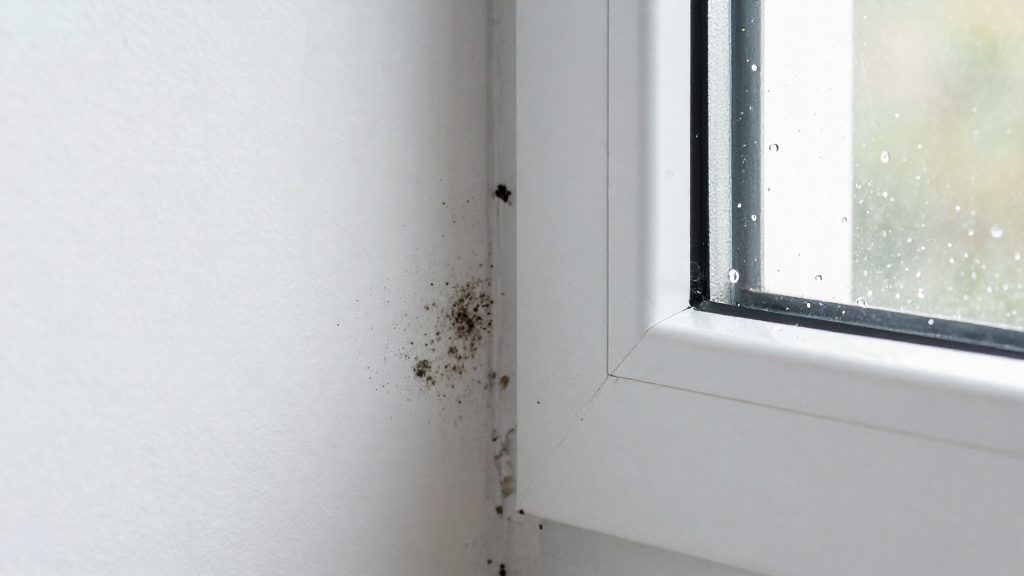
Condensation on window panes and walls
In a bedroom, the coolest surfaces are usually the glazing and any external wall, because they lose heat to the outside at night. Condensation on glass is visible in the morning. The same process can occur unseen behind furniture pushed against an external wall, where it is harder to detect.
Mould on damp surfaces and textiles
Mould grows on surfaces that stay damp for hours. In a bedroom, these include window frames, wall corners, curtains, headboards and the fabric of the bed. Because overnight moisture lasts longer than a short morning airing, these materials often remain damp when the room is next occupied. Mould on textiles usually appears as dark spots or a musty smell.
Dust mite proliferation in bedding and mattresses
Dust mites live in bedding, mattresses and soft furnishings. Humid bedding gives them the moisture conditions they need, so a mattress that stays damp beneath sheets and duvets creates a favourable environment for dust mites.
| Surface | Overnight risk | Typical sign |
|---|---|---|
| Window panes | Coolest surface, condenses first | Water beads on glass in the morning |
| External walls and corners | Cold surface, often behind furniture | Dark patches or a damp feel |
| Mattress and bedding | Moisture from sleep stays in the fabric | Musty smell |
| Curtains and textiles | Close to cold glass, absorb moisture | Dark spots or musty smell |
What humidity level is healthy in Canada?
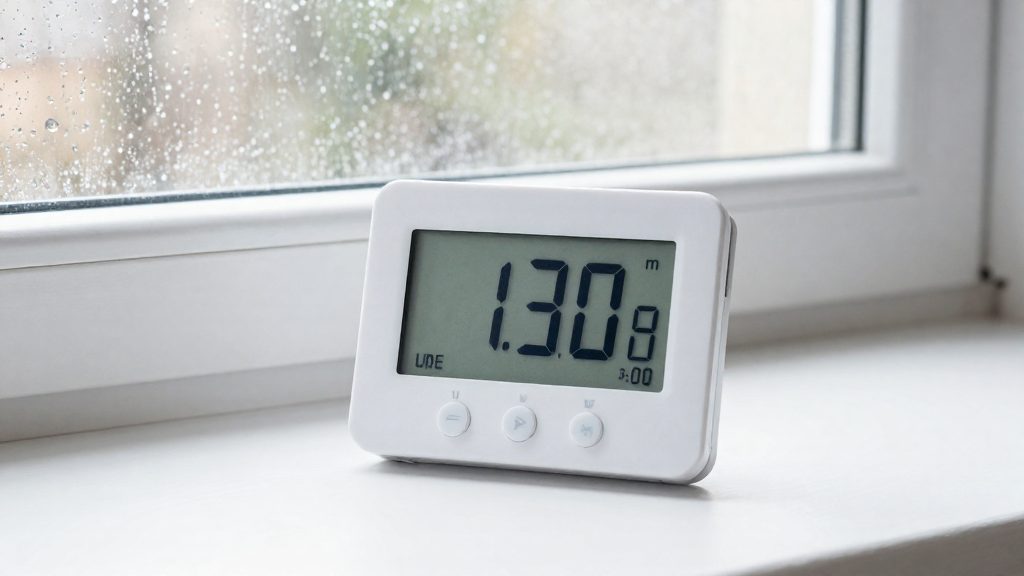
Health Canada recommends keeping indoor relative humidity between 30 and 50 percent (Health Canada, 2023). This range is the reference for deciding whether a bedroom needs a dehumidifier. It is a band, not a single target, so a bedroom reading 42 percent and one reading 48 percent are both within the guideline. Health Canada’s advice on dehumidifier use starts at the upper limit of that band.
When Health Canada advises running a dehumidifier
Health Canada advises running a dehumidifier in three situations:
- Relative humidity above 50 percent
- Damp areas such as basements
- Moisture condensing on cold surfaces, such as window panes
The first condition is a measurable trigger. The other two are visual or location-based, so they apply even when a reading has not been taken.
Choosing and reading a hygrometer
Check hygrometer readings with these steps:
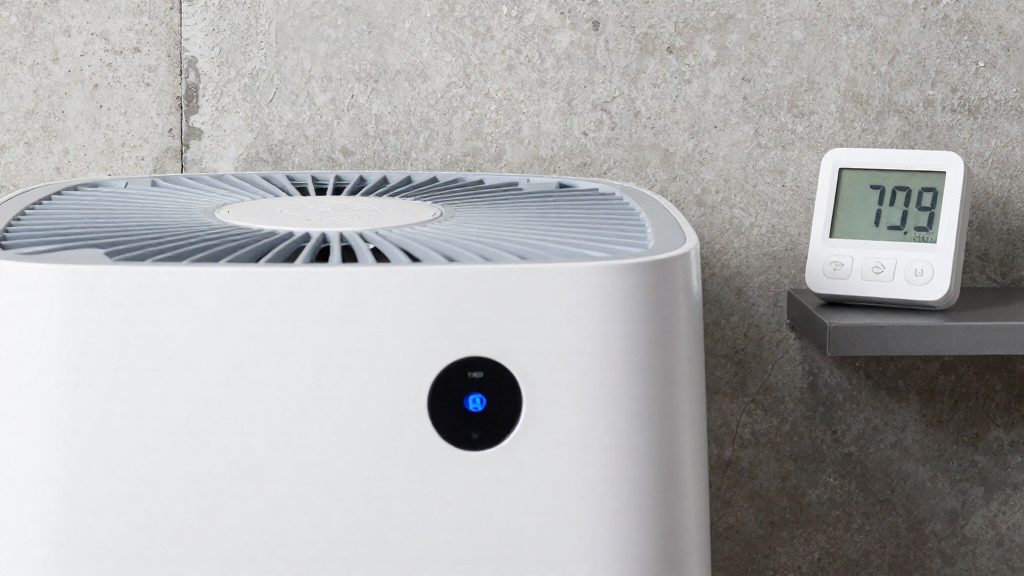
- Place the hygrometer at bed height, away from windows, radiators and the dehumidifier outlet. These spots give local readings that differ from the room average.
- Allow the device to settle after moving it before reading it.
- If a reading seems off, compare it with a second hygrometer placed in the same spot.
- Take readings at more than one time of day, since indoor humidity changes with occupancy, showering and outdoor weather.
The threshold above 50 percent
When readings return to the 30 to 50 percent band, the trigger no longer applies. Keeping the hygrometer reading in view during this period shows whether the dehumidifier is needed at a given time.
How quiet is quiet enough?
A dehumidifier’s published noise rating comes from a narrow test setup, and it rarely matches what you hear at the bedside. According to dBSkeptic (2026), manufacturer dB figures are usually measured at 1 metre from the unit on its lowest fan speed. Bedside readings can run 4 to 10 dB higher than the published figure, and some models publish no dB specification at all. Treat the number as a lab baseline, not a guarantee for your bedroom.
What the published figure measures
- Distance: 1 metre from the unit.
- Fan speed: the lowest setting, which is usually not the speed the unit runs at when the air is very humid.
- Comparability: figures are only meaningful side by side when they are stated under the same conditions.
Estimating the bedside level
Use the table below to read each figure correctly.
| Noise figure | Condition | How to read it for the bedroom |
|---|---|---|
| Published dB rating | 1 metre, lowest fan speed | Lower bound for the sound you will hear |
| Bedside reading | Listening position near the bed | Can run 4 to 10 dB higher than the published rating |
| No dB specification | Manufacturer publishes no figure | Noise cannot be compared like for like |
Check the unit at the position where you sleep before relying on it, since the bedside margin is what determines whether it stays unobtrusive overnight.
Models without a published dB figure
Some models publish no dB specification. Without a number, there is no basis for comparing their noise with other units, so ask the seller for a written rating or check the manual before buying. If neither source provides a figure, treat the noise level as unknown.
Compressor, desiccant or Peltier: which is quietest?
Peltier (semiconductor) dehumidifiers are the quietest type, but they remove much less water. According to dBSkeptic (2026), they are very quiet and remove roughly 30 to 40 oz per day, while compressor units remove 15 to 40+ pints per day and produce audible hum and clicking.
Peltier units: very quiet, low capacity
A Peltier unit has no compressor, so it has no motor cycle that starts and stops.
Compressor units: higher capacity, audible operation
dBSkeptic (2026) reports two sound characteristics:
- Continuous humming while the compressor runs.
- Clicking on startup, when the compressor engages.
The sound is steady rather than silent, so a compressor unit is more likely to be noticed at night than a Peltier unit.
Heat added to the room
Compressor units add heat to the room, according to dBSkeptic (2026). Their operation comes with a warming effect, which matters in a bedroom that is already warm.
| Feature | Peltier (semiconductor) | Compressor |
|---|---|---|
| Daily removal | roughly 30 to 40 oz | 15 to 40+ pints |
| Operating sound | very quiet | hum, click on startup |
| Heat added to room | not specified | yes, per dBSkeptic (2026) |
How do you size a dehumidifier for a bedroom?
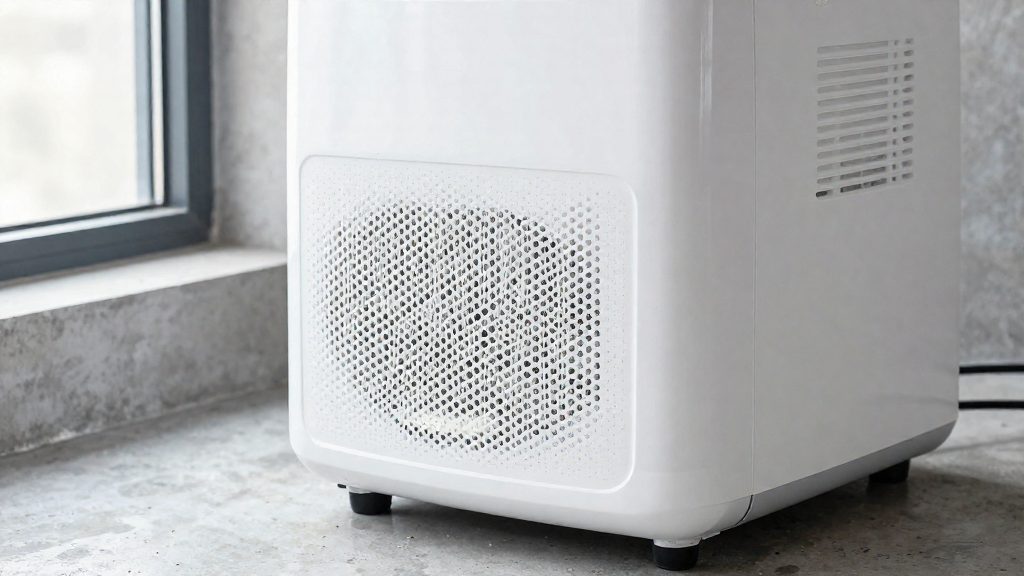
For a bedroom of 150 to 350 square feet (about 14 to 33 m²), dBSkeptic (2026) suggests a 20 to 30 pint compressor unit (about 9 to 14 litres per day, in US pints). It also suggests a semiconductor unit, which has a much lower capacity. Floor area is the starting point, but the room’s moisture load decides whether the rated capacity is enough. Two rooms of the same size can need very different units if one is damp and the other is not.
Sizing steps
- Measure the floor area. Multiply length by width in feet to get square feet, then find the matching band: 150 to 350 square feet for the suggested capacity range.
- Measure the current relative humidity. Use a hygrometer.
- Assess the moisture load. A room with several damp signs at once sits at the upper end of the band, or calls for a larger unit.
- Match the technology to the capacity you need. 4. Match the technology to the capacity you need. dBSkeptic (2026) suggests either a 20 to 30 pint compressor unit or a semiconductor unit for this room size. Semiconductor units have a much lower capacity (roughly 2 pints per day), so they only suit a light moisture load. Compressor units cover a much wider range and suit a heavier one.
Placement and settings to reduce noise
Placement and control settings determine how much of a dehumidifier’s operating sound reaches the bed.
Distance from the bed, walls and floor
- Place the unit clearly away from the bed rather than at the headboard, because compressor vibration and fan noise travel most directly toward a nearby sleeper.
- Keep the air intake and outlet free of walls, curtains and furniture. Restricted airflow makes the fan run harder, which raises noise.
- Stand the unit on a level, firm floor. Vibration through an uneven surface can produce a rattle that is louder than the unit’s own sound.
- Use the manufacturer’s installation guidance for exact figures.
Continuous drain hose or manual emptying
| Drainage method | Overnight effect | Routine work |
|---|---|---|
| Continuous drain hose | Avoids a full-tank alarm overnight (dBSkeptic, 2026) | Hose must be routed to a drain |
| Manual drain pan emptying | A full tank stops the unit until it is emptied | Empty the pan regularly (Health Canada, 2023) |
Health Canada (2023) advises either emptying the drain pan regularly or draining the unit directly into a drain. For a bedroom unit, the continuous drain hose is the setup that keeps the unit running through the night without a manual check.
Humidistat setpoint
Set the humidistat to about 50% relative humidity. dBSkeptic (2026) states that a target of about 50% RH reduces compressor cycling, meaning the repeated start and stop cycles that cause audible clicks. A target of about 50% is the level dBSkeptic (2026) links to fewer compressor start-ups. Check the manual for how the unit’s humidistat is set.
When is a dehumidifier not enough?
A dehumidifier removes water vapour from the air, but it cannot stop water from entering a building. When the moisture comes from outside the room, through the structure, or from a failed ventilation system, the unit may lower the humidity reading while the underlying problem continues. Recognising these cases early prevents repeated cleaning and damage to walls, floors and furnishings.
Mould that returns after cleaning
Mould that reappears after cleaning is the clearest sign that the moisture source has not been removed. According to Health Canada (2023), if mould returns after cleaning, the moisture source has not been fixed and a professional should be consulted. A dehumidifier can reduce airborne moisture, but it does not reach water trapped inside a wall cavity or under a floor.
Structural leaks and rising damp
Some moisture problems originate in the building fabric. Typical signs include:
| Sign | Likely source | Can a dehumidifier fix it? |
|---|---|---|
| Damp patches that grow after rain | Roof, gutter or wall leak | No |
| Stains or mould at the base of walls | Ground moisture rising through the foundation or masonry | No |
| Water marks around windows or pipes | Failed seal or plumbing leak | No |
| Damp that is worst in one room only | Localised leak or cold bridge | Only reduces air moisture |
Rising damp draws groundwater up through masonry, so the water is replenished faster than any appliance can remove it. A leak that is repaired at its source is the only lasting solution.
Ventilation faults
Where the cause is poor air exchange, the moisture source is the air itself, and it is generated indoors by cooking, showering and breathing. Blocked exhaust grilles, a disconnected or failing exhaust fan, or a faulty mechanical ventilation system (such as an HRV or ERV) prevent humid air from leaving the room. In these cases a dehumidifier removes moisture that the building cannot shift, so the unit runs continuously while condensation remains. Restoring the ventilation path is the correct fix.
Frequently asked questions
How loud is a bedroom dehumidifier at night?
Manufacturer decibel figures are usually measured at 1 metre on the lowest fan speed, so the decibel (dB) rating on the box may understate what you hear at the bed. According to dBSkeptic (2026), bedside readings can run 4 to 10 dB higher, and some models publish no dB figure at all.
Should I choose a Peltier or a compressor model for my bedroom?
A semiconductor (Peltier) dehumidifier is very quiet but removes only about 30 to 40 US fl oz (roughly 0.9 to 1.2 L) per day, which suits light moisture loads. A compressor unit removes 15 to 40+ US pints (roughly 7 to 19 L) per day, but it hums, clicks on startup and adds heat to the room. For a 150 to 350 sq ft (about 14 to 33 m²) bedroom, dBSkeptic (2026) suggests either a 20 to 30 pint compressor or a semiconductor unit, depending on how much moisture the room produces.
Can I run a dehumidifier all night without emptying the tank?
Health Canada (2023) advises emptying the drain pan regularly or draining the unit directly into a drain. For overnight use, a continuous drain hose is the practical option, because dBSkeptic (2026) notes it avoids the full-tank alarm during the night.