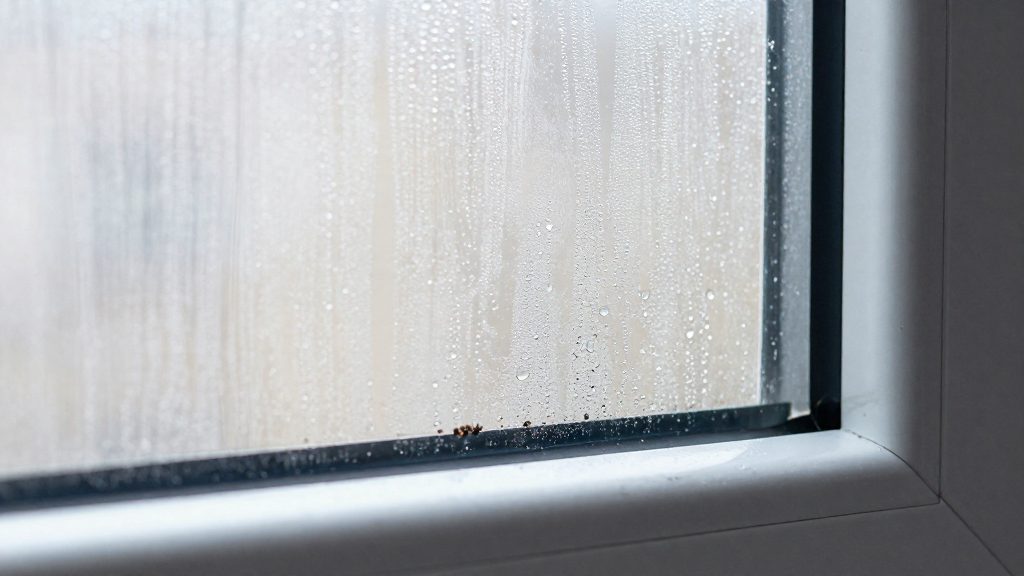
The window frame usually condenses first because it is typically the coldest surface in the building envelope. Condensation forms when an interior surface drops below the room’s dew point. Metal frames conduct heat well, so their interior surfaces stay cold. According to the National Research Council of Canada (1960), the window is often the coldest part of the envelope, so it sets the practical limit on indoor humidity in winter.
Why does the window frame condense first?
How heat escapes through the frame
A continuous metal element that runs from inside to outside forms a thermal bridge. Heat flows through it bypassing the insulation around it, and the interior face of the frame stays cold. The NRC (1960) states that metal frames stay cold on the inside and that aluminium makes the problem worse. Wood frames are generally warm enough to avoid condensation, though this is not guaranteed.
| Frame type | Behaviour reported by NRC (1960) |
|---|---|
| Metal without a thermal break | Interior surface stays cold; condenses at about the same humidity limits as single glazing |
| Aluminium without a thermal break | Makes the metal-frame problem worse |
| Wood | Generally warm enough to avoid condensation |
The role of the thermal break
The remedy is a thermal break: an insulating separator of about ½ to 1 inch (roughly 13 to 25 mm) made of material with conductivity similar to wood. It interrupts the metal path so the inner face of the frame runs warmer. The NRC (1960) also notes that double and triple glazing allow higher indoor humidity than single glazing before condensation appears.
Indoor humidity and ventilation
Condensation on windows is linked to excessive indoor humidity, insufficient ventilation, or poorly performing windows, such as failed seals, metal spacers, or low insulation. The Cold Climate Housing Research Center (undated, a US-based source for a cold climate, not a Canadian standard) recommends 30 to 50% relative humidity, aiming for less than 40% in cold climates. The same source suggests checking the mechanical ventilation. If condensation persists with a heat recovery ventilator (HRV), adjust its operation.
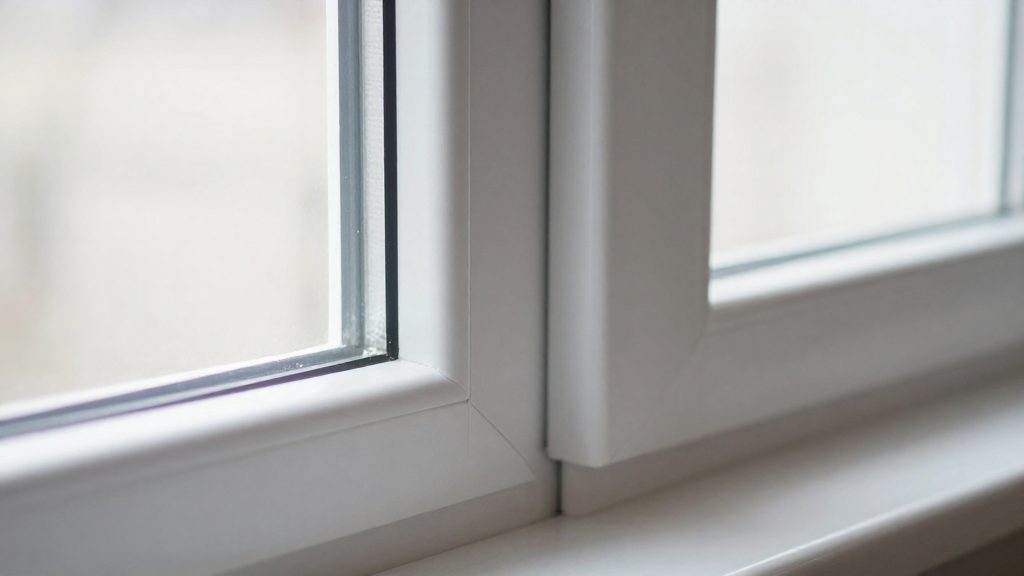
Thermal bridge: understanding the cold spot
Window condensation forms when the inside surface of a window is colder than the dew point of the room air. According to the National Research Council of Canada (Canadian Building Digest CBD-4, 1960), the window is often the coldest part of the building envelope, so it sets the practical limit on indoor humidity in winter. The cause is a thermal bridge: a continuous path of conductive material that carries heat from inside to outside and pulls the frame’s inner surface down to the dew point.
How frame material changes the cold spot
Frame material determines how much heat escapes through the frame and whether its inner face stays above the dew point.
| Frame type | Inner surface behaviour | Condensation risk |
|---|---|---|
| Uninsulated metal | Conducts heat well, so the inner face stays cold | High |
| Aluminium | Worsens the problem compared with other metals | High |
| Wood | Generally warm enough to avoid condensation | Lower |
The thermal break
A thermal break interrupts the metal path. It is an insulating separator of about ½ to 1 inch (roughly 1.3 to 2.5 cm) of material with a conductivity similar to wood. Without one, a metal frame condenses at about the same indoor humidity limits as single glazing (NRC Canada, CBD-4, 1960). The same source notes that double and triple glazing permit higher indoor humidity than single glazing, because the inner pane stays warmer, and so is less likely to fall below the room’s dew point, as the insulating value of the unit rises.
Window performance as a contributing factor
The Cold Climate Housing Research Center (Your Northern Home, Alaska, undated) lists three causes of window condensation: excessive indoor humidity, insufficient ventilation, and poorly performing windows. The last includes failed seals, metal spacers and low insulation. These factors can add up, so a frame with a thermal break may still condense if excess humidity or insufficient ventilation is present.
Aluminium or Wood: How Does the Frame Material Affect Condensation?
Frame material largely determines how cold a window’s inside surface gets, and therefore whether condensation forms. According to the National Research Council of Canada (1960), metal frames conduct heat well, so their interior surfaces stay cold, and aluminium makes the problem worse. Wood frames are generally warm enough to avoid condensation. The sources consulted do not specify how PVC frames compare, so this section does not rank them.
| Frame material | Interior surface behaviour | Condensation risk (NRC, 1960) |
|---|---|---|
| Aluminium (uninterrupted metal) | Stays cold; conducts heat well | Highest; aluminium worsens the problem |
| Wood | Generally warm enough | Low |
Why metal frames fail: the thermal bridge
A metal frame that runs continuously from inside to outside forms a thermal bridge, a path that carries heat out of the room. The remedy is a thermal break: an insulating separator of about ½ to 1 inch (roughly 13 to 25 mm) of material with conductivity similar to wood. Without a thermal break, a frame condenses at about the same indoor humidity limits as single glazing. Double and triple glazing tolerate higher indoor humidity than single glazing, but only the thermal break addresses the frame itself.
Checking your frames in practice
- Identify the frame material first. Aluminium frames without a visible insulating break are the most exposed to condensation.
- Measure indoor relative humidity. The Cold Climate Housing Research Center (undated, Alaska) recommends 30 to 50%, and aims for less than 40% in cold climates. A reading of exactly 40% does not meet that target.
- If condensation persists, check mechanical ventilation. The same source lists insufficient ventilation, excessive indoor humidity, and poor window performance (failed seals, metal spacers, weak insulation) as causes.
What indoor humidity target should you aim for in winter in Canada?
Keep indoor relative humidity between 30 and 50% in winter, and below 40% in cold climates. The Cold Climate Housing Research Center (Your Northern Home, undated) gives this range, but it is an Alaskan source, not a Canadian one. The official sources consulted do not specify a separate Canadian winter target. The practical limit is set by the window. Condensation forms when a window’s inside surface is colder than the room’s dew point, and the NRC’s Canadian Building Digest CBD-4 (1960) notes that the window is often the coldest part of the envelope. A humidity level that is acceptable elsewhere in the room can therefore still produce condensation on the glass or frame.
The frame and glazing type change how much indoor humidity a window can tolerate:
| Window component | Condensation behaviour (NRC Canada, CBD-4, 1960) |
|---|---|
| Metal frame without a thermal break | Inside surface stays cold; condenses at about the same humidity limits as single glazing |
| Aluminium frame without a thermal break | Worse than other metal frames |
| Wood frame | Generally warm enough to avoid condensation |
| Double or triple glazing | Allows higher indoor humidity than single glazing |
A thermal break is a layer of insulating material, about ½ to 1 inch thick with conductivity similar to wood, placed between the inside and outside parts of a metal frame.
To check a winter humidity problem, follow these steps:
- Measure indoor relative humidity with a hygrometer and compare the reading against the 30 to 50% range, or below 40% in cold climates.
- Identify the frame material and whether the frame has a thermal break.
- Check mechanical ventilation, since insufficient ventilation is a cause of window condensation.
- If condensation persists, adjust the operation of the heat recovery ventilator (HRV).
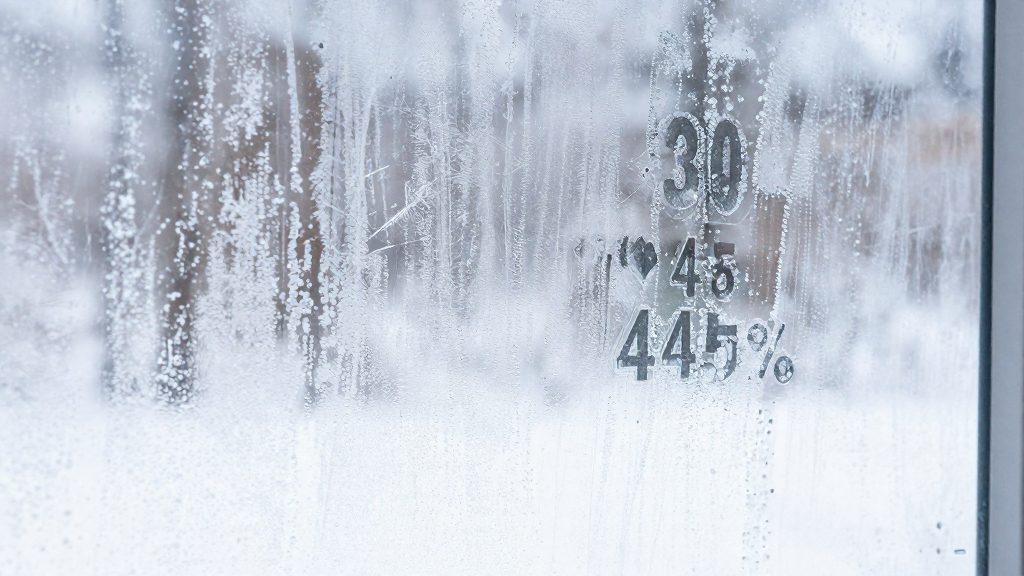
Condensation or Air Leakage: How to Tell the Difference
Condensation and air leakage can appear together around a window frame, but they have different causes. Condensation is a moisture problem: water forms when warm, humid indoor air meets a surface colder than its dew point. Air leakage is an air-movement problem: outdoor air enters through gaps in the seals. The diagnosis depends on where the water appears and whether air moves at the frame.
| Sign | Condensation | Air leakage |
|---|---|---|
| Where it appears | Inner glass or inner frame surface | Wall or floor next to the frame edge |
| Air movement | Not a reliable indicator, since a leak can coexist with condensation (not covered by the sources consulted) | Draft at the frame joint (not covered by the sources consulted) |
| Visible trace | Wet film or droplets (not covered by the sources consulted) | Not covered by the sources consulted |
| Link to indoor humidity | Rises as indoor humidity rises | Little or no link |
Checking for condensation
Water on the inside of the glass or frame points to a cold inner surface. The National Research Council of Canada (Canadian Building Digest CBD-4, 1960) notes that the window is often the coldest part of the envelope. Metal frames stay cold on the inside, and aluminium makes this worse, while wood frames are generally warm enough to avoid condensation. Without a thermal break (a layer of about ½ to 1 inch of material with conductivity similar to wood), a frame condenses at roughly the same humidity limits as single glazing (CBD-4, 1960).
Checking for air leakage
Air leakage is best checked on a windy day:
- Pass the back of your hand slowly along the perimeter of the frame and the sash.
- Hold a thin strip of tissue near the joints; movement indicates an air path.
- Look for dust or dark lines on the wall at the frame edges, which mark where air enters.
Narrowing the cause
- Record indoor humidity with a hygrometer over several days, including cold spells.
- Compare readings with the target. The Cold Climate Housing Research Center (Your Northern Home, Alaska, undated) recommends 30 to 50% relative humidity, aiming for below 40% in cold climates.
- If humidity is on target but condensation persists, check the window seals and frame condition.
- If humidity is high and condensation persists, check mechanical ventilation. With a heat recovery ventilator (HRV), adjust its operation.
Ventilation, HRV and dehumidifier: which solutions?
Window condensation is a humidity problem before it is a window problem. According to the National Research Council of Canada (1960), the window is often the coldest part of the building envelope, so it sets the practical limit on indoor humidity in winter. Fixing it means two things: reducing the moisture released indoors and making sure that moisture leaves through ventilation. Equipment helps, but only once those two conditions are addressed.
Step 1: Measure the indoor humidity
Place a hygrometer in the room, away from the window and heat sources, and track relative humidity over several days before changing anything. The Cold Climate Housing Research Center (undated, Alaska) recommends 30 to 50% relative humidity, with a target below 40% in cold climates. Exactly 40% does not meet that target.
| Indoor relative humidity | Position against the recommendation |
|---|---|
| Below 30% | Under the recommended range |
| 30 to 39% | Within range, meets the cold-climate target |
| 40 to 50% | Within the general range, does not meet the cold-climate target |
| Above 50% | Above the recommended range |
Step 2: Check mechanical ventilation first
Insufficient ventilation is one of the causes of window condensation listed by the Cold Climate Housing Research Center (undated). Before adding equipment, confirm that the mechanical ventilation system runs as designed. If condensation persists, adjust the operation of the ventilation system, including a heat recovery ventilator (HRV, or VRC in French) if one is installed. The sources consulted do not specify settings for a particular model, so use the manufacturer’s documentation for those.
Step 3: Use a dehumidifier to reduce excess moisture
A dehumidifier removes the excess moisture that the same source names as a cause of condensation. It treats the symptom, however, so reduce the sources as well: avoid drying laundry indoors and keep showers and cooking vented to the outside where possible. As general practice (not covered by the sources consulted), run the dehumidifier until the hygrometer reads inside the target band, then check the reading again.
Step 4: Assess the window and frame
Glazing and frame type change how much humidity the window tolerates. According to the National Research Council of Canada (1960), double and triple glazing allow higher indoor humidity than single glazing. Metal frames without a thermal break condense at about the same humidity limits as single glazing. A thermal break is an insulating separator of about ½ to 1 inch of material with conductivity similar to wood. Failed seals, metal spacers and low insulation are also listed as causes, so inspect these before attributing condensation to indoor air alone. The sources consulted do not specify current product performance, so compare current specifications directly.
When should you replace or insulate the window?
Replacing a window is rarely the first step. Condensation on glass or frames usually means that indoor humidity is too high, ventilation is insufficient, or the window performs poorly, and the window is simply where moisture meets a cold surface first. The official sources consulted do not give a single threshold for replacement, so the decision depends on measuring relative humidity and checking the ventilation before judging the window itself.
According to the Cold Climate Housing Research Center (Your Northern Home, Alaska, undated), the recommended relative humidity is 30 to 50%, and in cold climates the target is below 40%. A reading of exactly 40% therefore does not meet the cold-climate target.
Diagnosis by symptom
| Observation | Most likely cause | Next step |
|---|---|---|
| Condensation on a metal frame, with the glass dry | Continuous metal conducts heat and stays cold inside | Check humidity first; if it stays high, consider a frame with a thermal break |
| Condensation on a wooden frame | Wood is generally warm enough to avoid condensation, so the frame is unlikely to be the cause | Lower indoor humidity and check ventilation |
| Fogging between the panes | Possibly failed seals or metal spacers | Have the sealed unit inspected before deciding on replacement |
| Condensation that persists after ventilation is corrected | Low insulation of the window | Consider double or triple glazing |
Conditions that justify changing the window
- Metal frame without a thermal break. Without a break of about ½ to 1 inch of material with conductivity similar to wood, the frame condenses at about the same humidity limits as single glazing (National Research Council of Canada, Canadian Building Digest CBD-4, 1960).
- Single glazing. Double and triple glazing allow higher indoor humidity than single glazing before condensation forms (NRC Canada, CBD-4, 1960).
- Failed seals or metal spacers. The official sources consulted list these as window causes of condensation, alongside excessive humidity and insufficient ventilation.
Recommended order of checks
- Measure indoor relative humidity with a hygrometer over several days, including the coldest part of the day.
- Verify mechanical ventilation. If the home has a heat recovery ventilator (HRV), adjust its operation if condensation persists.
- Inspect the window for failed seals and metal spacers.
- Only if the problem remains after these steps, plan a frame or glazing change.