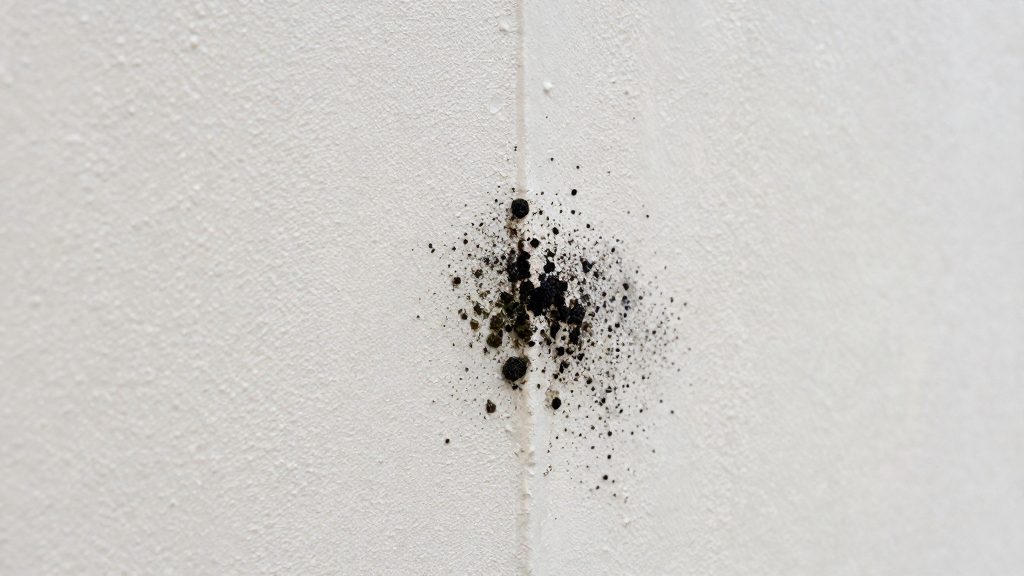
Exterior wall corners get cold because they meet two outdoor-facing walls, so heat escapes through two surfaces instead of one. Structural elements that run through the corner can also conduct heat outward without any insulation in the path. The inner surface at the junction therefore ends up colder than the flat wall beside it, which makes the corner the first place where cold spots tend to appear.
Why do exterior wall corners get cold?
Corner geometry exposes two exterior faces
A flat wall has one exterior face. A corner joins two exterior faces at an angle, so the building envelope at that point is in contact with outdoor air on two sides. The exposed area per unit of interior surface is larger, and the corner loses heat through a bigger share of its fabric than a flat section of the same wall.
Heat flows through thermal bridging
Thermal bridging creates cold zones where heat moves through a path of lower resistance than the surrounding wall. At corners, structural members that are not insulated provide that path. According to Polar Knowledge Canada (2022), thermal bridging creates cold zones where humidity condenses, so the problem is built into the junction itself and not only into the air around it.
Lower inner surface temperature at junctions
Because heat leaves the corner faster, the interior face of the corner stays cooler than the adjacent wall. This difference is measurable with a surface thermometer or an infrared thermometer, and it is the reason corners are the first place to check when a room feels cold or shows staining.
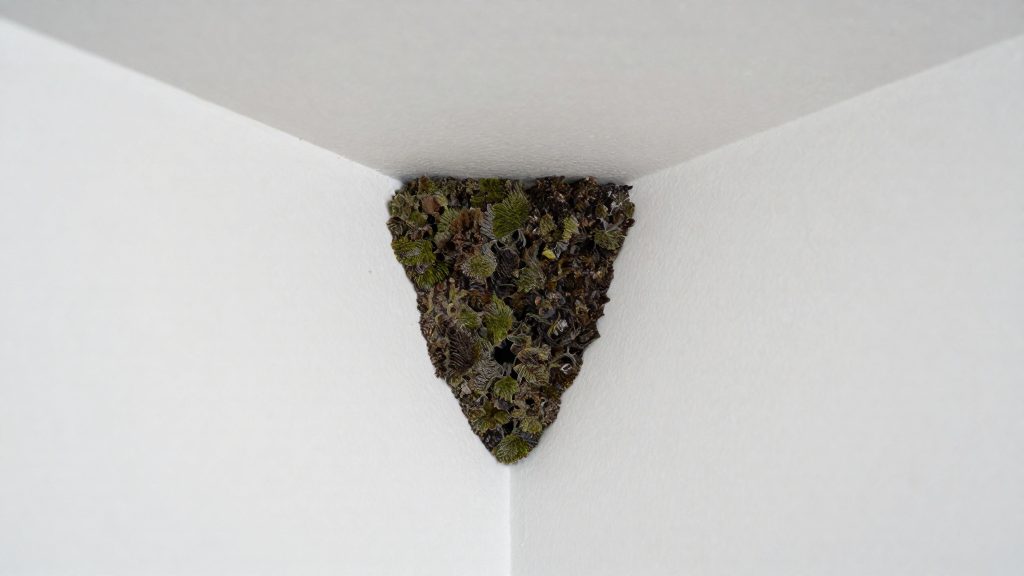
How condensation turns a cold spot into mould
A cold spot on an exterior wall corner becomes mould through a sequence of physical steps. Warm indoor air carries water vapour. When that air touches a surface cooler than its dew point, the temperature at which air is saturated, the vapour changes back into liquid water. Polar Knowledge Canada (Government of Canada, 2022-06-09) notes that humid air condensing on cold surfaces creates favourable conditions for mould.
The chain follows a predictable order:
| Stage | Physical condition | Result |
|---|---|---|
| 1. Moisture source | Warm indoor air holds water vapour from cooking, bathing and breathing | Humidity rises in the room |
| 2. Cold surface | Thermal bridge lowers the wall surface temperature at the corner | Surface falls below the dew point |
| 3. Condensation | Vapour turns into liquid on the wall | Water collects on the cold spot |
| 4. Absorption | Plaster and paper absorb the water and stay wet | Moisture persists in the material |
| 5. Germination | Mould spores find damp conditions | Mould can begin growing within 48 hours in damp areas (Health Canada) |
The fourth stage explains why the corner is worse than a smooth, dry surface. Porous materials such as plaster and paper can hold water longer than non-porous finishes, which can keep the surface damp after the air has dried. Mould therefore develops on the material that stays wet, not on the air itself.
Health Canada also warns that tighter buildings can raise indoor humidity when ventilation is insufficient.
What relative humidity should you target in winter?
For winter, Health Canada recommends keeping indoor relative humidity (RH) between 30% and 50%. The cold season makes this band harder to hold because heated indoor air meets cold exterior surfaces. Exterior corners are where this mismatch is most likely to produce moisture, so the target matters most there.
Why 50% is the upper limit
Health Canada advises using a dehumidifier as needed, for example in damp areas such as basements or when humidity is above 50%. Above that threshold, moisture is more likely to settle on surfaces.
| Indoor RH | Status |
|---|---|
| 30% to 50% | Recommended winter range (Health Canada) |
| Above 50% | Dehumidifier use advised; condensation on cold surfaces and mould growth become more likely |
Placing and reading the hygrometer
A hygrometer measures the air around it, so its position determines whether the reading is representative. To measure the room rather than the cold corner:
- Position the instrument on an interior wall, away from exterior corners and cold surfaces.
- Avoid placing it behind furniture or storage, since stagnant air there does not reflect the room.
- Take readings in the corner and in the room centre. A clear gap between them points to a localised cold spot.
- Log readings over several days rather than relying on a single check. Monitoring RH is a method Polar Knowledge Canada (Government of Canada) (2022-06-09) identifies as a way to flag moisture problems early.
Is it mould or just dirt? How to spot it
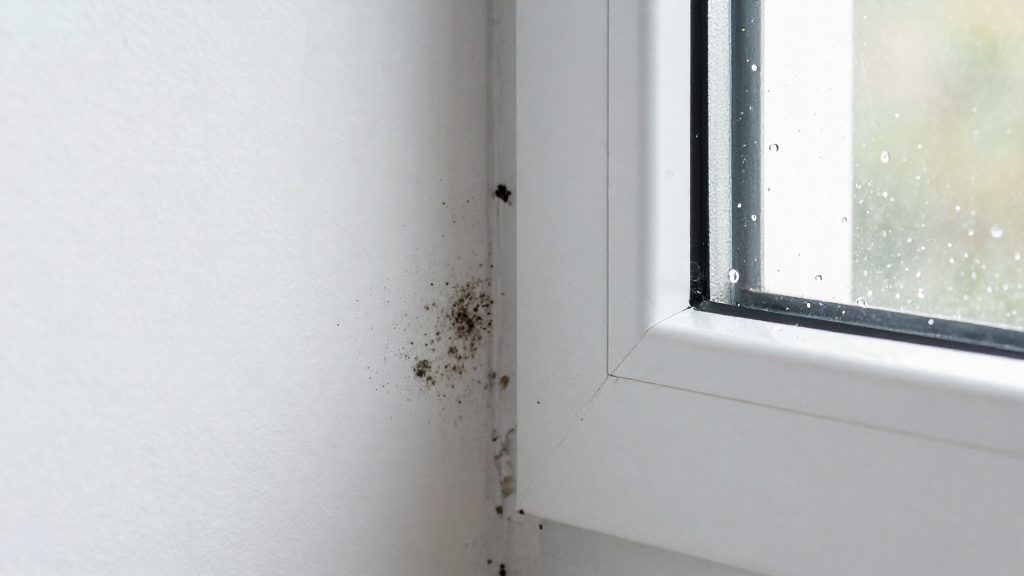
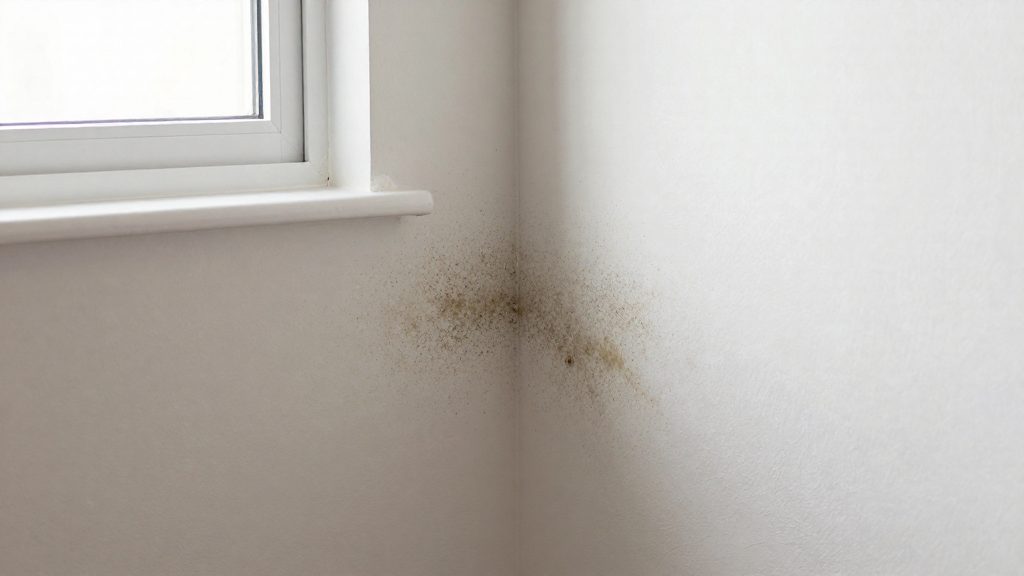
Mould on an exterior wall corner usually sits where warm, humid indoor air meets a cold surface. A dark mark in a corner is therefore not automatically dirt. Visual and smell checks can separate the two before any product is used.
Black or grey spots versus dust and grime
Dust and grime are deposits that sit on top of a surface. Mould grows into the surface and forms distinct spots or patches. Do not rub or wipe a suspected patch to test it, because this can disturb it; use the visual and smell checks instead. The table below summarises the main differences.
| Feature | Dust and grime | Mould growth |
|---|---|---|
| Appearance | Even grey film or soft dark deposits | Distinct black, grey or greenish spots, often clustered |
| Location | Spread across skirting, sills and furniture tops | Concentrated in the coldest corner, often against outside walls |
| Odour | Usually none | Musty smell |
Look at the spot from a low angle with a torch, since this shows whether the mark is raised, patterned or sunk into the surface. Avoid brushing the area to test it.
Fuzzy, velvety texture and musty odour
Mould can look fuzzy or velvety, especially in damp conditions. A musty odour in a corner that has been dusted and looks clean is a signal worth investigating. The smell may indicate growth on the far side of the surface, where the cold zone and condensation are located.
Mould often recurs in the same cold corner
A spot that comes back in the same corner usually reflects conditions that have not changed. Health Canada notes that mould can begin growing within 48 hours in damp areas.
How do you clean mould on a wall corner safely?
Health Canada states that occupants can usually clean mould on areas of 1 m² or less, and that patches over 3 m² need a professional. For patches between 1 m² and 3 m², consider getting professional advice, especially if the mould is on porous materials or keeps returning. The same guidance sets out the protective equipment and disposal steps that apply before any work begins.
Protective equipment before cleaning
Wear the following before touching the affected surface:
- An N95 respirator
- Goggles
- Gloves
Health Canada says cleaning mould safely calls for this combination. Put on all three items before disturbing the patch, not after scrubbing has started.
Scope limit for DIY work
Measure the affected area before starting. Patches of 1 m² or less fall within the DIY scope described above. Larger patches fall outside it.
Removing residue and disposing of material
Use a HEPA vacuum to remove mould debris from the surface, since Health Canada advises its use for this task. If the mould has grown into porous materials, such as drywall or insulation, those materials should be discarded rather than cleaned, because Health Canada advises discarding mouldy porous materials.
Methods to avoid
| Method | Status | Reason |
|---|---|---|
| Discarding mouldy porous materials | Required | Health Canada advises discarding them |
| HEPA vacuuming of debris | Recommended | Health Canada advises its use |
| Painting over mould | Avoid | Painting over mould does not kill it |
| Bleach | Avoid | Health Canada says not to use bleach |
Painting over the patch hides the growth without removing it, so the mould remains on the wall behind the new coat.
Ventilation and furniture placement that help
Daily ventilation habits and furniture layout determine how much moisture reaches the cold surfaces of exterior walls, where condensation most often starts. Health Canada advises running the bathroom fan for at least 30 minutes after a shower and using the range hood while cooking. It also warns that tighter buildings can raise indoor humidity when ventilation is insufficient, so these routines matter most in airtight homes.
Ventilation habits
Health Canada advises venting kitchen and bathroom exhaust fans outdoors, not into the attic. Polar Knowledge Canada (Government of Canada, 2022-06-09) identifies inadequate ventilation as a major cause of moisture and mould.
Furniture and storage layout
A bed, sofa or wardrobe pushed against an outside wall limits the air movement that would otherwise help that surface stay drier. Health Canada advises keeping beds, furniture and storage away from outside walls so air can circulate, and keeping storage near those walls uncluttered.
Window coverings and sills
Health Canada advises keeping window coverings open, because heavy curtains or blinds can trap cold and moisture. It also advises drying window frames and sills daily, which helps remove moisture left by condensation on cold surfaces.
| Habit or layout change | Health Canada guidance |
|---|---|
| Run the bathroom fan | At least 30 minutes after a shower |
| Use the range hood | While cooking |
| Keep furniture off outside walls | So air can circulate |
| Keep storage near outside walls | Uncluttered |
| Open window coverings | Heavy curtains or blinds can trap cold and moisture |
| Dry window frames and sills | Daily |
Dehumidifier or insulation: which fixes the cause?
A dehumidifier and insulation act on different variables. Condensation forms when warm, moist indoor air meets a surface cold enough to bring it to its dew point, so the fix depends on which variable is driving the problem at the corner. A dehumidifier reduces moisture in the air. Insulation raises the temperature of the wall surface. Diagnosing which one is in excess tells you which tool to use.
Dehumidifier: the moisture side. Health Canada advises running a dehumidifier when moisture condenses on cold surfaces such as window panes. Removing water vapour lowers the amount of moisture available to condense, which helps when indoor humidity is the main driver. It does not change the wall temperature, so a corner that stays cold will still attract condensation whenever humid air reaches it.
Insulation: the temperature side. Insulation raises the inner surface temperature of the wall, so the corner stays above the dew point of the room air. This works even when indoor humidity is moderate, because the surface no longer falls to the temperature at which vapour condenses.
Diagnosing the cause:
- Monitor relative humidity with a hygrometer.
- Note when condensation appears. Corner condensation that tracks high indoor humidity points to moisture as the driver. Condensation that persists while indoor humidity is moderate points to a cold surface.
- Check the corner surface by touch or with a surface thermometer, and compare it with the adjacent wall. A corner that is consistently colder than the rest of the wall indicates a thermal bridge.
| Fix | Cause it targets | Mechanism | Suitable when |
|---|---|---|---|
| Dehumidifier | Excess indoor moisture | Removes water vapour from the air | Condensation occurs on cold surfaces and indoor air is humid |
| Insulation | Cold inner surface at a thermal bridge | Raises inner surface temperature | The corner stays cold even when indoor humidity is moderate |
When should you call a professional?
A mould problem moves from a task you can handle yourself to one that needs a professional when its size, its persistence, or its effect on the people in the home crosses a clear threshold. Health Canada sets the first threshold: mould patches over 3 m² need a professional. Two other triggers matter just as much for cold spots on exterior wall corners. The first is growth that returns despite good humidity control and ventilation. The second is any health symptom in an occupant. Health Canada does not propose a health-based exposure limit for indoor mould, so a symptom-based decision is more reliable than waiting for a measured threshold.
| Criterion | Threshold | Why it matters |
|---|---|---|
| Patch size | Over 3 m² | Health Canada says patches this large need a professional |
| Recurrence | Growth returns after cleaning | Suggests a moisture source the occupant has not controlled |
| Respiratory or eye symptoms | Any onset linked to the affected room | Points to exposure that needs assessment, not just cleaning |
Recurring growth despite humidity and ventilation control
Recurring mould is the clearest sign that the cause sits in the structure, not on the surface. Health Canada advises ventilating kitchen and bathroom exhaust fans outdoors, not into the attic. If mould returns in the same corner after indoor humidity is kept under control and the bathroom fan runs for at least 30 minutes after a shower, a cold-surface condensation problem is one possible cause, but leaks or other moisture sources should also be checked. A cold corner that keeps condensing despite these measures calls for a building assessment, because the source may be insulation gaps or water entering the wall.
Health symptoms that warrant assessment
Health Canada links mould and dampness to eye, nose and throat irritation, coughing, wheezing and worsened asthma. Anyone with these symptoms should consult a health care professional, and seek prompt medical attention for severe symptoms such as difficulty breathing. Symptoms that improve away from the home or worsen in a specific room are also a reason to have the building assessed by a professional. Infants, children, seniors, pregnant people and people with respiratory conditions face greater risk, so the threshold for calling an expert should be lower in households that include them.
Frequently asked questions
How can I tell if a corner is causing condensation?
Check the inner face of the corner for droplets, staining or dark patches, especially in the morning. Use a hygrometer to track the room’s relative humidity, which Health Canada recommends keeping between 30% and 50%, and run a dehumidifier when readings rise above that range.
Is it safe to place furniture against an exterior corner?
Health Canada advises keeping beds, furniture and storage away from outside walls so air can circulate. Leaving a gap also keeps air circulation moving over the cold surface, so keep storage near those walls uncluttered.
What should I do if mould is already growing in a corner?
Health Canada says occupants can usually clean patches of 1 m² or less wearing an N95 respirator, goggles and gloves, and advises against bleach. Patches over 3 m² need a professional, and painting over mould does not kill it. For patches between 1 and 3 m², seek professional advice, and consult a health care professional if coughing or wheezing occurs.