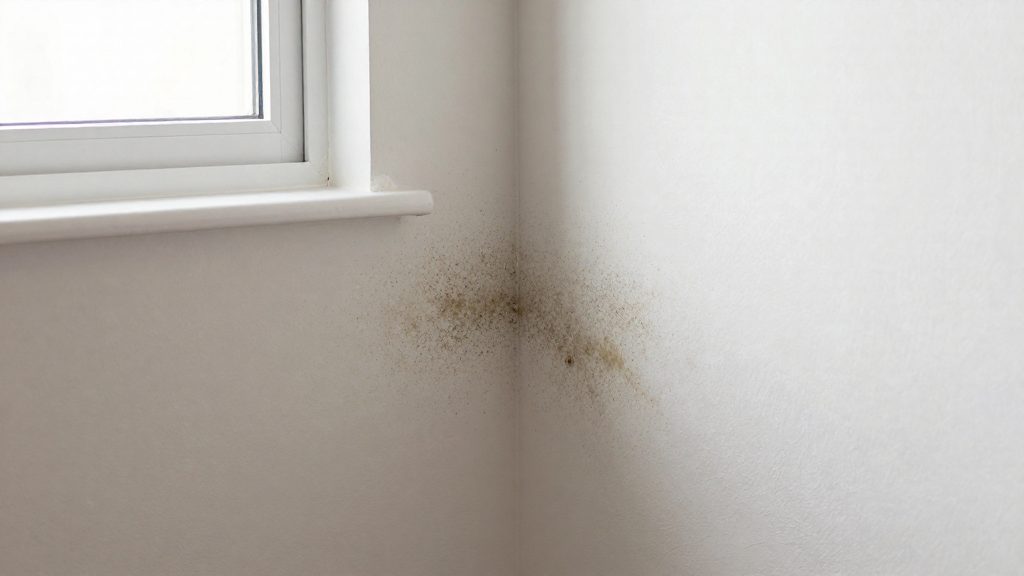
Persistent condensation can be linked to health effects. In a bedroom, the concern is prolonged exposure, because occupants spend many consecutive hours in the room. Health Canada sets no health-based exposure limit for indoor mould, so visible condensation, damp patches and mould are the practical signals to act on. Symptoms such as coughing or wheezing are a further warning sign, but their absence does not mean the room is safe.
Respiratory symptoms linked to damp air
Health Canada (2026) lists the following effects as associated with dampness and mould:
- Irritation of the eyes, nose and throat
- Coughing
- Wheezing
- Worsening of existing asthma
These are associations, not a diagnostic test. A pattern worth noting is symptoms that ease when the occupant spends time away from the bedroom and return when sleeping there.
Allergic reactions and asthma triggers
Health Canada (2026) links mould to asthma worsening. People who already have asthma should treat a new cough or wheeze in a damp bedroom as a reason to seek medical advice.
Groups at higher risk
Health Canada (2026) identifies these higher-risk groups:
| Group | Relevance in a bedroom |
|---|---|
| Infants | Sleep long periods in a crib in the same room |
| Children | Sleep long periods and may have less ability to report symptoms |
| Seniors | Named by Health Canada as higher risk |
| Pregnant people | Named by Health Canada as higher risk |
| People with respiratory conditions | Named by Health Canada as higher risk |
What humidity level should a bedroom have?
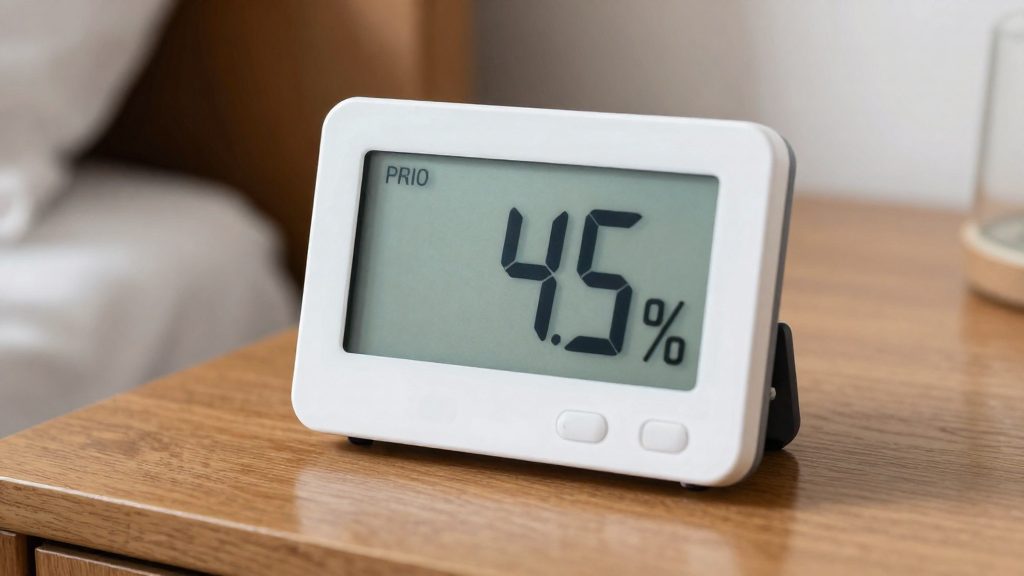
Health Canada recommends keeping indoor relative humidity between 30% and 50%, and using a dehumidifier when levels rise above 50% or when moisture condenses on cold surfaces (Health Canada, 2026). For a bedroom, this range is the target to measure against. Reaching it depends on accurate readings, so the choice, calibration, and placement of the measuring device matter as much as the target itself.
Reading the range
| Relative humidity | Health Canada guidance (2026) |
|---|---|
| 30% to 50% | Recommended indoor range |
| Above 50% | Use a dehumidifier (confirm the reading is persistent and ventilation is already used correctly) |
| Any level with moisture condensing on cold surfaces | Use a dehumidifier |
Choosing a hygrometer
Use a digital hygrometer that displays relative humidity as a percentage. Look for a model that shows minimum and maximum values, since overnight peaks are easy to miss with a single spot reading. Compare the stated accuracy in each manufacturer’s specification.
Calibration
A practical check is to place two hygrometers side by side for 24 hours and compare their readings. If they differ consistently, the comparison alone cannot show which one is correct. Check them against a known reference and treat the readings as approximate until you have done so. Replace a device only once it is confirmed to be inaccurate.
Placement
- Position the hygrometer at about head height on an interior wall, where the air is representative of the room.
- Keep it away from heating vents, direct sunlight, and exterior walls, which are colder and can give local readings that do not reflect the room.
- Allow several minutes for the reading to settle after moving the device.
Seasonal variation
In practice, a bedroom can move in and out of the 30% to 50% range as outdoor weather and occupancy change. Check readings across the year rather than once, and log them at the same time of day so the comparisons are fair.
How to dry condensation and clean mould safely
Dry condensation as soon as you see it. Health Canada advises drying window frames and sills daily, because condensation often forms on cold surfaces such as window panes, frames, sills and pipes (Health Canada, 2026). In a bedroom, wipe away water on the wall and window areas, keep curtains or blinds open so warm air reaches the windows, and keep heating vents clear of furniture. Mould can begin growing within 48 hours in damp areas, so drying should not be delayed.
Protective equipment before cleanup
Before you touch any mould, wear an N95 respirator, goggles and gloves.
Cleaning washable surfaces
Scrub washable surfaces with an unscented soap solution. The following table summarises the main cleaning rules from Health Canada (2026):
| Situation | Recommended action |
|---|---|
| Washable surface with mould | Scrub with unscented soap solution |
| Cleaning agent | Do not use bleach |
| Mould covered by paint | Painting over it does not kill the mould, so it must be cleaned first |
Discarding porous items
Mattresses and other porous items that cannot be cleaned should be discarded. Fabrics in the room, such as bedding or curtains, fall into this category when mould has grown into them and they cannot be properly cleaned. Discarding them is safer than attempting to clean material that holds moisture and mould below the surface.
What cleanup does not fix
Mould that returns after cleaning means the moisture source has not been fixed. Cleaning removes visible growth but does not address the cause, so the condensation that fed the mould must also be dealt with (Health Canada, 2026).
Ventilation: exhaust fans, range hoods and HRV systems
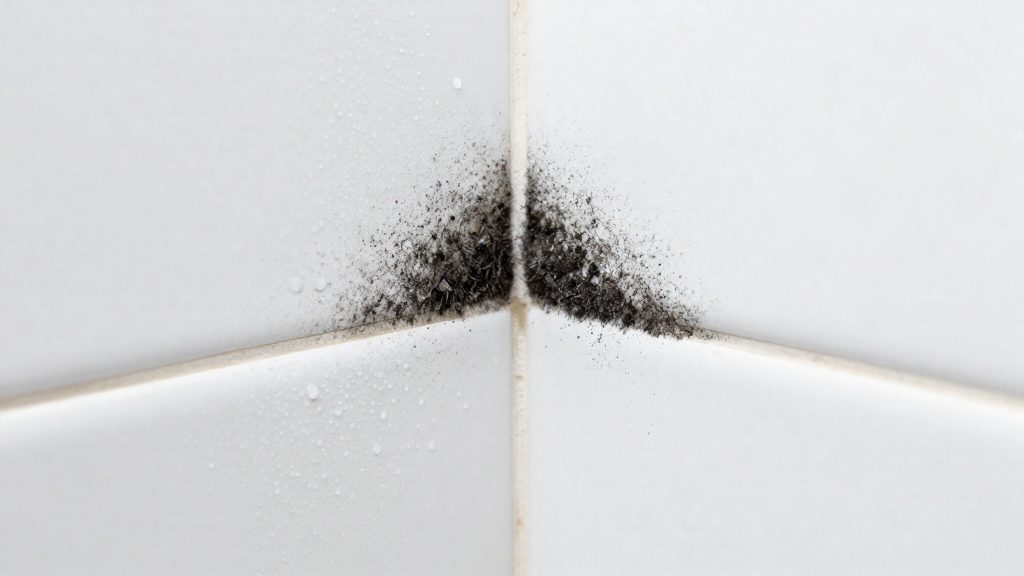
Mechanical ventilation removes the water vapour that showers, cooking and breathing add to indoor air. A room that stays above the recommended range is at higher risk of condensation and mould. Ventilation controls moisture at its source, so it should run as a routine part of daily use rather than only after a problem appears.
Bathroom exhaust fans
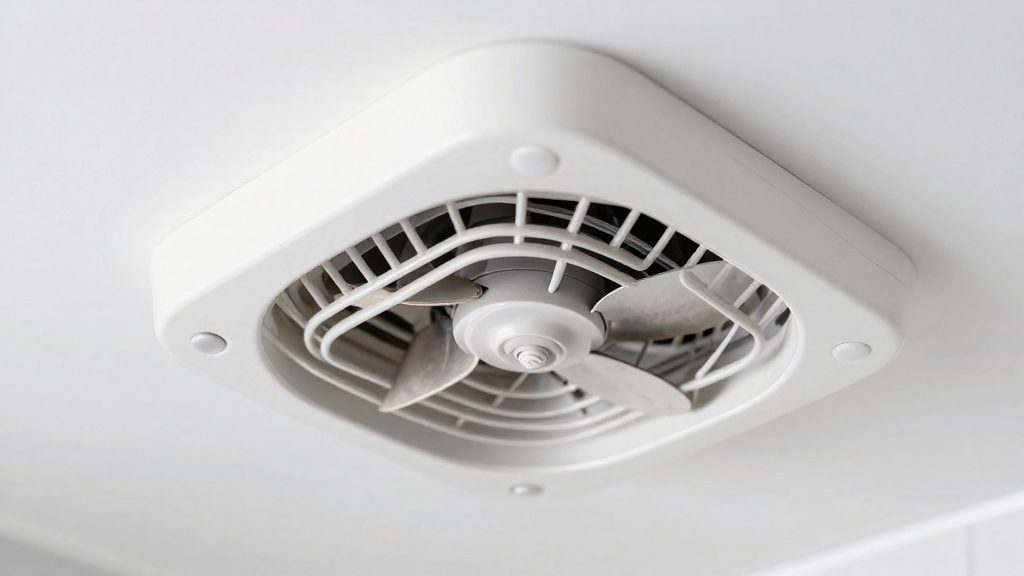
Bathrooms are the main source of short-term moisture spikes in a home. Health Canada (2026) advises that a bathroom should have an exhaust fan that vents outside, not into the attic. Venting into the attic moves humid air into the roof space, where it can condense on cold surfaces.
The fan should keep running after you finish. Health Canada (2026) recommends running it at least 30 minutes after a shower or bath. Stopping the fan as soon as you leave the room leaves the mirror, tiles and walls damp, and that residual moisture is what fuels corner condensation. Keep the bathroom door closed while showering so the moist air is drawn toward the fan rather than spreading into the bedroom.
Kitchen range hoods
The kitchen range hood should be used whenever you cook, according to Health Canada (2026). Boiling, frying and steaming release large amounts of vapour, and running the hood at the start of cooking captures it before it reaches the walls and ceilings of adjoining rooms.
Airtight homes and HRV systems
Airtight, energy-efficient homes limit the natural air exchange that older buildings receive through gaps and leaks. Health Canada (2026) notes that these homes may need extra ventilation. A heat recovery ventilator (HRV) addresses this by exchanging stale indoor air for fresh outdoor air while transferring heat between the two streams.
For an HRV to work properly, the supply airflow (fresh air into bedrooms and living areas) and the exhaust airflow (stale air out of bathrooms and kitchens) must be balanced. If exhaust exceeds supply, the house depressurises and draws moist air through leaks in the building envelope. If supply exceeds exhaust, humid air can be pushed into wall cavities. Balancing is a setup task for a qualified technician, and the balance should be rechecked when the system is serviced.
| Measure | Guidance from Health Canada (2026) |
|---|---|
| Bathroom exhaust fan | Vents outside, not into the attic |
| Fan run time after shower or bath | At least 30 minutes |
| Kitchen range hood | Use whenever cooking |
| Airtight, energy-efficient homes | May need extra ventilation |
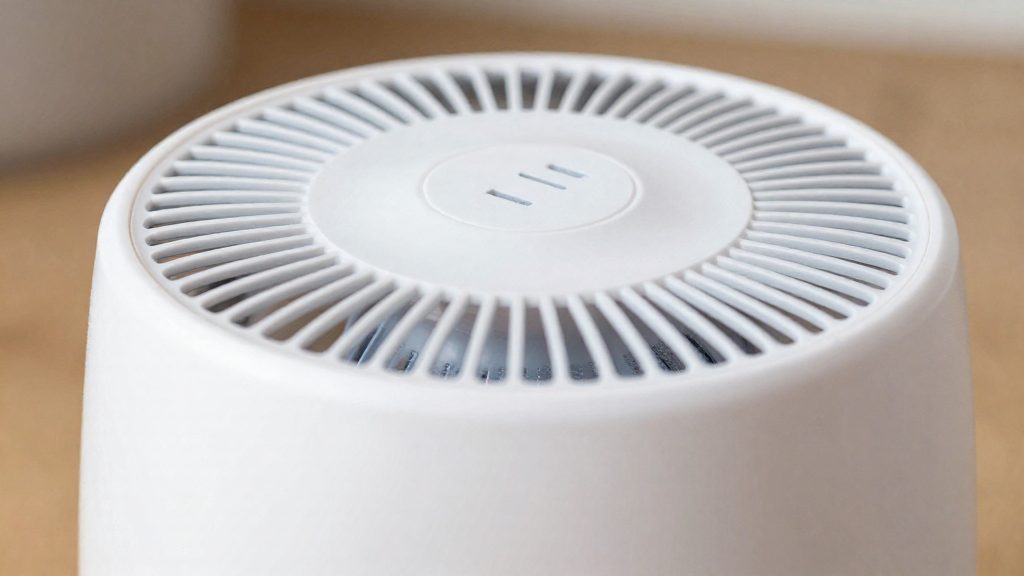
When does a dehumidifier help?
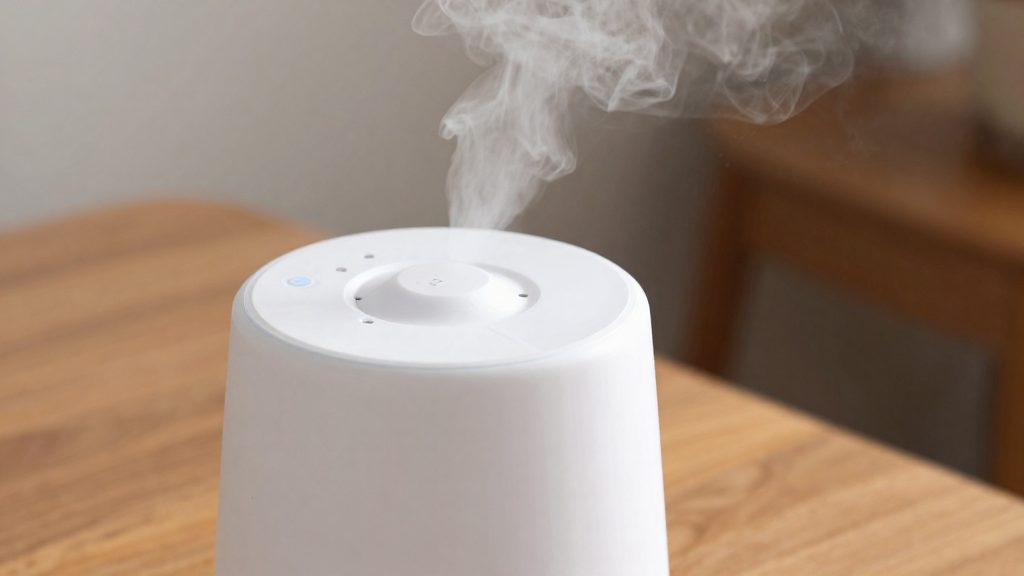
A dehumidifier is the right tool when ventilation and control of moisture sources cannot keep indoor humidity within a safe range.
Persistent readings above the upper humidity limit
A single high reading is not enough evidence. Humidity rises after a shower or when laundry dries indoors, then falls again. The signal to act is a persistent reading above 50%. Place a hygrometer away from windows, radiators and direct sunlight, and log readings at several times of day over several days. If readings stay above 50% after local ventilation is used correctly, a dehumidifier is a reasonable next step. Condensation that keeps returning on cold surfaces such as window panes points to the same conclusion.
Compressor versus desiccant technology
The two main types remove water by different methods, which determines where each performs best.
| Feature | Compressor dehumidifier | Desiccant dehumidifier |
|---|---|---|
| Removal method | Cools air so water condenses on a cold coil | Takes up water vapour with a hygroscopic material |
| Best suited to | Warmer rooms, where air holds enough moisture to condense efficiently | Cooler rooms, where a compressor unit’s condensation process is less effective |
| Key selection question | Is the room warm enough for condensation to occur reliably? | Does the room need drying at low temperature? |
Compare the rated figures in each manufacturer’s product specifications rather than assuming one type is more powerful.
Sizing capacity by room volume and moisture load
Sizing depends on two inputs:
- Room volume: room volume = length × width × height, in cubic metres.
- Moisture load: the water added to the air by indoor activities, such as drying laundry indoors, showers taken without local extraction, cooking and the number of occupants.
A room with a high moisture load needs more removal capacity than its volume alone suggests. Choose a unit whose rated capacity covers both the room volume and the moisture load you have observed in your readings. An undersized unit runs continuously and does not reach the target humidity. Confirm the rated figure against the manufacturer’s specifications.
When should you call a professional?
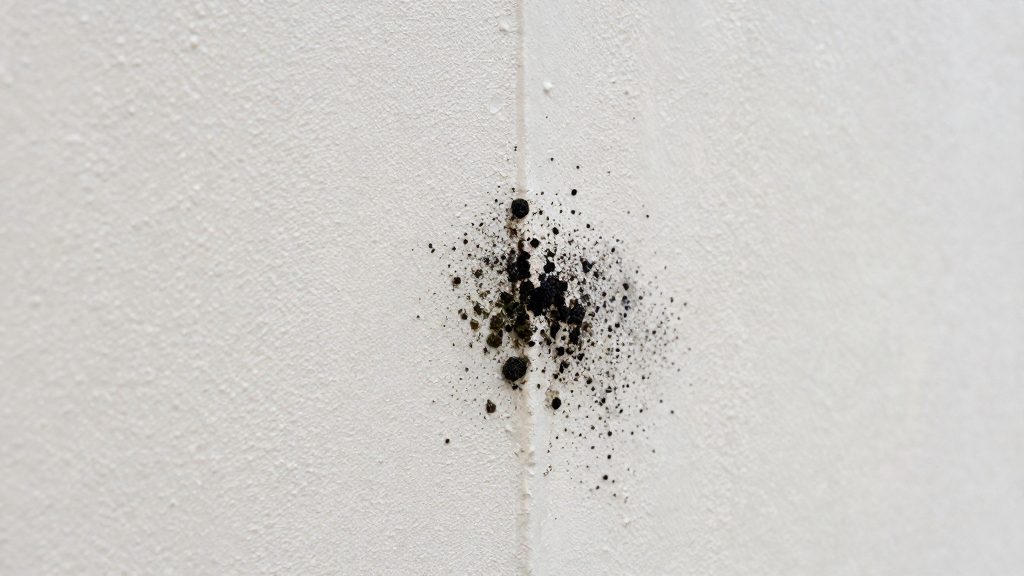
Whether mould in a bedroom corner is a DIY job or needs an expert depends on two factors: the total area affected and whether the moisture source is still active. Health Canada (2026) sets size thresholds based on patch count and surface area, which give a practical point at which to stop and call in help.
Mould size classes
| Size class | Criteria (Health Canada, 2026) | Recommended action |
|---|---|---|
| Small | 3 or fewer patches, totalling 1 m² or less | Usually DIY |
| Medium | More than 3 patches, or 1 to 3 m² | Professional assessment recommended |
| Large | A single patch over 3 m² | Professional assessment and cleanup required |
Count patches across the whole room, not only the corner you noticed first. Several small patches along one wall can move a room into the medium class even when each patch looks minor. A single large patch over 3 m² requires professional cleanup regardless of how the rest of the room looks.
Recurring mould and hidden moisture
Health Canada (2026) states that if mould returns after cleaning, the moisture source has not been fixed. This is the clearest sign that a professional is needed, because the cause may sit outside what a homeowner can see. A cold wall that repeatedly develops mould in the same spot can point to moisture arriving from within the wall structure, not only from humid room air. Finding that source requires a structural diagnosis, which goes beyond surface inspection and is a task for a professional. Removing visible growth alone will not resolve it.
Why air testing does not settle the question
A professional decision should therefore rest on the visible extent of the growth and the condition of the moisture source, not on a sample taken from the room air.
Higher-risk occupants
If a higher-risk occupant sleeps in the affected bedroom, treat a medium-class patch as a reason to request a professional assessment sooner rather than later.