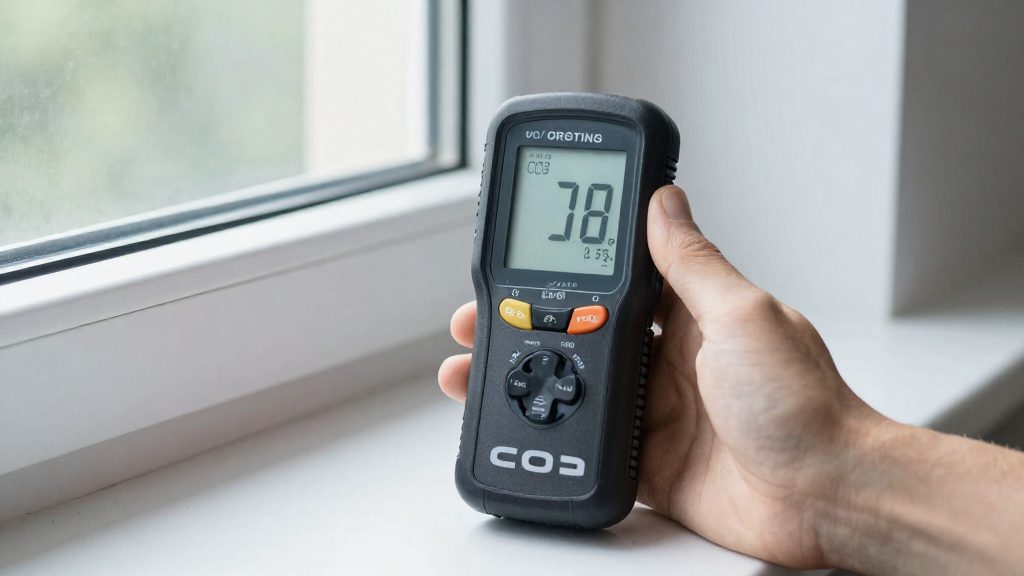
Ventilation can only bring a room’s CO2 down to the level of the incoming air, so a sensor that still reads high with the windows open is usually measuring something other than fresh outdoor air. The most likely causes are an unrealistic expectation of the outdoor baseline, sensor placement close to people or indoor sources, a calibration offset linked to altitude, or a reading taken before the room has stabilised. Health Canada (2021) measured a median outdoor level of 419 ppm at four Ottawa schools, with a 95th percentile of 532 ppm.
Why does my CO2 sensor show a high reading with the windows open?
Compare the reading with the outdoor baseline
Use the outdoor reference values from Health Canada (2021) as your benchmark:
| Reference | Value (ppm) |
|---|---|
| Median outdoor air, four Ottawa schools | 419 |
| 95th percentile, same measurements | 532 |
| Outdoor range assumed by ASHRAE | 300 to 500 |
| Expected sensor reading outdoors | Not below roughly 400 |
Verify calibration and altitude
An Aranet support forum entry reported a unit reading 900 to 1,050 ppm near an open window at about 1,000 m altitude. Manufacturer support said that unit had been factory-calibrated at a lower altitude and recommended manual calibration using the published instructions. If you live at a higher elevation, check whether your sensor’s factory calibration assumed a different altitude, then follow the manufacturer’s calibration procedure.
What Is the Normal Outdoor CO2 Level?
Outdoor air is the outdoor baseline against which any indoor CO2 reading should be judged. According to Health Canada (2021), ASHRAE assumes outdoor CO2 levels of 300 to 500 ppm. Health Canada’s own measurements at four Ottawa schools had a median within the assumed range, but a 95th percentile above its upper end (see the table above). The measured distribution is therefore more useful for checking a sensor than the assumption alone.
Using the Baseline to Check a Sensor
A CO2 monitor placed outdoors, away from vehicle exhaust and combustion sources, should read close to the values above. The 95th percentile of 532 ppm is a practical upper boundary: most outdoor readings in the Ottawa measurements fell below it. A sensor that reads well above it while outside points to a placement or calibration problem rather than a typical outdoor concentration.
To run this check:
- Place the sensor outdoors in an open area, out of direct exhaust flow.
- Allow the reading to stabilise before comparing it to the table.
- Repeat the check at different times of day, since a single reading only shows a moment in time.
- If the reading stays high, verify the calibration procedure in the device manual before drawing conclusions about the room.
Why Outdoor Readings Matter for Windows Open Cases
Outdoor air is the reference level toward which indoor CO2 falls when ventilation is working. IQAir lists outdoor CO2 seeping in as one contributor to indoor levels, alongside breathing, combustion and vehicle exhaust. When a room is ventilated with open windows, the indoor reading should move toward the outdoor baseline, so a sensor that stays far above it is a signal to check the instrument first.
What Health Canada says about indoor CO2
Health Canada’s recommended long-term exposure limit for indoor carbon dioxide is 1,000 ppm, based on a 24-hour average. According to Health Canada (2021), this value is consistent with ASHRAE and other countries’ standards, which rest on general air quality rather than direct health effects. Indoor CO2 is therefore treated as a proxy for ventilation rate and occupant bioeffluents, not as a direct measure of health hazard. A single high reading, such as one taken near an open window, does not by itself show that the limit is exceeded.
| Indoor reference | Value | Source |
|---|---|---|
| Health Canada long-term indoor limit | 1,000 ppm, 24-hour average | Health Canada (2021) |
| ASHRAE indoor guideline | No more than 700 ppm above ambient | Health Canada (2021) |
A reading well above outdoor levels near an open window points to the sensor measuring the air at that spot, not a building-wide average.
Health Canada also notes that winter indoor median hourly levels in Edmonton and Halifax were about 80 to 160 ppm higher than summer levels. Seasonal ventilation habits, rather than window position alone, therefore shape long-term readings.
Sensor placement and stabilisation time
A CO2 reading only reflects the room if the sensor is placed well and given time to settle. Check the device manual for guidance on how long it needs to settle.
Sensor position
A sensor placed close to an open window samples air that is closer to outdoor air, so it is not representative of the room, and outdoor air is not zero.
To keep sensor position representative of the occupied space:
- Place the sensor at roughly breathing height, in the zone where people spend most time.
- Keep it away from direct drafts, combustion or heating sources, and from the breath of people sitting close by.
- Avoid placing it where incoming air hits it directly, since this makes the reading unrepresentative of the occupied space.
| Factor | Effect on reading | Source |
|---|---|---|
| Open window near sensor | Pulls the reading toward outdoor levels | Health Canada (2021) |
| Occupancy and room size | Raises indoor CO2 through breathing | IQAir |
| Combustion appliances | Add CO2 to indoor air | IQAir |
Logging and comparison
Log values over a full day rather than reading a single spot value. Compare the logged average against the threshold you are testing, and record whether windows were open or closed during each period. Because winter levels run higher than summer levels, compare readings taken in the same season.
Calibration, Altitude and Sensor Faults
A reading is only meaningful relative to the calibration reference, so the sensor’s calibration state should be checked before the air quality is judged. The outdoor air is the most practical reference, using the values in the table in the first section.
Altitude
Check the device manual for an altitude setting and for the manual calibration procedure.
CO2 Sources and Insufficient Ventilation
When a CO2 sensor stays high with the windows open, the usual cause is a source inside the room that produces CO2 faster than the open window can remove it. Most indoor CO2 comes from occupant breathing, and the level that builds up depends on room size and the number of people present. A small room with several occupants accumulates CO2 much faster than a large room with one person, so the same open window can produce very different readings.
Other sources include combustion appliances such as stoves, fireplaces, tobacco, and heaters, as well as exhaust from an attached garage or from road vehicles. Outdoor CO2 can also seep indoors. According to IQAir, these are the main contributors besides occupants, and each one adds to the indoor concentration even when ventilation is adequate.
Outdoor air sets the floor for any reading. A reading that stays well above outdoor levels with the window open points to an indoor source or to an airflow too small for the number of occupants.
How to Ventilate Effectively: Windows and Mechanical Ventilation
Opening windows is the fastest way to bring fresh air into a room, but the CO2 reading only tells you something useful when you compare it to a baseline. A short spike while a window is open is not a direct health measure, since the long-term indoor limit is based on a 24-hour average. The aim is to lower the indoor concentration toward outdoor levels, not to chase a single number.
Establish the Outdoor Baseline
Before judging an indoor reading, check what the air outside looks like. A reading far above outdoor levels indicates that the air inside the room has not yet been replaced.
Ventilation Method Checklist
- Cross-ventilation: Open windows on opposite sides of the room so air moves through the space rather than stalling near one opening.
- Trend monitoring: Watch whether the value falls steadily after opening windows. A flat reading suggests a source inside the room, such as combustion appliances or occupants, is still adding CO2.
- Mechanical systems: A mechanical ventilation system provides continuous air exchange without depending on open windows. Its effectiveness should be checked with the same trend method.
When Should You Replace or Recalibrate Your CO2 Sensor?
Recalibration Steps
- Compare with a window test. Open a window for several minutes and watch whether the reading falls toward the outdoor baseline. A reading that stays high may point to a calibration error, but also to an indoor source or insufficient airflow; confirm by taking the sensor outdoors, away from exhaust, before recalibrating.
- Apply the manufacturer’s manual calibration. Follow the published instructions for your model.
When to Replace
Drift that cannot be corrected by recalibration is the main reason to replace a unit. Judge the device by its test results rather than by its age.
Frequently asked questions
What CO2 reading should I expect with the windows open?
Outdoor air sits close to 400 ppm, so a sensor placed in a well-ventilated room should settle near that level. Readings well above it usually point to the sensor’s position, its calibration, or a source still feeding the room.
Can altitude make my CO2 sensor read high?
Yes. A factory calibration set for a lower elevation can push readings upward at higher altitude. Follow the manufacturer’s manual calibration procedure rather than trusting the default setting.
How long should I monitor before judging the reading?
A short spot check can capture a temporary spike from people or appliances, so it rarely gives a fair picture. Compare your readings over at least 24 hours before deciding whether the ventilation is working.