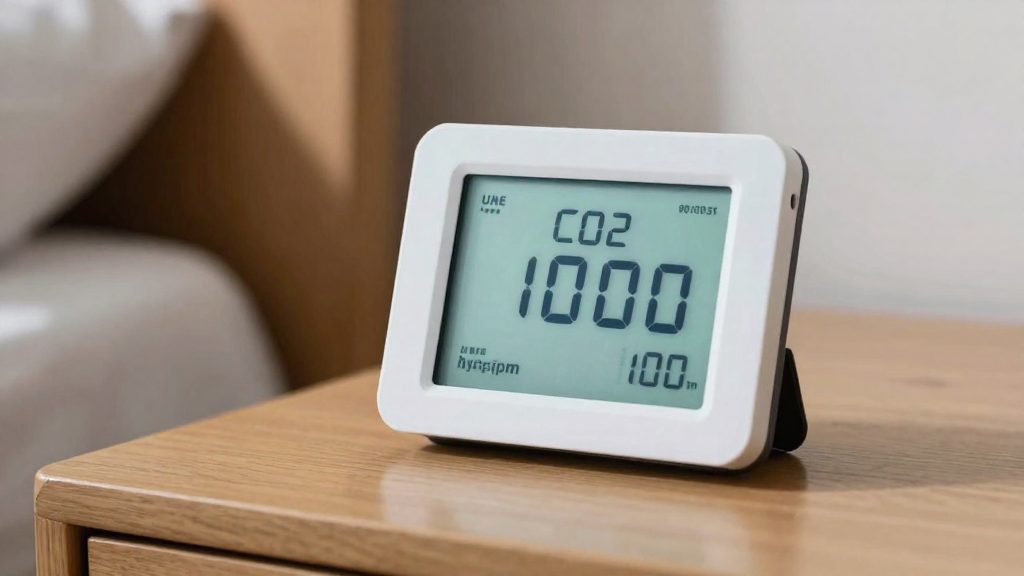
A CO2 level below 1,000 ppm is a practical reference point for a well-ventilated bedroom at night. Health Canada (2021) sets 1,000 ppm as a long-term indoor exposure limit based on a 24-hour average. It does not set a separate night-time limit, so overnight readings are best compared with this value as an indicator of ventilation. Outdoor air typically measures about 300 to 500 ppm, so a sealed bedroom with sleeping occupants can drift well above the limit by morning. Keeping the room under 1,000 ppm depends mainly on ventilation, not on air cleaning.
What CO2 level is safe in a bedroom at night?
Health Canada’s guideline is based on a 24-hour average, so the measurement must cover at least 24 hours under normal conditions to be meaningful. The main indoor source is occupant breathing. Each sleeper adds to the load, and fuel-burning appliances that are unvented or poorly vented add more.
Airthings (2025), a CO2 sensor manufacturer, classifies bedroom readings as follows:
| CO2 level (ppm) | Airthings rating |
|---|---|
| Under 800 | Excellent |
| 800 to 1,000 | Fair |
| 1,000 to 2,000 | Poor |
| Above 2,000 | Serious ventilation problem |
Airthings recommends cracking a window a few inches, leaving the bedroom door open, and airing the room before bed. Health Canada (2021) adds that windows should be opened only when the AQHI shows acceptable outdoor air quality, and that mechanical ventilation can be used. Overnight monitoring with a CO2 sensor shows whether the room stays under the threshold.
What Health Canada Says About CO2
Health Canada recommends a long-term indoor CO2 exposure limit of 1,000 ppm, based on a 24-hour average. The limit is assessed over a full day rather than at a single moment, so brief peaks are judged against the average.
| Parameter | Health Canada guidance |
|---|---|
| Long-term indoor limit | 1,000 ppm, 24-hour average |
| Outdoor air baseline | About 300 to 500 ppm |
| Minimum measurement period | 24 hours, under normal conditions |
Main Sources Indoors
Occupant respiration is the main indoor source of CO2. Levels rise with more occupants, less ventilation and higher activity. Health Canada (2021) also identifies unvented or poorly vented fuel-burning appliances and smoking as contributors.
Health Effects and Vulnerable Groups
Health Canada (2021) associates rising indoor CO2 with headache, tiredness, dizziness, difficulty concentrating, and eye, throat and nasal irritation. Children and people with asthma or allergies are among the groups it identifies as vulnerable. The guideline also states that most studies could not separate CO2 from other pollutants, so symptoms cannot be attributed to CO2 alone.
Ventilation Measures Recommended
Health Canada (2021) states that keeping indoor CO2 below 1,000 ppm indicates adequate ventilation. Its recommended measures are:
- Opening windows when outdoor air quality is acceptable, after checking the AQHI (Air Quality Health Index).
- Using mechanical ventilation.
- Using a range hood vented to the outside.
- Avoiding unvented fuel-burning appliances indoors.
Why does CO2 rise during sleep?
Bedroom CO2 comes mainly from the people sleeping in it. Sleep is a low-activity state, but occupants keep breathing out CO2 throughout the night. Any concentration above the outdoor baseline builds up when fresh air cannot replace the exhaled gas quickly enough.
The key factor is the air exchange rate, meaning how often indoor air is replaced with outdoor air. A closed bedroom, with the door shut and windows closed, has a low exchange rate, so concentration climbs through the night. Airthings (manufacturer, 2025) reports that closed bedrooms can exceed 2,000 ppm overnight, especially with two occupants.
Overnight readings therefore should be interpreted as part of a full-day pattern, not as a single peak. A high CO2 reading is best read as a sign of weak ventilation rather than as proof of a specific health effect.
Practical ppm thresholds for the bedroom
Because a bedroom stays closed for hours while occupants breathe out CO2 continuously, a daytime spot reading tells you little. Measure over at least 24 hours under normal conditions, and treat the overnight period as the critical window.
Readings above 1,000 ppm suggest a ventilation shortfall, and the response is to increase air exchange. Sensor accuracy should still be kept in mind when interpreting a single device’s readings. The rise is driven by occupant respiration, so the number of people sleeping in the room matters as much as the room’s size.
The gap between the bedroom value and the outdoor baseline shows how much CO2 the occupants have added without enough air exchange. For vulnerable occupants, the upper bands of the Airthings rating deserve prompt attention.
Symptoms of Stale Air on Waking
Waking with a headache, a dry throat, or a heavy, sluggish feeling can point to a bedroom that has accumulated carbon dioxide overnight. Occupants exhale CO2 throughout the night, so a closed room gradually builds up concentration.
Reading Overnight CO2 Levels
A single night’s peak does not map directly onto the 24-hour guideline, so logging several nights gives a more reliable picture.
Who Is Most Affected
Children and people with asthma or allergies may react more strongly to the irritation effects listed above.
Limits of Symptom-Based Diagnosis
Morning symptoms do not confirm CO2 as the cause, since other indoor pollutants may contribute. A measured reading is needed to link the two.
How to Reduce CO2 in the Bedroom at Night
Overnight CO2 in a bedroom comes mainly from occupant respiration, so the practical goal is to bring in outdoor air faster than occupants exhale it. Ventilation is the main lever.
Ventilating Before and During Sleep
- Air the room before bed. Airthings (2025) recommends ventilating the bedroom shortly before sleep, so that the air starts the night closer to outdoor levels.
- Crack a window a few inches. Airthings (2025) suggests keeping a window slightly open overnight.
- Leave the bedroom door open. This lets air move in from the rest of the home, according to Airthings (2025).
- Use mechanical ventilation. Health Canada (2021) advises using mechanical ventilation alongside opening windows.
Health Canada (2021) recommends opening windows only when outdoor air quality is acceptable, and checking the AQHI first.
Limiting Indoor Combustion and Cooking Sources
Health Canada (2021) identifies unvented or poorly vented fuel-burning appliances and smoking as additional indoor CO2 sources. Its advice is to avoid unvented fuel-burning appliances indoors and to use a range hood vented outside when cooking.
| Measure | Source | Key detail |
|---|---|---|
| Crack a window a few inches | Airthings (2025) | Overnight ventilation |
| Leave the bedroom door open | Airthings (2025) | Air moves from the rest of the home |
| Open windows when AQHI is acceptable | Health Canada (2021) | Check the AQHI first |
| Range hood vented outside | Health Canada (2021) | Removes cooking air outdoors |
| Avoid unvented fuel-burning appliances indoors | Health Canada (2021) | Reduces a direct indoor source |
Verifying the Result
Monitoring overnight with a CO2 sensor shows whether these measures work. A single short reading does not reflect the bedroom’s typical level.
Which CO2 sensor to choose and where to place it?
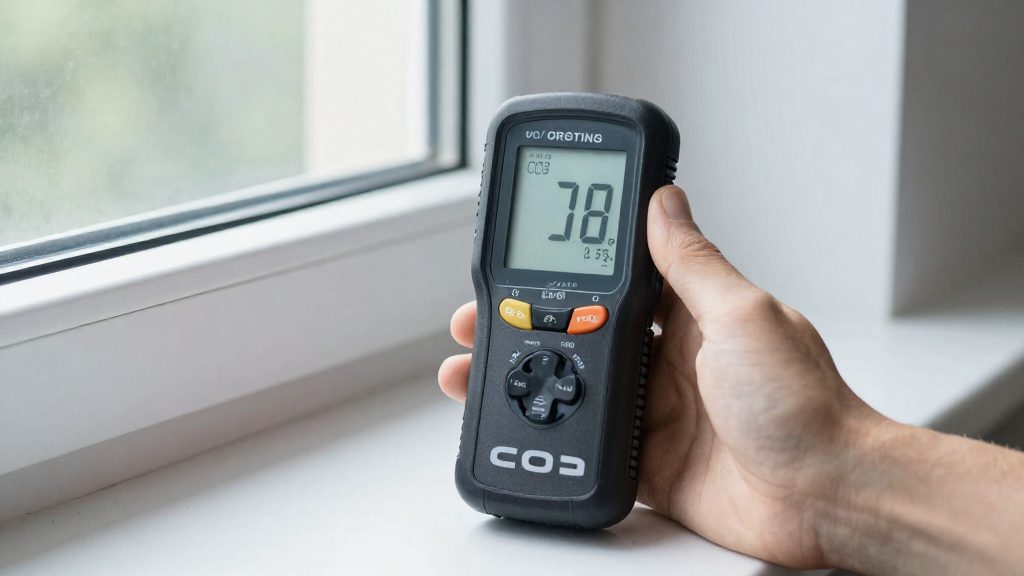
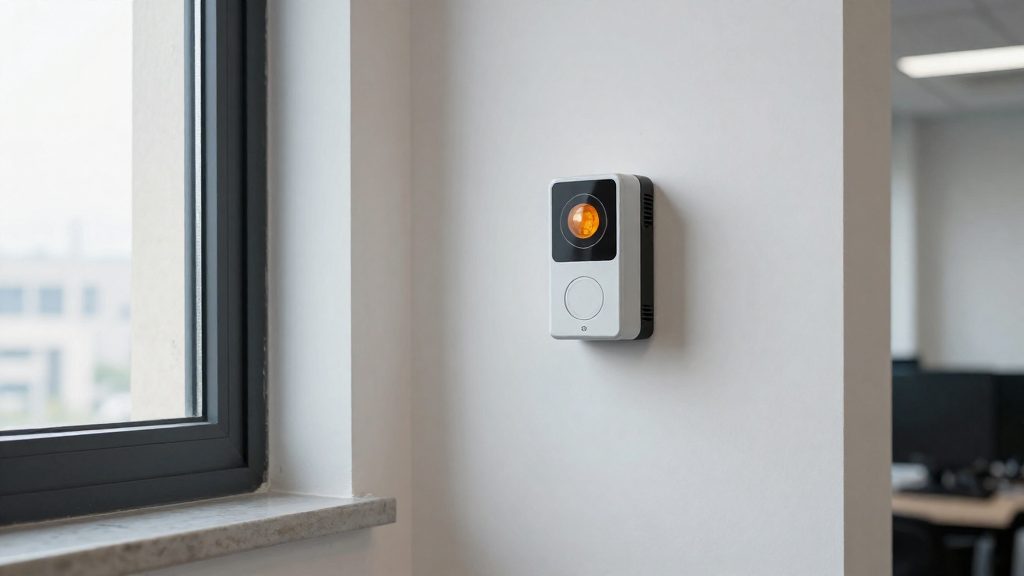
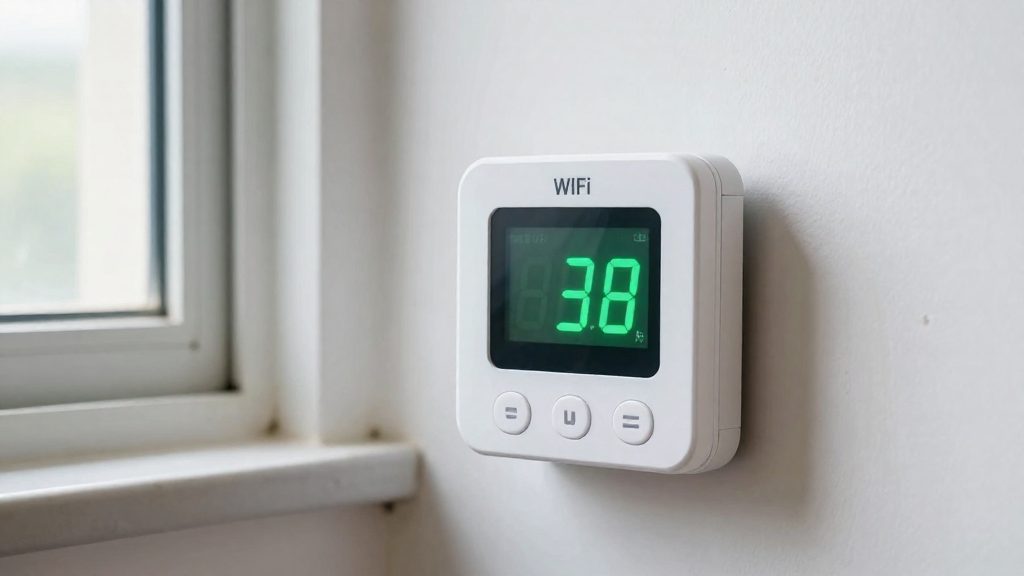
A bedroom CO2 monitor is only useful if it reports concentration in ppm and records the whole night. A reading taken at bedtime or on waking misses the peak, which in a closed bedroom builds up during sleep.
Selection criteria
- Units in ppm: Choose a device that displays parts per million, so readings can be compared with published thresholds.
- Logging over at least 24 hours: A history graph lets you see the overnight rise and the morning decline, which a single number cannot show.
- Clear ventilation thresholds: Look for a device or app that labels readings against recognised ranges.
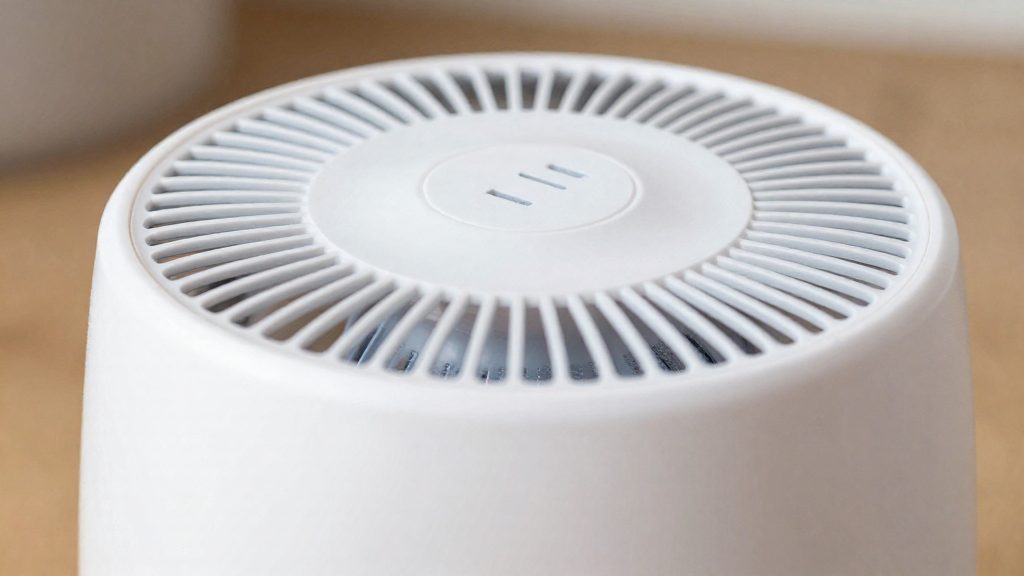
A HEPA air purifier cannot replace a sensor or ventilation.
Where to place the sensor
- Inside the bedroom: Position the sensor in the room where you sleep, not in the corridor or near the entrance, so it reflects the air you breathe.
- Away from the bed: Keep it at a distance so exhaled air does not hit the sensor directly, which would make readings spike unrealistically.
- Away from windows and vents: If your sensor sits by an open window and shows a value near the outdoor range of 300 to 500 ppm, the reading reflects outdoor air rather than the room.
Interpreting the readings
Use the Airthings rating table in the first section. Readings that climb into the poor range overnight suggest the room needs more air exchange, even if the morning value looks acceptable.
Frequently asked questions
Is 1,000 ppm an enforceable limit for my bedroom?
No. Health Canada (2021) sets 1,000 ppm as a long-term residential indoor exposure guideline, not a regulatory limit, and it does not define a separate threshold for bedrooms or night-time. Use the value as a benchmark for ventilation quality rather than a strict pass or fail line.
Will an air purifier lower CO2 in my bedroom overnight?
No. Airthings (2025) notes that HEPA air purifiers do not remove CO2, because they filter particles rather than gases. Changing the ventilation, such as slightly opening a window or running mechanical ventilation, is what alters the CO2 concentration.
How can I tell whether my bedroom CO2 is a problem?
Monitor the room with a CO2 sensor for at least 24 hours, since Health Canada’s guideline uses a 24-hour average. If readings stay above 1,000 ppm or climb toward the range Airthings (2025) labels as a serious ventilation problem, the room needs more fresh air.