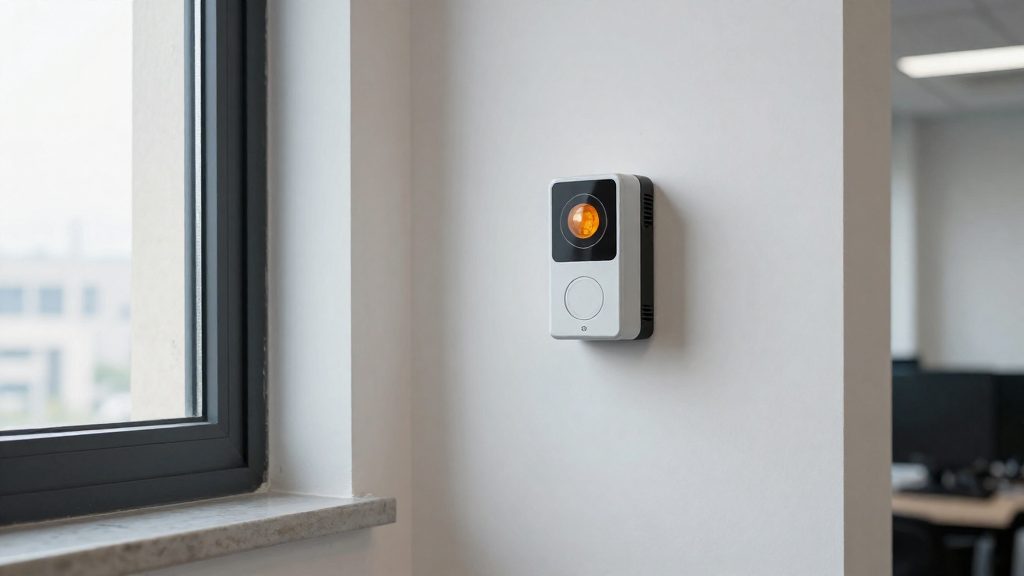
Indoor CO2 rises when the carbon dioxide that occupants exhale builds up faster than outdoor air can dilute it. Outdoor air sets the starting point, typically 328 to 442 ppm according to Health Canada (2020). Any indoor reading far above that range in an occupied office means the room is receiving too little fresh air for the number of people in it. The rise follows a simple mass balance, and the concentration keeps climbing for as long as the room stays occupied with low air exchange.
Why does CO2 rise in a closed office?
The mass balance behind CO2 build-up
Indoor CO2 is set by two opposing flows. Occupants add CO2 to the room, and outdoor air that replaces indoor air removes it. Health Canada (2023) describes the same relationship: indoor CO2 depends on the outdoor concentration, the indoor sources, and how well ventilation dilutes CO2 with outdoor air.
In a steady state, the excess above the outdoor level can be approximated as:
Excess CO2 (ppm) ≈ CO2 generation rate ÷ outdoor air supply rate
Both rates must use consistent units, for example litres per second. The relationship has two practical consequences. If the fresh-air supply is halved while occupancy stays the same, the excess roughly doubles. If the supply rises, the excess falls in proportion.
Outdoor baseline as the floor of the balance
The outdoor value is the lower limit of the balance, so indoor readings should always be interpreted against it.
| Reference point | CO2 level | Source |
|---|---|---|
| Typical outdoor air | 328–442 ppm | Health Canada (2020) |
| Median outdoor level at four Ottawa schools | 419 ppm | Health Canada (2020) |
A reading close to the outdoor range indicates little excess CO2. A reading that stays well above it while the room is occupied indicates that the outdoor air supply is not keeping pace with the people inside.
Build-up in rooms with low air exchange
Low air exchange is the condition that lets the balance tip. Health Canada (2020) notes that lower ventilation in more airtight buildings allows CO2 to accumulate. In a sealed room, the concentration does not stabilise at the outdoor level, because the removal term is too small to offset generation. The effect is strongest in spaces with high occupancy relative to their volume and supply rate, such as meeting rooms.
Where indoor CO2 comes from
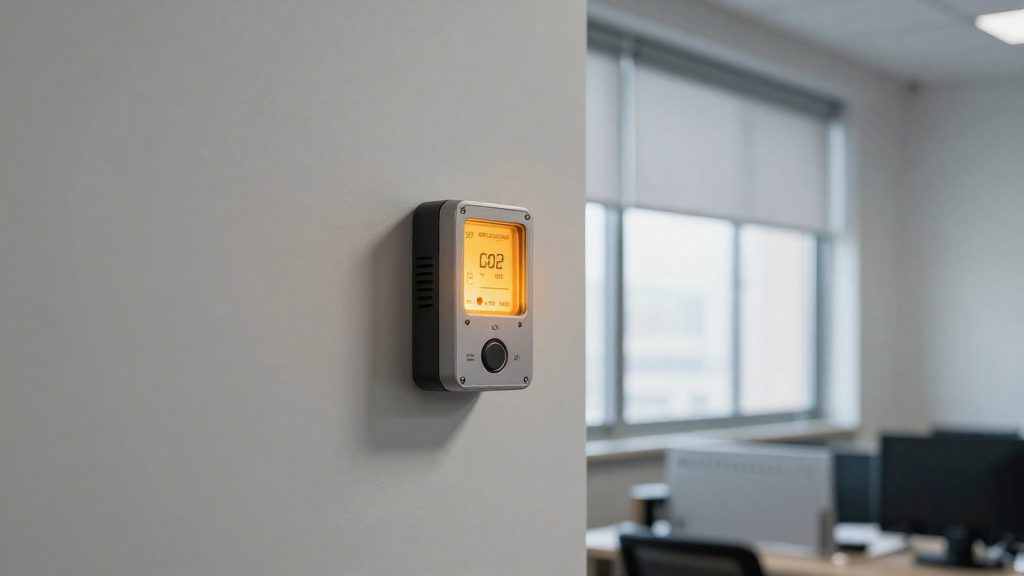
In offices, the main source of indoor carbon dioxide is occupant breathing. According to Health Canada (2023), CO2 in offices comes mainly from people exhaling. Unvented or poorly vented fuel-burning appliances and cigarette smoke are other sources. Each person releases CO2 continuously, so more people in a room, and longer occupancy, means more exhaled CO2 in the air. This is why Health Canada (2023) recommends continuous CO2 sampling over a working day, especially in meeting rooms.
Occupant respiration
Breathing is the baseline indoor source in any occupied office. Exhaled CO2 is released whether people are seated, working or in a meeting. Because this source is always present when the room is in use, the CO2 level is driven by how many people use the room and for how long, not by a single emission point.
Fuel-burning appliances and cigarette smoke
The table below summarises the three indoor sources named in the guidance and the conditions that increase their contribution.
| Source | Where the CO2 goes | Condition that raises indoor levels |
|---|---|---|
| Occupant breathing | Released directly into the occupied room | Many occupants or long occupancy |
| Unvented fuel-burning appliances | Combustion gases stay indoors | No connection to an outdoor exhaust |
| Poorly vented fuel-burning appliances | Combustion gases partly stay indoors | Exhaust that does not carry gases fully outside |
| Cigarette smoke | Released into the room air | Smoking indoors |
Fuel-burning appliances, such as gas-fired heaters, release combustion gases. When an appliance is unvented or poorly vented, those gases remain in the room rather than leaving through an exhaust. Health Canada (2023) lists this as a separate source from breathing, so it adds to the occupant baseline rather than replacing it.
Cigarette smoke is listed by Health Canada (2023) as an additional indoor source of CO2. It is not a substitute for occupant breathing, and it adds to the room’s total.
How ventilation and occupancy change CO2 levels
In a closed office, indoor CO2 settles at a steady concentration when the CO2 released by occupants is balanced by the outdoor air that ventilation brings in. The concentration rises when people add CO2 faster than the air is replaced, and it falls when the outdoor air supply increases.
Dilution rate set by outdoor air intake
The dilution rate is the share of indoor air replaced by outdoor air over time. A higher intake lowers the steady-state concentration, and a lower intake raises it. Health Canada (2023) states that poor ventilation pushes indoor levels up, and that CO2 tends to peak when outdoor air intake is lowest.
| Factor | Effect on indoor CO2 | Source |
|---|---|---|
| Low outdoor air intake | Levels tend to peak | Health Canada (2023) |
Occupancy above the space design capacity
Ventilation is sized for a specific number of occupants. With the same outdoor air supply, each additional person adds CO2 to the room while the dilution stays the same, so the steady-state level rises. Health Canada (2023) lists more occupants than the space was sized for as a direct cause of higher levels. The effect is strongest in meeting rooms, where occupancy can change quickly.
Airtight buildings and extreme-weather intake reduction
In airtight buildings, less air leaks in through the envelope, so mechanical ventilation carries most of the dilution load. Health Canada (2023) also reports that CO2 tends to peak when outdoor air intake is lowest, for example during extreme cold or heat. Separately, Health Canada (2020) reports winter indoor CO2 roughly 80–160 ppm higher than summer levels in some Canadian cities.
What CO2 level is acceptable in Canada?
Health Canada’s proposed guidance sets a proposed 24-hour limit of 1,000 ppm (1,800 mg/m³) for long-term indoor carbon dioxide. According to Health Canada (2020), this value would replace the 1987 guideline of 3,500 ppm. The reference level is therefore 1,000 ppm, not the older ceiling, and it is a 24-hour value rather than a single reading.
The 1987 guideline and the proposed change
The 1987 guideline set an upper ceiling of 3,500 ppm. Health Canada (2020) states that the proposed 1,000 ppm limit would replace it, which means the proposed value is 3.5 times lower than the old ceiling (3,500 ÷ 1,000).
| Feature | 1987 guideline | Proposed 24-hour limit |
|---|---|---|
| CO2 limit | ≤3,500 ppm | 1,000 ppm (1,800 mg/m³) |
| Applies to offices | Not stated | Yes, according to the Health Canada draft (2023) |
Why the residential limit applies to offices
The Health Canada draft guidance (2023) states that the proposed residential long-term 24-hour limit of 1,000 ppm (1,800 mg/m³) also applies to offices.
The reason is occupancy. Health Canada (2020) notes that higher-occupancy spaces such as schools and offices are more likely to have elevated CO2 levels than lightly occupied homes. A room with many people produces more exhaled CO2, which is why elevated levels are more likely in these spaces.
How the 24-hour basis works
Because the limit is defined over 24 hours, it is a long-term measure. The sources describe 1,000 ppm as a proposed 24-hour limit. They do not detail how compliance is assessed, so readings should be interpreted with caution.
What are the effects of high CO2 on comfort?
Elevated CO2 in a closed office shows up first as discomfort. The clearest documented effect is eye, nose and throat irritation in people exposed to more than 800 ppm. Health Canada (2023) reports this finding from school and office exposure studies, where occupants at those levels reported more irritation than occupants in lower-concentration spaces. Because the symptoms are felt directly, they are often the first sign that a room is poorly ventilated.
Irritation above 800 ppm
- Eye, nose and throat irritation is the effect reported most consistently in school and office studies (Health Canada, 2023).
- Irritation was reported more often among people exposed to more than 800 ppm. The sources report more irritation above 800 ppm; they do not establish that lower concentrations are free of effects.
- Occupants report these symptoms themselves, so the irritation reflects how people experienced the room rather than a laboratory measurement.
Headache, tiredness and concentration
Health Canada (2020) links elevated CO2 to headache, tiredness and poor concentration. It also links levels from about 1,000 ppm to lower task performance. The same document states that these are associations only and that no causality was determined.
| Concentration | Reported effect | Source |
|---|---|---|
| Above 800 ppm | Eye, nose and throat irritation in school and office studies | Health Canada (2023) |
| From about 1,000 ppm | Associations with headache, tiredness and poor concentration | Health Canada (2020) |
Why the discomfort appears
Discomfort tends to rise when ventilation is weak (Health Canada, 2023). Seasonal conditions also matter, so complaints can cluster in colder months.
How to measure CO2 with a sensor
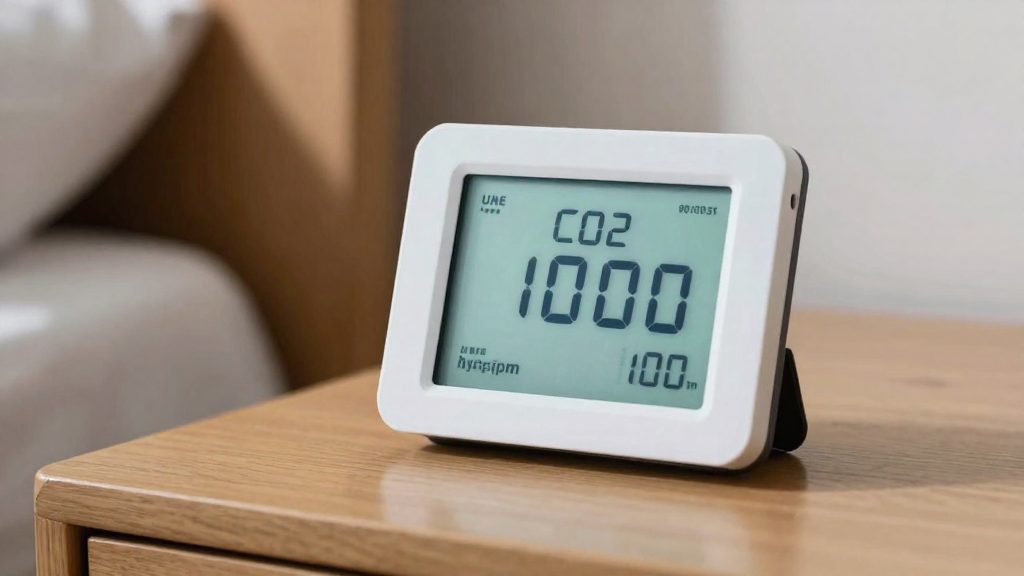
Measuring CO2 in an occupied office means recording how levels change across a full working day, not taking a single spot reading. Levels rise when ventilation dilutes less CO2. A useful sensor study has to capture the rhythm of occupancy, which is why the same guidance recommends continuous CO2 sampling over a working day, especially in meeting rooms.
Logging across a full working day
Set the sensor to record continuously from arrival to closing time rather than checking it at intervals. A reading taken during a quiet moment can miss the peaks that build up when people gather. Note the start time, the number of occupants when known, and whether windows or mechanical ventilation were in use, so readings can be matched to events later. Also record the day’s weather conditions alongside the data.
Priority placement in meeting rooms
Health Canada (2023) recommends continuous CO2 sampling over a working day, especially in meeting rooms. Place the sensor in the occupied zone, at the height of seated occupants’ breathing and away from supply vents and open doors, so it samples the air people actually breathe rather than air moving in from another room. Log the room during meetings with full attendance, since that is when its load is highest.
| Stage | Action | Purpose |
|---|---|---|
| Placement | Seated breathing height, clear of vents and doors | Samples air occupants breathe |
| Logging | Continuous, arrival to closing | Captures peaks during occupancy |
| Plausibility check | Reading in fresh outdoor air | Confirms the sensor reads plausibly |
How NDIR sensors work
Many CO2 sensors use non-dispersive infrared (NDIR) detection. CO2 absorbs infrared light at a specific wavelength, and the sensor estimates concentration from how much of that light is absorbed along its optical path. Because the signal depends on the air that reaches the optical chamber, placement and airflow directly affect what the sensor reports.
Calibration checks
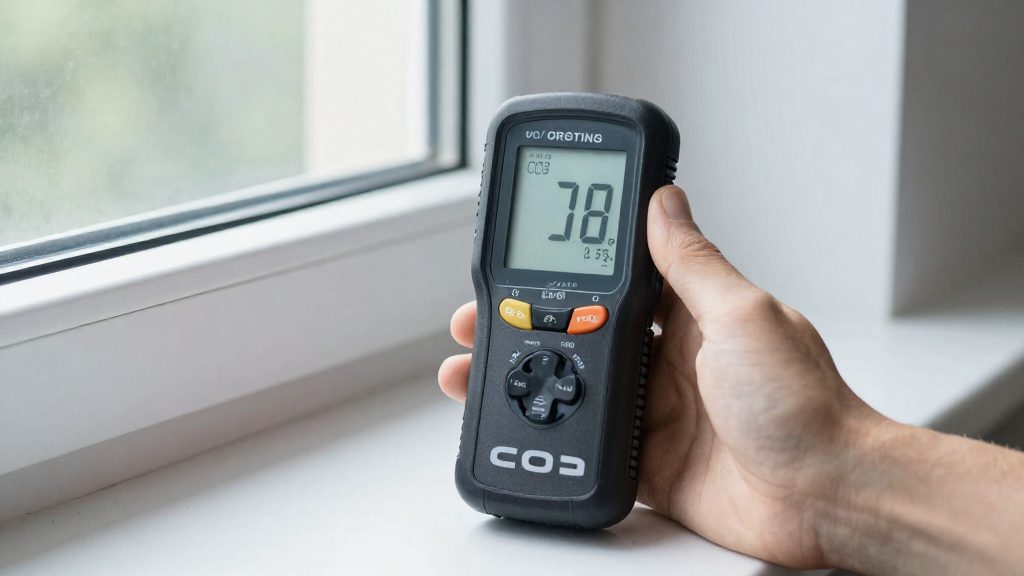
For calibration procedure and interval, check the sensor manufacturer’s documentation. A practical check is to compare the sensor against outdoor air. Take the sensor near an open window or outside, away from exhaust, and wait for the reading to stabilise. A reading well above typical outdoor levels in fresh air suggests drift or a fault, and the sensor should be checked before its office data is trusted.
Winter indoor CO2 was roughly 80–160 ppm higher than summer levels in some Canadian cities (Health Canada, 2020), so logs from different seasons should be compared with caution.
How to lower CO2 in an office
The practical goal is to bring in more outdoor air and to match ventilation to how many people are in the room. According to Health Canada (2023), the main levers are longer ventilation run times, more fresh air supplied to occupied spaces, and demand-controlled ventilation that responds to measured CO2. Avoiding overcrowding and reducing other indoor sources, such as unvented fuel-burning appliances and smoking, also lower levels.
Extend ventilation run times during occupied hours
- Run the ventilation system for the whole period the space is occupied, not only at the start of the day.
- Keep ventilation running after occupants leave if the space was used heavily, so that CO2 introduced during the day can clear.
- Give meeting rooms attention, since Health Canada (2023) recommends continuous CO2 sampling there, especially.
Supply more outdoor air to occupied spaces
- Increase the proportion of fresh air delivered to occupied areas rather than recirculating the same air.
- Check the outdoor air intake regularly.
- Plan for seasonal changes, so winter schedules need closer attention.
Use CO2-based demand-controlled ventilation
Demand-controlled ventilation adjusts the airflow according to measured CO2 instead of running at a fixed rate. Health Canada (2023) recommends it for offices. It lets airflow rise as CO2 rises with occupancy and fall when the room empties.
- Set the system to increase airflow as CO2 climbs in occupied rooms.
- Reduce airflow when the room is empty, which avoids running the system at full capacity without need.
- Apply it first to rooms with the highest occupancy density, such as meeting rooms.