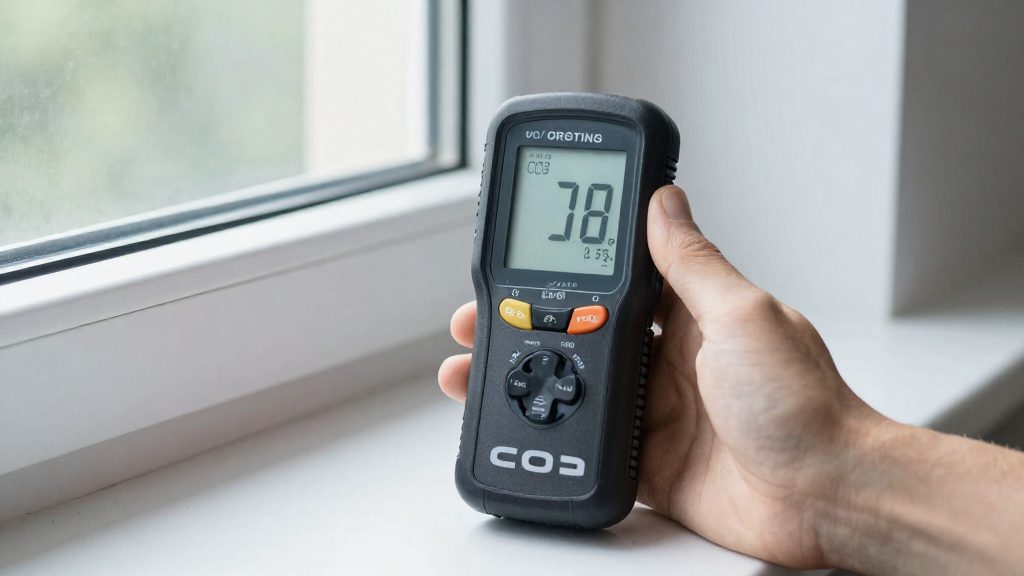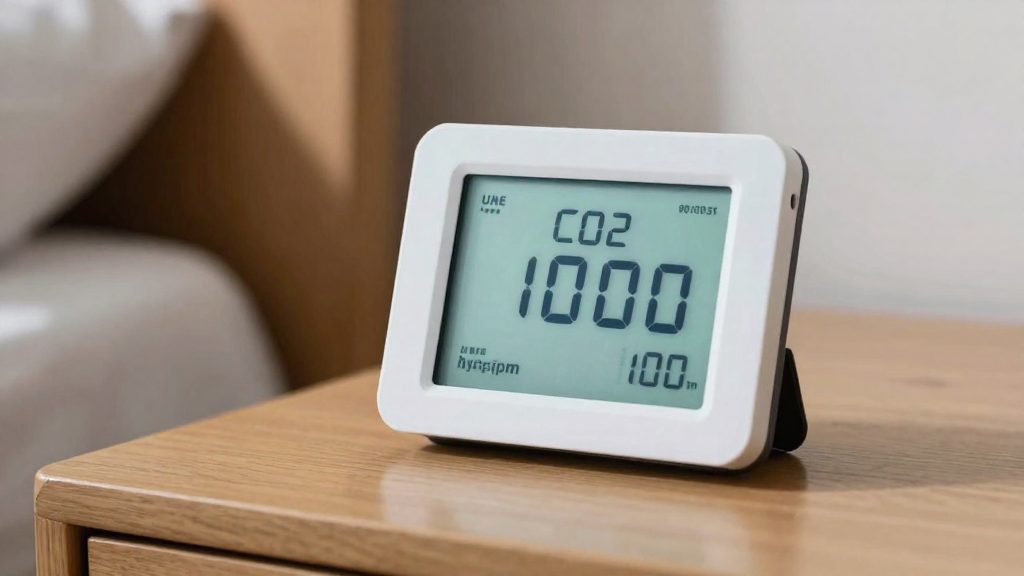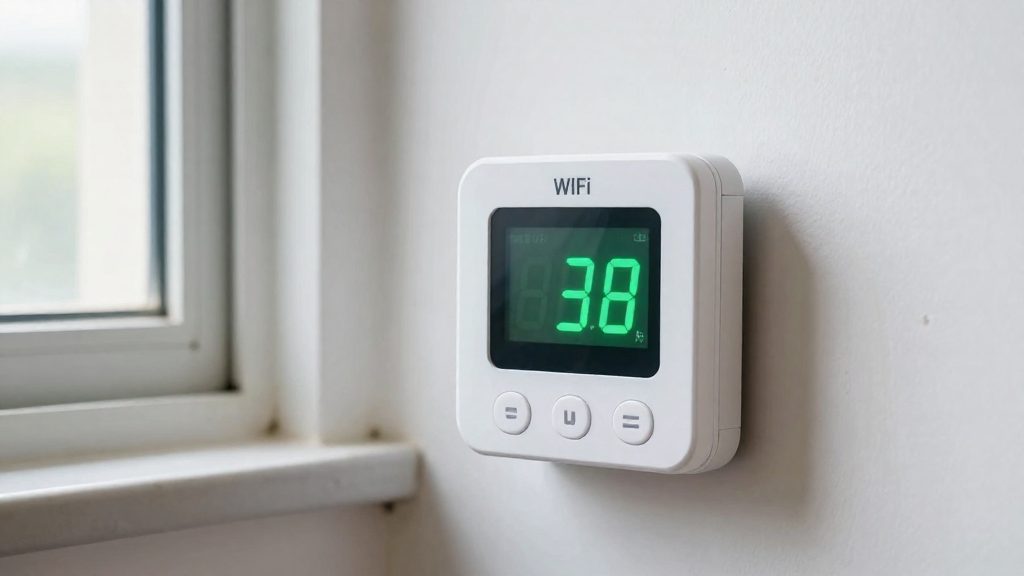
Measuring CO2 in a classroom shows whether the room is being ventilated enough. Health Canada sets a long-term indoor CO2 exposure limit of 1000 ppm (1800 µg/m³), averaged over 24 hours, and states that meeting it indicates adequate ventilation (Health Canada, 2021-03-19). A Wi-Fi CO2 monitor makes that indicator visible during the school day, so staff can act on measured levels instead of judging the room by how stuffy it feels.
Why measure CO2 in the classroom?
CO2 works as a practical proxy for ventilation, not as a direct health hazard at typical indoor levels. The INSPQ (2012-10-05) notes that concentrations above 1000 ppm signal insufficient ventilation and that CO2 is not considered dangerous for health at these levels. The same ventilation gap, however, can allow other pollutants to accumulate, which is why the reading matters.
| Reference | Value | Source |
|---|---|---|
| Long-term indoor exposure limit | 1000 ppm (1800 µg/m³), 24-hour average | Health Canada (2021-03-19) |
| Insufficient ventilation signal | Above 1000 ppm | INSPQ (2012-10-05) |
| Daycare study | 18 of 21 services (over 85%) averaged above 1000 ppm | INSPQ (2012-10-05) |
The INSPQ study also found that services with mechanical ventilation and more space per child had clearly lower concentrations. For a classroom, the study suggests that ventilation type and space per child are associated with lower CO2, and a monitor can help you assess both.
Health Canada advises opening windows when outdoor air quality is acceptable, after checking the AQHI, and using natural or mechanical ventilation while avoiding overcrowding (Health Canada, 2021-03-19).
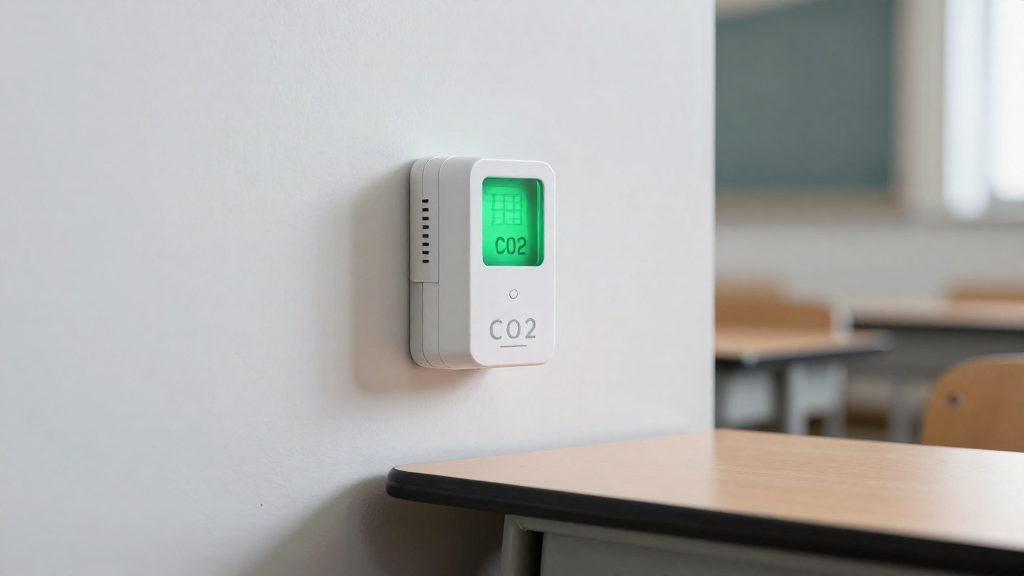
What CO2 threshold to target in a classroom in Canada?
The reference point for indoor CO2 in Canada is 1000 ppm. Health Canada sets a long-term exposure limit of 1000 ppm (1800 µg/m³), calculated as a 24-hour average, and states that meeting it indicates adequate ventilation (Health Canada, 2021). The INSPQ reads the same level as a ventilation signal: above 1000 ppm, the room is not being renewed enough (INSPQ, 2012).
| Reference | Value | Source |
|---|---|---|
| Long-term indoor exposure limit | 1000 ppm (1800 µg/m³), 24-hour average | Health Canada (2021) |
| Childcare services with mean CO2 above 1000 ppm | 18 of 21 (more than 85%) | INSPQ (2012) |
Why the 1000 ppm figure is a ventilation marker
CO2 is a proxy for how much air is exchanged with outdoors. At levels above 1000 ppm, the INSPQ does not consider CO2 itself dangerous to health. The concern is that insufficient ventilation can allow other pollutants to accumulate. A CO2 monitor therefore shows whether air is being renewed, not whether the air is clean in every other respect.
What the childcare study shows for classrooms
The INSPQ study of 21 Montreal daycare services found that 18 of them (more than 85%) had an average CO2 above 1000 ppm. Services with mechanical ventilation and more space per child had markedly lower concentrations. For a classroom, the two factors linked to lower CO2 are the ventilation type and occupancy density.
Practical steps to stay below 1000 ppm
- Because the Health Canada limit is a 24-hour average, a single short peak does not by itself mean the limit is exceeded. Track the trend over several days, and treat repeated or sustained readings above 1000 ppm as the signal to act on.
- When outdoor air quality is acceptable, open windows. Health Canada recommends checking the outdoor index (AQHI) before doing so.
- Combine natural ventilation with mechanical ventilation where available, and avoid overcrowding the room.
What does a high CO2 level mean?
A high CO2 reading on a classroom monitor is an indicator of insufficient ventilation, not a direct measure of danger. Health Canada sets a long-term indoor CO2 exposure limit of 1000 ppm (1800 µg/m³), averaged over 24 hours, and states that meeting this limit indicates adequate ventilation. The INSPQ (Quebec National Public Health Institute) reaches a similar conclusion: concentrations above 1000 ppm signal insufficient ventilation. At these levels, the INSPQ does not consider CO2 itself hazardous to health, but poor ventilation can allow other pollutants to accumulate.
| Reading | What it indicates | Source |
|---|---|---|
| 1000 ppm or below (1800 µg/m³, 24-hour average) | Meets the long-term exposure limit, indicating adequate ventilation | Health Canada (2021-03-19) |
| Above 1000 ppm | Insufficient ventilation; CO2 not considered hazardous at this level, but other pollutants may build up | INSPQ (2012-10-05) |
Interpreting a CO2 monitor correctly requires looking at trends rather than single readings. The Health Canada limit is a 24-hour average, and a school-day average is not that limit. A brief peak above 1000 ppm does not by itself establish that the limit has been exceeded, but it is still logged and read alongside the surrounding readings. Sustained readings above 1000 ppm are the pattern that points to insufficient ventilation (INSPQ, 2012-10-05).
The INSPQ study of childcare facilities found that 18 of 21 sites (more than 85%) had an average CO2 above 1000 ppm. Facilities with mechanical ventilation and more floor space per child had markedly lower concentrations, which suggests that ventilation design and space per child are associated with lower CO2.
Is a Wi-Fi CO2 monitor useful in a classroom?
Yes, as a ventilation indicator. CO2 concentration rises as occupants exhale in a closed room, so it shows whether enough outdoor air is reaching the space. Health Canada sets a long-term indoor exposure limit of 1000 ppm (1800 µg/m³), calculated as a 24-hour average, and states that meeting this limit indicates adequate ventilation (Health Canada, 2021). Because the limit is an average over 24 hours, a single short peak does not by itself establish a breach; it is still logged and compared with the readings around it.
Reading the thresholds
| Reference | Value | What it indicates |
|---|---|---|
| Health Canada long-term indoor limit | 1000 ppm (1800 µg/m³), 24-hour average | Adequate ventilation when respected |
| INSPQ (2012) | Above 1000 ppm | Insufficient ventilation |
According to INSPQ (2012), CO2 at these levels is not considered dangerous to health in itself. The concern is that insufficient ventilation can let other pollutants accumulate. A CO2 monitor therefore measures ventilation performance, not the toxicity of the air.
What the daycare data shows
In an INSPQ study, 18 of 21 daycare centres (more than 85%) had an average CO2 level above 1000 ppm. Centres with mechanical ventilation and more floor space per child had markedly lower concentrations (INSPQ, 2012). For classrooms, the study suggests that ventilation type and space per child are associated with lower CO2, and a monitor can reveal which rooms need attention.
Using a monitor in practice
- Log readings across the school day, not only at the start of a lesson, so that sustained patterns are visible. A school-day pattern is a ventilation indicator; it is not itself the 24-hour limit.
- Position the sensor away from direct draughts from open windows or supply vents, so the reading reflects the room air.
- Check the outdoor air quality (AQHI) before opening windows: Health Canada advises opening them only when outdoor air quality is acceptable.
- Where readings stay above 1000 ppm, act on ventilation (natural or mechanical) and on the number of occupants.
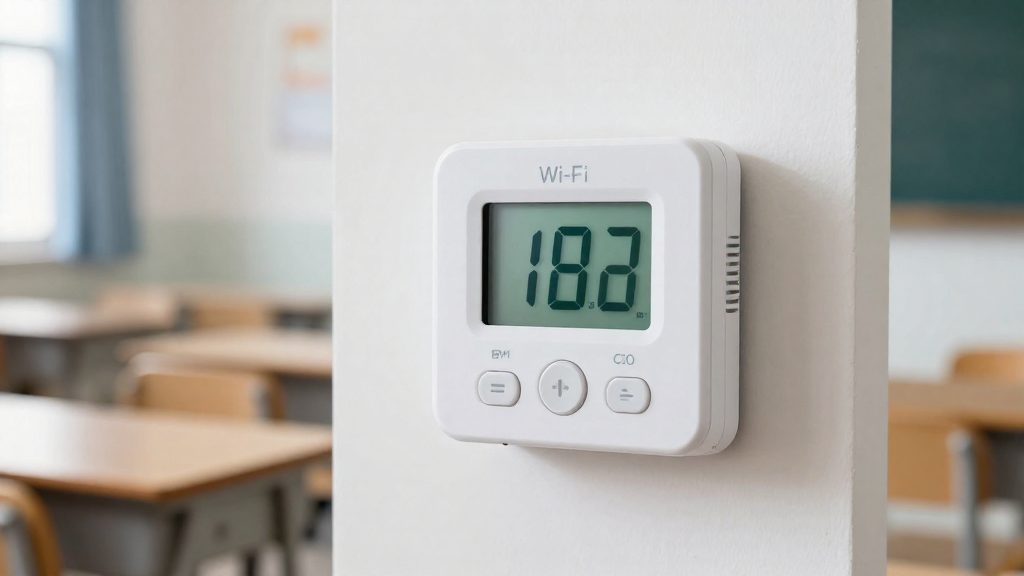
Criteria for choosing a CO2 monitor
A Wi-Fi CO2 monitor measures ventilation, not every indoor pollutant. Health Canada sets a long-term indoor CO2 exposure limit of 1000 ppm (1800 µg/m³), averaged over 24 hours, and states that meeting it indicates adequate ventilation (Health Canada, 2021). INSPQ (2012) notes that readings above 1000 ppm signal insufficient ventilation. At those levels CO2 itself is not considered dangerous, but poor ventilation can allow other pollutants to build up. A monitor is therefore an indicator of ventilation quality, and it should be chosen for that purpose.
Specifications to check
| Criterion | What to check | Why it matters |
|---|---|---|
| Unit | Readings displayed in ppm | Matches the 1000 ppm reference used by Health Canada and INSPQ |
| Data logging | Stored history or exportable data | The limit is a 24-hour average, so instant values alone are insufficient |
| Alert threshold | Adjustable, and settable to 1000 ppm | Flags periods when ventilation falls short |
| Sensor documentation | Stated accuracy and calibration method | Readings can only be compared across rooms if the device is calibrated |
| Wi-Fi connectivity | Remote dashboard or app access | Lets staff review several rooms without entering each one |
| Display | Readable from the teaching area | Students and teachers can act on a reading immediately |
Placement and interpretation
Place the monitor where it represents the occupied zone: away from open windows, supply vents and doors, which can produce readings that do not reflect the air students breathe. Compare readings across comparable rooms and across the school day, since the INSPQ study of 21 childcare services found that 18 of them (more than 85%) averaged above 1000 ppm. Services with mechanical ventilation and more floor space per child recorded markedly lower concentrations, which suggests that occupancy density and ventilation type should be recorded alongside each CO2 reading.
Where to place the sensor in the classroom (general guidance)
A CO2 monitor is only useful if it measures the air students actually breathe. Health Canada sets a long-term indoor CO2 exposure limit of 1000 ppm (1800 µg/m³), calculated as a 24-hour average, and states that meeting it indicates adequate ventilation (Health Canada, 2021-03-19). That comparison is valid only if the sensor represents the room’s occupied zone, the area where pupils sit for most of the day.
Choosing a representative spot
- Place the device at seated breathing height in the occupied zone, not on a high shelf or in a corner where air stagnates.
- Keep it away from open windows and supply vents. A local draught brings in fresh air and produces a reading lower than the room’s average.
- Avoid positions beside a single fixed occupant, such as the teacher’s desk, because the reading would reflect one person’s exhaled air more than the whole class.
- Stay clear of direct heat sources and the door, where air mixes with the corridor and changes quickly.
Use the room layout and the seated-height principle as the guide.
Turning readings into action
The INSPQ (2012-10-05) states that concentrations above 1000 ppm signal insufficient ventilation. At these levels CO2 is not considered dangerous to health in itself, but poor ventilation can let other pollutants accumulate. In the INSPQ’s study of daycare services, 18 of 21 services (more than 85%) had an average above 1000 ppm. Those with mechanical ventilation and more space per child had clearly lower concentrations.
| Reading pattern | Meaning | Response |
|---|---|---|
| Sustained readings at or below 1000 ppm | Consistent with adequate ventilation (Health Canada, 2021-03-19) | Keep current ventilation routine |
| Sustained readings above 1000 ppm | Signals insufficient ventilation (INSPQ, 2012-10-05) | Open windows if outdoor air quality is acceptable (check AQHI), use natural or mechanical ventilation, and reduce overcrowding |
How to improve air when CO2 rises
According to INSPQ (2012-10-05), CO2 concentrations above 1000 ppm indicate insufficient ventilation. At these levels CO2 is not considered dangerous to health, but poor ventilation can let other pollutants accumulate. Health Canada sets a long-term indoor CO2 exposure limit of 1000 ppm (1800 µg/m³), averaged over 24 hours, and states that meeting it indicates adequate ventilation (Health Canada, 2021-03-19). When a monitor reads above this level, the corrective step is to increase fresh air exchange and reduce occupancy.
Actions recommended by Health Canada
Health Canada (2021-03-19) recommends the following measures:
| Action | Condition or detail |
|---|---|
| Open windows | Only when outdoor air quality is acceptable; check the AQHI or COVQA index first |
| Use natural or mechanical ventilation | Applies to any enclosed occupied space |
| Avoid overcrowding | Reduces the number of people sharing the same air |
What the INSPQ study shows about classrooms
In an INSPQ study, 18 of 21 childcare centres (more than 85%) had an average CO2 concentration above 1000 ppm. Centres with mechanical ventilation and more space per child had markedly lower concentrations (INSPQ, 2012-10-05). For a classroom, a high reading signals insufficient ventilation; the daycare study suggests that ventilation type and space per child are associated with lower levels. The INSPQ study links mechanical ventilation and more space per child to lower concentrations, which is an association, not proof of cause. Health Canada recommends opening windows when outdoor air quality is acceptable, using natural or mechanical ventilation and avoiding overcrowding.
Frequently asked questions
Is 1000 ppm a classroom-specific CO2 limit in Canada?
Health Canada’s 1000 ppm figure is a long-term indoor limit, measured as a 24-hour average, in residential guidance (Health Canada, 2021-03-19), so school or provincial requirements may differ.
Does a short spike above 1000 ppm mean the room is unsafe?
Not by itself. The 1000 ppm limit is defined over 24 hours, so a brief peak does not establish that it was exceeded. According to the INSPQ (2012-10-05), readings above 1000 ppm point to insufficient ventilation, which is why repeated high readings are the more useful signal.
Can a CO2 monitor tell me whether the ventilation system or class size is the cause?
No. A CO2 monitor reports the concentration of CO2 in the room, not the type of ventilation or the space per pupil, which must be recorded separately. The INSPQ (2012-10-05) study found that mechanical ventilation and more space per child were linked to lower levels in Montreal daycares, which is an association rather than proof of cause.