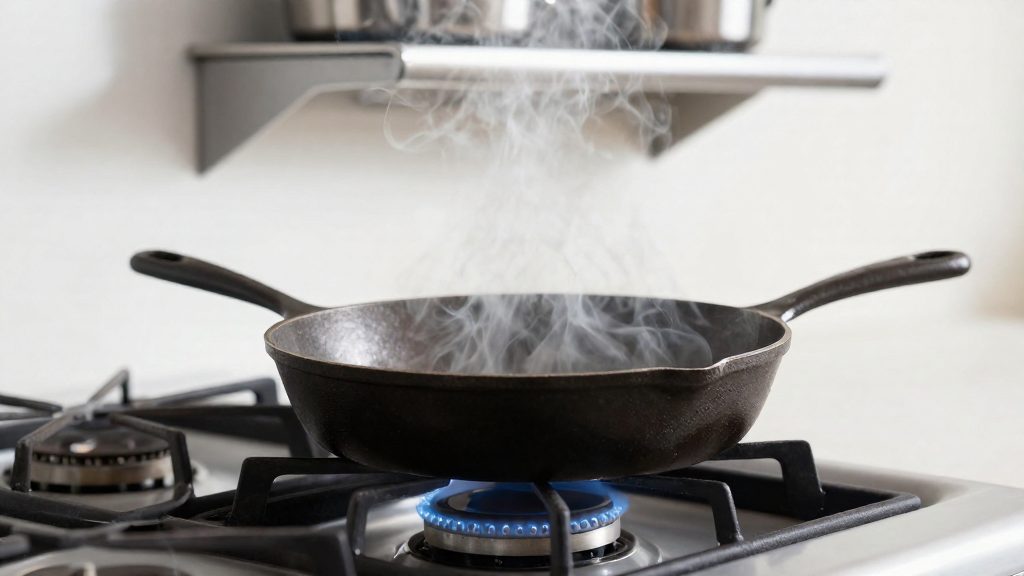
Cooking releases airborne pollutants and moisture into the same room you breathe. According to Health Canada (2021-01-12), cooking produces particulate matter from frying, roasting, broiling and toasting, nitrogen dioxide and carbon monoxide, the last two mainly from gas stoves, and water vapour that can lead to mould growth. A Health Canada study found that particulate matter levels can reach 65 times background levels after cooking.
What do cooking fumes contain?
Cooking fumes are a mixture of combustion gases, food-derived particles and steam. Each component comes from a different process and behaves differently indoors.
| Component | Main source in cooking | Documented indoor point (Health Canada, 2021-01-12) |
|---|---|---|
| Particulate matter | Frying, roasting, broiling, toasting | Levels can reach 65 times background after cooking (Health Canada study) |
| Nitrogen dioxide | Mainly gas stoves | Listed as a cooking pollutant |
| Carbon monoxide | Mainly gas stoves | Health Canada advises installing at least one CO alarm |
| Water vapour | Cooking in general | Can lead to mould growth |
Health Canada links particulate matter to frying, roasting, broiling and toasting.
Gas stoves are the main documented source of nitrogen dioxide and carbon monoxide.
Water vapour is the link between cooking and moisture problems. Because it is released into the same air as the other pollutants, cooking adds both particles and humidity to the room, and the humidity can support mould growth.
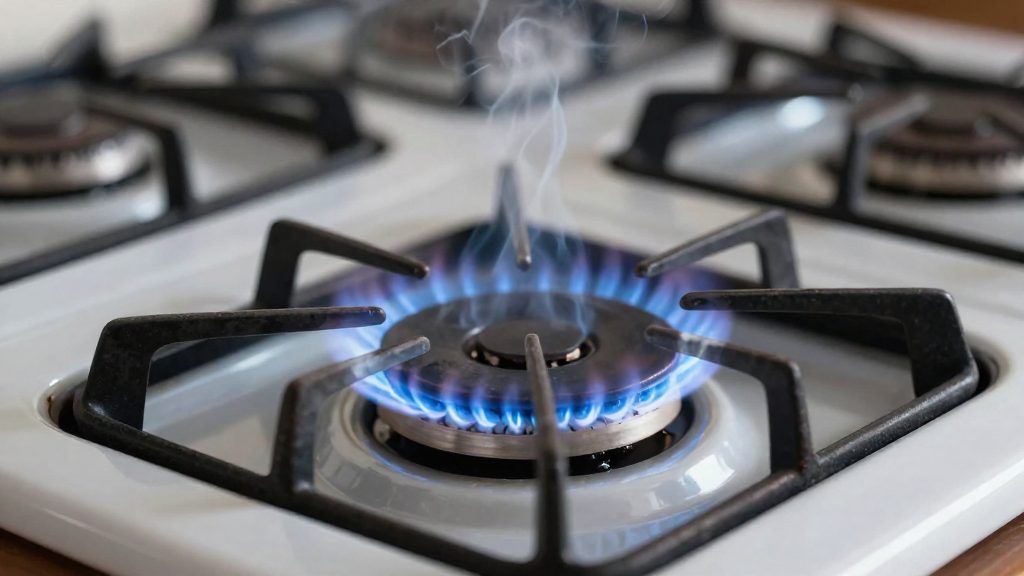
Why does cooking increase humidity and mould?
Cooking adds water vapour to indoor air, and Health Canada (2021) identifies that vapour as something that can lead to mould growth. The same activity also releases pollutants, so one kitchen session raises moisture and contaminant levels together, and ventilation is the main way to clear both.
What cooking releases
- Water vapour: released during cooking and able to lead to mould when it accumulates indoors.
- Particulate matter: produced by frying, roasting, broiling and toasting.
- Nitrogen dioxide and carbon monoxide: produced mainly by gas stoves.
According to Health Canada (2021), particulate matter levels can reach 65 times background levels after cooking. Health Canada therefore recommends running the range hood on high while cooking.
Using the range hood
Health Canada (2021) reports that running a range hood on high, at 300 cfm, can cut exposure to cooking pollutants by more than 80% compared with slower speeds. Its guidance also recommends choosing a hood that fully covers the burners. If a home has no hood, Health Canada recommends installing one.
Supporting measures
| Measure | Source |
|---|---|
| Use the back burners where possible | Health Canada (2021) |
| Open a nearby window | Health Canada (2021) |
| Run the furnace or ventilation fan | Health Canada (2021) |
Gas stoves: pollutants and recommended measures
Cooking indoors releases several pollutants, and a gas stove adds combustion gases to the mix. According to Health Canada (2021-01-12), cooking produces particulate matter from frying, roasting, broiling and toasting, along with nitrogen dioxide and carbon monoxide, which come mainly from gas stoves. Cooking also releases water vapour, which can lead to mould growth. Capturing these emissions at the source is the most direct way to limit exposure.
Pollutants released during cooking
| Pollutant or byproduct | Main source | Indoor air concern |
|---|---|---|
| Particulate matter | Frying, roasting, broiling, toasting | Health Canada study: levels can reach 65 times background levels after cooking |
| Nitrogen dioxide | Mainly gas stoves | Named by Health Canada as a cooking pollutant |
| Carbon monoxide | Mainly gas stoves | Named by Health Canada as a cooking pollutant |
| Water vapour | Cooking | Can lead to mould growth |
Ventilation settings that reduce exposure
Health Canada (2021-01-12) recommends the following measures:
- Run the range hood on high. At 300 cfm, running the hood on high can cut exposure to cooking pollutants by more than 80% compared with slower speeds.
- Choose a hood that fully covers the burners. Health Canada recommends this to improve capture.
- Use the back burners where possible.
- Open a nearby window and run the furnace or ventilation fan.
- If there is no hood, install one.
Carbon monoxide alarms
Health Canada advises installing at least one carbon monoxide alarm. Check the manufacturer’s instructions for placement and testing intervals.
Is a Range Hood Really Effective?
A range hood is one of the most effective tools for reducing cooking pollution, but only when it is used correctly. According to Health Canada (2021-01-12), running a range hood on high, at 300 cfm, can cut exposure to cooking pollutants by more than 80% compared with slower speeds. Cooking releases particulate matter, nitrogen dioxide, carbon monoxide and water vapour, and the hood’s capture rate depends largely on the fan setting and how well the hood covers the cooking surface.
Why Fan Speed Matters
The fan setting has the largest effect on performance. The 80% reduction cited by Health Canada applies to high speed compared with lower settings, so a hood left on a low setting captures far less of the pollution it is meant to remove.
| Parameter | Value | Context (Health Canada, 2021-01-12) |
|---|---|---|
| Fan airflow on high | 300 cfm | Reference setting for the exposure reduction |
| Exposure reduction | More than 80% | Compared with slower speeds |
| Particulate matter after cooking | Up to 65 times background levels | Measured in a Health Canada study |
Coverage and Placement
Health Canada recommends a hood that fully covers the burners. Health Canada recommends a hood that fully covers the burners. Check the hood manufacturer’s specifications for dimensions and capture distance.
Supporting Ventilation
A hood works best as part of a wider ventilation strategy. Health Canada advises opening a nearby window and running the furnace or ventilation fan to bring in fresh air and dilute what the hood does not capture. Homes without a hood should have one installed. Because gas stoves produce carbon monoxide, Health Canada also advises installing at least one CO alarm.
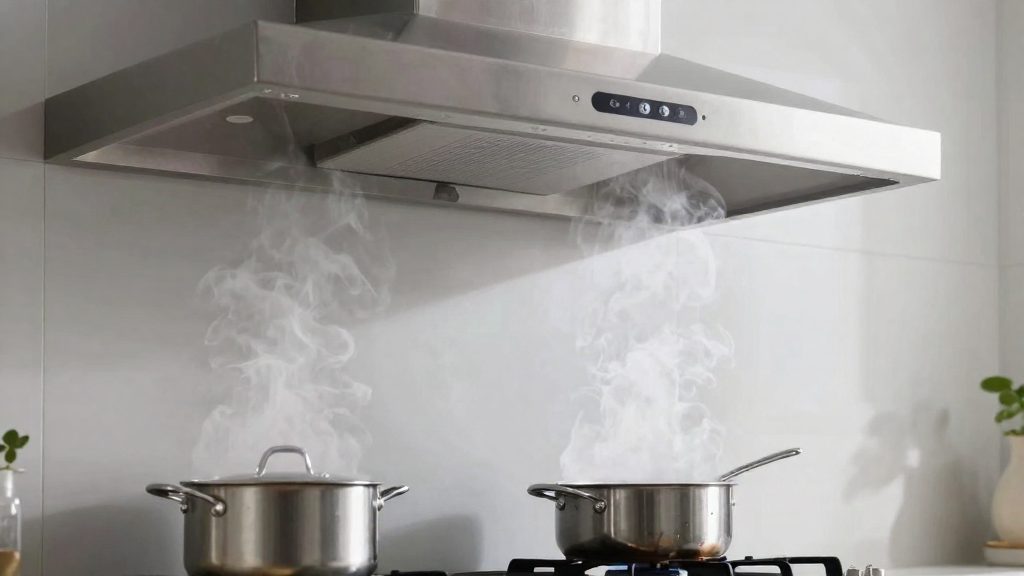
Range hood settings: fan speed, coverage and supporting ventilation
Range hoods are the most direct control point for cooking pollutants. Health Canada (2021-01-12) identifies particulate matter from frying, roasting, broiling and toasting, nitrogen dioxide and carbon monoxide (mainly from gas stoves), and water vapour that can lead to mould growth. The settings with a quantified effect are fan speed, burner coverage and supporting ventilation.
Fan speed
| Metric | Value | Context |
|---|---|---|
| Particulate matter after cooking | Up to 65 times background levels | Health Canada study, cited by Health Canada (2021-01-12) |
| Hood fan on high (300 cfm) | More than 80% lower exposure to cooking pollutants | Compared with slower speeds, per Health Canada (2021-01-12) |
Running the fan on high is the only fan setting with a quantified effect in the Health Canada guidance: it can cut exposure to cooking pollutants by more than 80% compared with slower speeds. For intermediate speeds, check the hood manufacturer’s specifications.
Hood coverage and burner choice
Health Canada recommends a hood that fully covers the burners. The same guidance recommends using the back burners where possible. Check the hood manufacturer’s specifications for minimum dimensions.
Supporting ventilation
If the kitchen has no hood, Health Canada recommends installing one. Opening a nearby window and running the furnace or a ventilation fan add air exchange, which dilutes pollutants that the hood does not capture (Health Canada, 2021-01-12).
Carbon monoxide safeguards
Gas stoves produce carbon monoxide, so the hood does not replace detection. Health Canada advises installing at least one carbon monoxide alarm (Health Canada, 2021-01-12).
How do ventilation and windows complement the range hood?
A range hood captures smoke and vapour at the cooktop, but it does not remove everything that cooking releases. Health Canada (2021-01-12) lists particulate matter from frying, roasting, broiling and toasting, nitrogen dioxide and carbon monoxide (mainly from gas stoves), and water vapour that can lead to mould growth. Pollutants that escape the hood’s capture zone spread through the rest of the home, so whole-room ventilation is the second layer of control.
| Measure | Health Canada recommendation (2021-01-12) | Cooking pollutant it addresses |
|---|---|---|
| Furnace or ventilation fan | Run it while cooking | Cooking pollutants in general |
| Nearby window | Open it | Cooking pollutants in general |
| Range hood (if absent) | Install one | Cooking pollutants in general |
Running the ventilation system
Health Canada recommends running the furnace or ventilation fan while cooking. This moves air out of the kitchen and through the rest of the building. Health Canada recommends running the furnace or ventilation fan while cooking.
Opening a nearby window
Opening a window close to the cooking area gives the extracted air a route outdoors and lets fresh air replace it. This is a supplement to the hood, not a substitute: the source recommends it alongside, not instead of, running the hood fan on high.
Carbon monoxide detection
Ventilation reduces pollutant levels but cannot detect a problem. Health Canada advises installing at least one CO alarm, because carbon monoxide is produced mainly by gas stoves.
CO2, PM2.5 and CO Sensors: What to Monitor
Cooking releases several pollutant groups, and each needs a different measurement. Health Canada (2021) identifies particulate matter from frying, roasting, broiling and toasting, nitrogen dioxide and carbon monoxide (mainly from gas stoves), and water vapour that can lead to mould growth. Each pollutant calls for a different type of monitor.
| Pollutant | Main cooking source (Health Canada, 2021) | Suitable monitor |
|---|---|---|
| Fine particulate matter (PM2.5) | Frying, roasting, broiling, toasting | PM2.5 monitor |
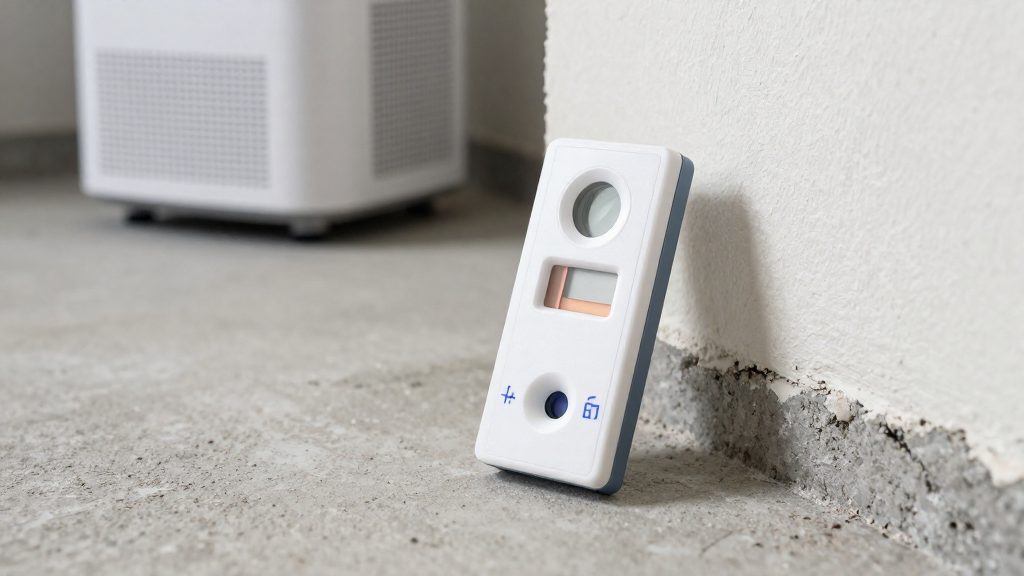
| Carbon monoxide (CO) | Mainly gas stoves | CO alarm |
| Nitrogen dioxide (NO2) | Mainly gas stoves | NO2 sensor |
| Water vapour | Cooking, with mould risk | Hygrometer (relative humidity) |
PM2.5: measure the peak, not the average
Particulate matter is the pollutant with the largest short-term swing. Health Canada (2021) reports that levels can reach 65 times background levels after cooking. Record a baseline before cooking, then log readings during and after. The peak height and the time needed to return to baseline can give an indication of how well the range hood works. Place the PM2.5 monitor following the manufacturer’s instructions.
CO: an alarm is a separate safety device
Carbon monoxide from gas stoves is a safety hazard rather than a comfort issue. Health Canada advises installing at least one CO alarm. Place it according to the manufacturer’s instructions. If it sounds, leave the home immediately and call 911 or your local emergency number; do not go back in until it has been declared safe.
CO2 and humidity: indirect indicators
Treat a CO2 sensor as a general indicator of how well a room is ventilated. For water vapour, a hygrometer shows how long relative humidity stays high after cooking. Persistently high readings show that humidity stays high after cooking, and Health Canada notes that water vapour can lead to mould growth.
Frequently asked questions
Do cooking fumes affect the air I breathe indoors?
Yes. Frying, roasting, broiling and toasting release particulate matter, and gas stoves add nitrogen dioxide and carbon monoxide. Water vapour from cooking can also support mould growth, according to Health Canada (2021-01-12).
Does the fan speed on my range hood make a difference?
It does. According to Health Canada (2021-01-12), running a range hood on high (300 cfm) can cut exposure to cooking pollutants by more than 80% compared with slower speeds. The hood should also fully cover the burners, so choose one that spans the whole cooktop.
Do I need a carbon monoxide alarm if I cook on gas?
Health Canada advises installing at least one carbon monoxide alarm, and it does not limit this advice to homes with gas cooking (Health Canada, 2021-01-12). Gas stoves are the main documented source of carbon monoxide in the kitchen.