Radon is a naturally occurring radioactive gas that rises from soil and rock into buildings. Health Canada identifies it as the number one cause of lung cancer among non-smokers (Health Canada, 2025). Radon has no smell, colour or taste, so the health risk gives no warning. A measurement is the only way to find out whether a Canadian home has a dangerous level, and the basement is usually the first place to check.
Why test for radon in a Canadian basement?
Radon is the #1 cause of lung cancer for non-smokers, according to Health Canada (2025). Because exposure produces no symptoms at the time, a test is the only practical way to identify a problem.
Basements concentrate exposure for several reasons:
- Direct ground contact: The basement floor and walls sit against soil, which is the source of the gas.
- Foundation openings: Radon enters through cracks in concrete slabs and walls, joints between the slab and the walls, and gaps around pipes, drains and sump pits.
- Air movement: - Air movement: Warm indoor air rises and escapes through the upper levels. This lowers the pressure in the basement relative to the surrounding soil and can draw soil gas in through these openings. The effect is generally strongest in cold weather, when the indoor-outdoor temperature difference is greatest.
- Proximity: The lowest level is closest to the source, so its air typically holds higher concentrations than upper floors.
The only reliable way to know the level in a particular basement is to measure it.
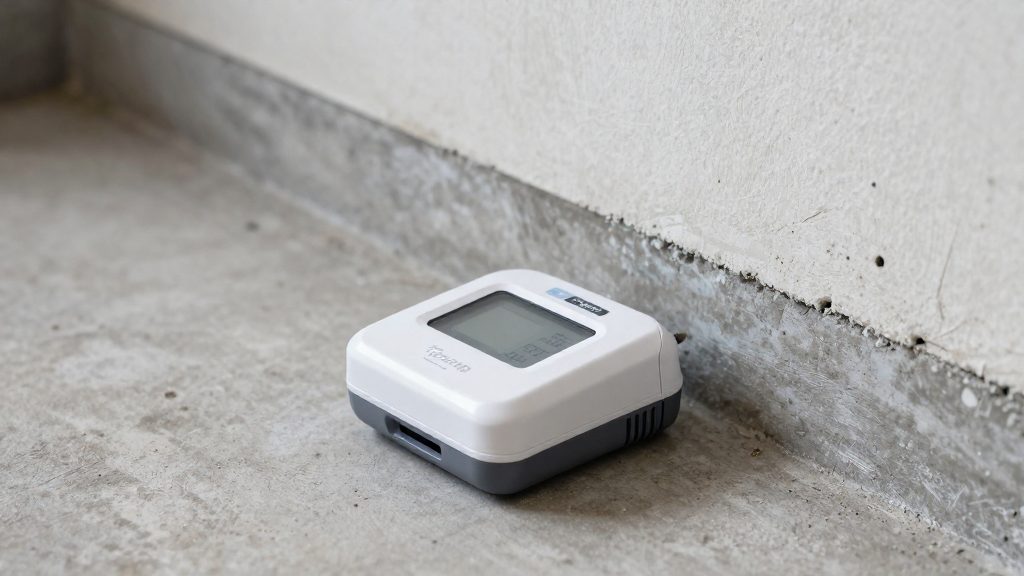
What does the 200 Bq/m³ guideline mean?
The Canadian radon guideline is 200 Bq/m³, and it applies to an annual average, not to a single measurement. Health Canada advises corrective action when the average level over a year exceeds this value. A single reading is a snapshot taken over a short period, and radon concentrations change with season, weather and how a home is ventilated. A reading above 200 Bq/m³ taken during one short window therefore does not, on its own, establish that the annual average exceeds the guideline. The guideline is a comparison against a yearly average, which is why results must be gathered over a longer period before they are interpreted.
The guideline is also expressed in becquerels per cubic metre, but many North American test kits and reports use picocuries per litre (pCi/L). The conversion is fixed:
| Unit | Equivalent |
|---|---|
| 1 pCi/L | 37 Bq/m³ |
| 200 Bq/m³ | about 5.4 pCi/L (200 ÷ 37) |
To convert a result from pCi/L to Bq/m³, multiply by 37. To convert from Bq/m³ to pCi/L, divide by 37. Mixing the two units without converting is a common source of error, because a reading of 5 pCi/L is a different number from 5 Bq/m³ and falls on a very different scale.
Why 200 Bq/m³ triggers corrective action
Health Canada sets 200 Bq/m³ as the level above which it advises corrective action. What the guideline establishes in practice is a decision point: an annual average at or below 200 Bq/m³ does not trigger the advice, and an average above it does. The health reasoning behind radon exposure is covered in the section on lung cancer risk.
How long should a radon test run?
A valid long-term radon test in a Canadian basement must run at least 91 days, with at least 91 days falling in the heating season. Health Canada recommends a monitoring period of 3 to 12 months to estimate the annual average, which is the figure compared against the 200 Bq/m³ guideline (Health Canada, 2026-05-22).
| Requirement | Value | Purpose |
|---|---|---|
| Minimum validity, long-term test | 91 days | Shortest period accepted for mitigation decisions |
| Recommended monitoring period | 3 to 12 months | Estimates the annual average |
| Days within the heating season | At least 91 | Prevents underestimating the annual average |
Minimum validity
The 91-day minimum is the threshold that separates usable results from screening readings. Tests shorter than 91 days, including short-term passive devices and short-term electronic monitor readings, are not appropriate for mitigation decisions (Health Canada, 2026-05-22). A short reading can indicate that a deeper test is worth running, but it cannot justify installing or skipping a mitigation system on its own.
Heating-season coverage
The heating-season requirement is separate from total duration. At least 91 days of the test should fall in the heating season. Health Canada notes that fewer heating-season days may underestimate the annual average and may require a re-test (Health Canada, 2026-05-22). A test of exactly 91 days therefore has to fall entirely within the heating season, and a longer test needs at least 91 heating-season days, so plan the start date around the heating months.
Choosing a total duration
A 3-month long-term kit meets the minimum only if it runs at least 91 days, and all of those days must fall in the heating season to satisfy the heating-season requirement. Extending monitoring toward 12 months gives a fuller estimate of the annual average. Extending monitoring toward 12 months within the recommended range gives a fuller estimate of the annual average, while the heating-season rule still applies to whichever period is chosen.
Where to place the detector in the basement
In a basement, the test location depends on how the space is used, not on the floor name alone. According to Health Canada (2026), the detector belongs on the lowest lived-in level, which is the lowest floor where someone spends 4 or more hours a day. If the basement meets that threshold, it is the test site. If it is used only for storage or is rarely occupied, the test moves up to the lowest floor where someone spends 4 or more hours a day.
Choosing the room
Within that level, the device should sit in a normal occupancy area. Health Canada names three:
| Room type | Eligible? |
|---|---|
| Bedroom | Yes |
| Living room | Yes |
| Office | Yes |
| Kitchen | No, excluded |
| Laundry room | No, excluded |
| Bathroom | No, excluded |
When the basement contains several rooms, the choice is between the eligible rooms only. A finished basement with a home office and a laundry room, for example, leaves the office as the candidate.
Decision sequence
- List the floors of the home, including the basement.
- For each floor, check whether someone spends 4 or more hours a day there.
- Select the lowest floor that passes this check.
- Within that floor, pick a bedroom, living room or office.
- If the basement passes the check, test there.
Follow the instructions supplied with your test kit for positioning the device within the chosen room.
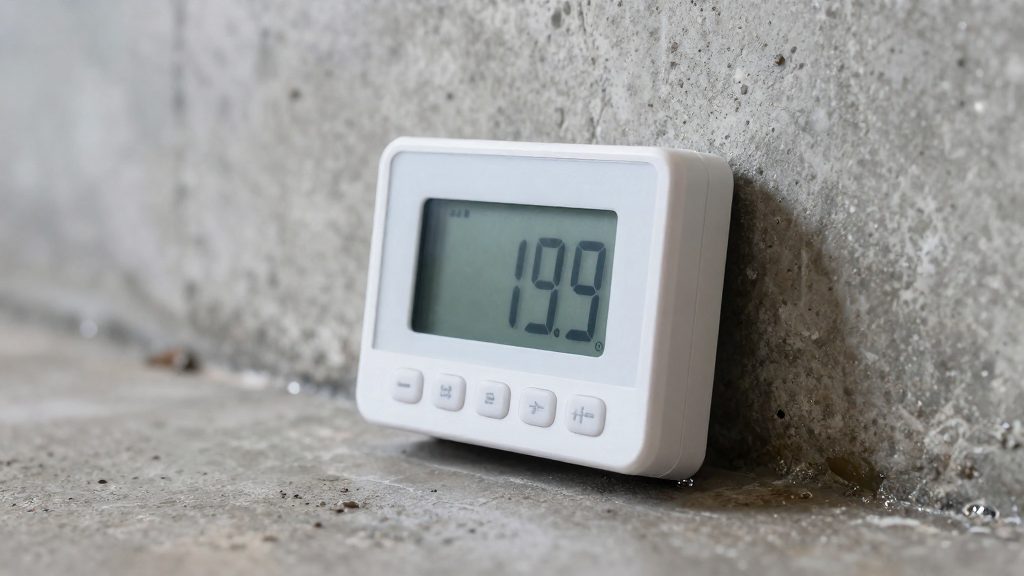
Short-term or long-term test: which to trust?
Short-term and long-term radon tests both measure radon, but only one of them can support a decision about mitigation.
Passive short-term devices and electronic monitors compared
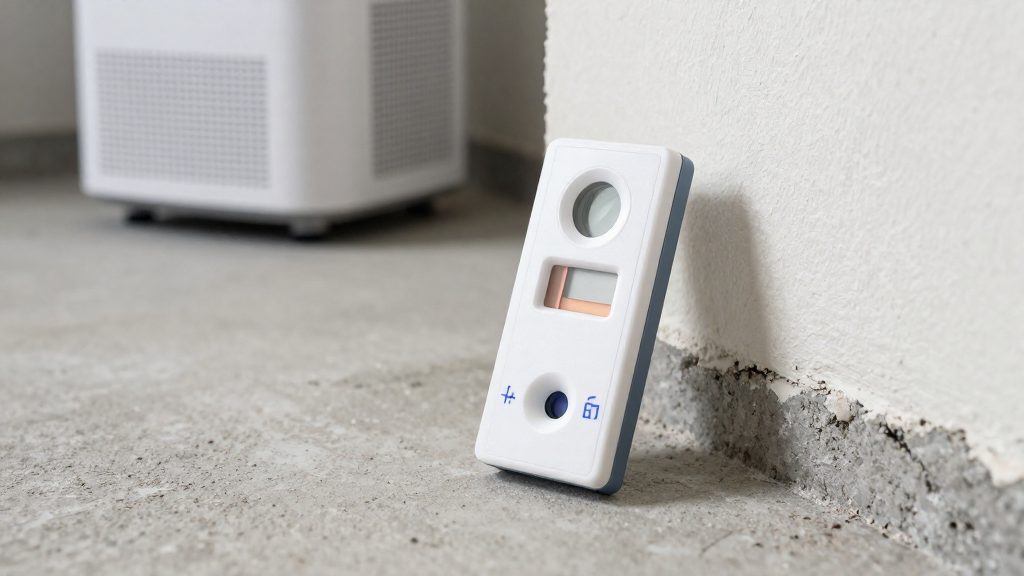
Two types of short-term tools are commonly used in homes. Passive devices collect radon without power and are then sent for analysis. Electronic monitors record levels continuously and display readings during the test. The difference between them matters less than their duration.
| Test type | Duration | Suitable for mitigation decision |
|---|---|---|
| Short-term passive device | Shorter than 91 days | No |
| Short-term electronic monitor reading | Shorter than 91 days | No |
| Long-term (3-month) kit | At least 91 days | Yes |
Why short-term readings cannot support mitigation decisions
A short-term reading captures one window of time. An electronic monitor can display a high or low number at any moment, but that instantaneous figure is not the measure the guideline uses.
The three-month long-term kit as the most accurate option
Health Canada (2025) describes the long-term (3-month) test kit as the most accurate way to check for a dangerous level. It is the option that produces a result the guideline can be applied to. Health Canada recommends a test period of 3 to 12 months to estimate the annual average, and the shortest valid test is 91 days, with at least 91 days in the heating season. Once a valid long-term result exceeds 200 Bq/m³, Health Canada (2025) advises hiring a certified radon mitigation professional.
What to do if the result is above 200 Bq/m³
A result above the 200 Bq/m³ Canadian guideline means corrective action is advised. Health Canada (2025-12-22) recommends hiring a certified radon mitigation professional rather than attempting a fix yourself. The process has four stages: hiring the professional, installing a mitigation system, re-testing to confirm the system works, and re-testing on a fixed schedule afterward.
| Step | Action | Source and detail |
|---|---|---|
| 1 | Hire a certified radon mitigation professional | Health Canada (2025-12-22) advises this for results above 200 Bq/m³ |
| 2 | Install a mitigation system, such as active soil depressurization | Health Canada (2025-12-22): installation can take less than a day |
| 3 | Re-test after installation | Health Canada (2026-05-22) advises this to confirm the system works |
| 4 | Re-test every 5 years | Health Canada (2026-05-22) applies this to homes with active systems |
Hiring a certified professional
Ask any contractor for proof of radon mitigation certification before work begins. A certified professional can assess the building and recommend a system suited to its construction. Compare written quotes directly.
Active soil depressurization
Active soil depressurization is an active mitigation method: a fan draws soil gas from beneath the floor and vents it outside, which lowers the pressure under the slab and limits radon entry into the basement. Health Canada (2025-12-22) reports that a mitigation system reduces radon levels by more than 80% in most homes. That figure describes typical outcomes, not a guarantee for a specific house.
Re-testing and the five-year schedule
Re-test after installation to confirm the system is working. Health Canada (2026-05-22) recommends re-testing homes with active mitigation systems every 5 years after that. If the basement is lived in, test there, in a normal occupancy area such as a bedroom, living room or office.
Radon, humidity and ventilation: what is the link?
Radon is a colourless, odourless gas that rises from the soil under a building. How much of it enters depends mainly on pressure differences and on the openings in the foundation. The conditions below matter because they change how much soil gas reaches the living space.
Stack effect draws soil gas into basements
Warm indoor air rises and leaks out through upper floors and the attic. The house replaces that air through its lowest openings, which is known as stack effect. In a heated home during cold weather, the basement can be at slightly lower pressure than the surrounding soil, which can draw soil gas in. The effect grows with the temperature difference between indoors and outdoors and weakens in mild weather.
Ventilation dilutes radon, and the role of mechanical ventilation
Ventilation lowers indoor radon by replacing indoor air with outdoor air, which reduces the concentration. A mechanical ventilation system (such as an HRV or ERV) controls this exchange, but it does not remove gas from the soil. It dilutes what enters, and its airflow balance can also change how much soil gas is drawn in.
An imbalanced system can make the problem worse. An exhaust-dominant mechanical ventilation system or extractor fan removes more air than it supplies, which increases the negative pressure in the basement and pulls in more soil gas. Balanced systems, such as HRV or ERV units, keep supply and exhaust closer together, but only a radon test can show whether the level is acceptable.
Moisture and entry paths through foundation cracks
Only a measurement can show the level in a given basement.
Humidity control and radon control are separate tasks. A dehumidifier removes water vapour from the air, but it does not remove radon. Sealing foundation openings can limit some entry paths, but it does not replace a long-term test, and above 200 Bq/m³ Health Canada advises hiring a certified radon mitigation professional.
Frequently asked questions
Which room should I test if my basement is used as living space?
Test on the lowest lived-in level, meaning the lowest floor where someone spends at least 4 hours a day. If the basement qualifies, place the detector in a regular occupancy area such as a bedroom, living room or office. Kitchens, laundry rooms and bathrooms are excluded from the measurement, according to Health Canada (2026).
How long must a radon test run before the result is reliable?
A valid long-term test runs at least 91 days, and Health Canada recommends 3 to 12 months to estimate the annual average. At least 91 days of the test should fall in the heating season, because a shorter heating period can underestimate the annual average and may require a re-test. Short-term passive devices and short-term electronic readings are not suitable for mitigation decisions, according to Health Canada (2026).
What should I do after a radon mitigation system is installed?
Re-test after installation to confirm the system is lowering the concentration. Homes using active soil depressurization should repeat the test every 5 years, according to Health Canada (2026).