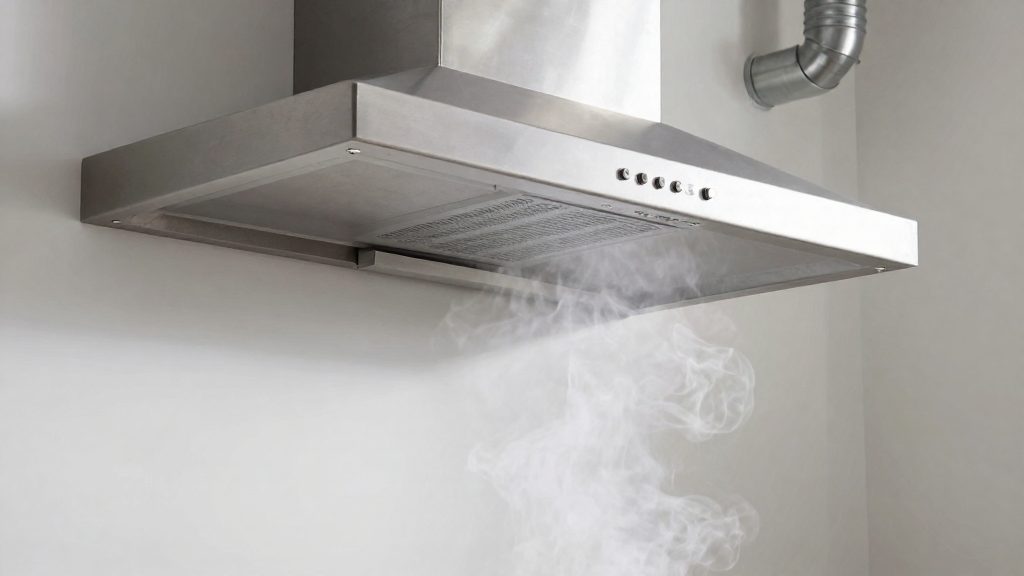
It depends on the hood and the code that applies. In Canada, section 9.32 of the National Building Code of Canada (NBC) 2015 requires makeup air to counteract the effects of exhaust systems, particularly in homes with high-capacity range hoods, according to Fantech (2024). The official sources consulted do not specify an NBC airflow threshold above which makeup air becomes mandatory. Provincial codes, such as the Ontario Building Code, may add requirements beyond the NBC, so the local building authority determines the final obligation for a given project.
Why exhaust without makeup air creates negative pressure
Why Exhaust Creates Negative Pressure
A range hood that exhausts more air than the home can replace produces negative pressure indoors. Fantech (2024) links this condition to three problems:
- Back-drafting of combustion appliances, where exhaust gases can be drawn back into the living space instead of venting outdoors.
- Infiltration of outdoor pollutants through gaps in the building envelope.
- Temperature and humidity imbalances across the home.
How to Check Whether Your Project Needs Makeup Air
- Ask the local building authority which code applies, including any provincial requirements added to the NBC.
- Check the hood’s rated exhaust capacity with the manufacturer or installer, and ask whether that capacity triggers a makeup air requirement under local code.
- List every combustion appliance in the home, such as a gas furnace, water heater, or fireplace, before choosing the hood.
- Confirm the makeup air solution with the installer before the permit is closed, so the requirement is resolved during construction rather than after installation.
What the National Building Code says
The National Building Code of Canada (NBC) 2015 addresses makeup air in Section 9.32, which requires makeup air to counteract the effects of exhaust systems. According to Fantech (2024), this requirement is particularly relevant in homes with high-capacity range hoods, since a powerful hood removes indoor air faster than the rest of the building can replace it. The official sources consulted do not specify an NBC airflow threshold above which makeup air becomes mandatory, so the need for it has to be judged from the hood’s rated airflow and the home’s construction rather than from a fixed number.
Why exhaust without makeup air matters
When a range hood exhausts air with no replacement source, the house can enter negative pressure. According to Fantech (2024), this condition can produce the following effects:
| Effect | What happens in the home |
|---|---|
| Back-drafting | Combustion gases from fuel-burning appliances can be drawn back into the living space instead of venting outdoors |
| Infiltration of outdoor pollutants | Unfiltered outdoor air enters through leaks and gaps in the building envelope |
| Temperature and humidity imbalances | Uncontrolled incoming air shifts indoor temperature and moisture levels |
Checking a home before installing a hood
- Identify every fuel-burning appliance, such as a gas furnace, water heater, fireplace, or gas range, since these are the appliances exposed to back-drafting.
- Read the hood’s rated airflow from the manufacturer’s specification and compare it with how airtight the home is.
- Ask the local building authority which requirements apply at the provincial and municipal level.
Does the NBC set a fixed airflow threshold for makeup air?
The official sources consulted do not confirm 400 CFM as a National Building Code of Canada (NBC) threshold for range hoods. Section 9.32 of the NBC 2015 requires makeup air to counteract the effects of exhaust systems, particularly in homes with high-capacity range hoods. According to Fantech (2024), the NBC provision gives no airflow threshold. Whether a hood needs makeup air therefore depends on the code requirement that applies to your home, not on a single fixed figure.
What Section 9.32 requires
- Purpose: Makeup air offsets the air a range hood removes from the home.
- Scope: The requirement applies in particular to homes with high-capacity range hoods.
- Numeric limit: The consulted sources do not state an airflow value in CFM.
Why the concern is negative pressure
A range hood moves air out of the house. If replacement air does not enter at a similar rate, the interior drops below outdoor pressure, which is called negative pressure. According to Fantech (2024), negative pressure from exhaust without makeup air can cause:
| Effect | What happens |
|---|---|
| Back-drafting of combustion appliances | Exhaust gases from fuel-burning appliances are drawn back into the home instead of venting outdoors. |
| Infiltration of outdoor pollutants | Unfiltered outdoor air enters through gaps in the building envelope. |
| Temperature and humidity imbalances | Uncontrolled air exchange disturbs indoor temperature and moisture levels. |
The third effect is directly relevant to humidity control: a pressure imbalance changes how moist air moves through the building.
Why Depressurization Causes Problems
When a range hood removes air faster than the home can replace it, the building goes under negative pressure. According to Fantech (2024), exhaust without makeup air can cause back-drafting of combustion appliances, infiltration of outdoor pollutants, and temperature and humidity imbalances. The effect is most pronounced in homes with high-capacity range hoods, which is why Section 9.32 of the National Building Code of Canada (NBC 2015) requires makeup air to counteract the effects of exhaust systems. The official sources consulted do not specify an NBC airflow threshold above which makeup air becomes mandatory, so the requirement should be checked against the hood’s rated capacity and the home’s construction.
| Effect | What happens in the home |
|---|---|
| Back-drafting of combustion appliances | Pressure difference can pull exhaust gases from fuel-burning appliances back into living space instead of venting them outside |
| Infiltration of outdoor pollutants | Unintended openings draw outdoor air into the building |
| Temperature and humidity imbalances | Uncontrolled air exchange shifts indoor temperature and moisture levels |
Checking Whether Makeup Air Is Needed
- Find the hood’s rated airflow in the manufacturer’s documentation.
- Identify the governing code for your location. Provincial codes, such as the Ontario Building Code, may add requirements beyond the NBC.
- Confirm whether the home has a dedicated supply path for replacement air. Without one, negative pressure builds as the hood runs.
- If the code or hood capacity calls for it, plan a makeup air supply sized to the exhaust rate before installation.
What Are the Humidity and Indoor Air Quality Risks?
Exhausting air without replacing it creates negative pressure in the home. According to Fantech (2024), this pressure can cause three main problems: back-drafting of combustion appliances, infiltration of outdoor pollutants, and temperature and humidity imbalances. The risks grow with the capacity of the range hood, since a high-capacity unit removes more air per minute than a standard one.
| Risk | What happens | Relevance to humidity and air quality |
|---|---|---|
| Back-drafting of combustion appliances | Negative pressure pulls exhaust gases from gas furnaces, water heaters, or fireplaces back into the living space | Introduces combustion gases into indoor air |
| Infiltration of outdoor pollutants | Air enters through gaps, cracks, and unsealed openings instead of through controlled intake | Brings in dust, outdoor contaminants, and unfiltered air |
| Temperature and humidity imbalances | Uncontrolled incoming air changes the indoor thermal and moisture balance | Can shift indoor humidity levels unpredictably |
Section 9.32 of the National Building Code of Canada (2015) requires makeup air to counteract the effects of exhaust systems, particularly in homes with high-capacity range hoods. The official sources consulted do not specify an NBC airflow threshold above which makeup air becomes mandatory, so the exact trigger should be confirmed with the local authority.
Provincial codes may add requirements beyond the NBC. The Ontario Building Code is one example, so the rules that apply depend on where the home is located.
To check whether a range hood may be creating negative pressure, observe whether the kitchen door becomes difficult to open while the hood runs, or whether combustion appliances in the same house show signs of drafting in reverse. Confirm the requirements with a qualified HVAC professional before adding or upgrading a range hood.
How to Provide Makeup Air?
Makeup air is the outdoor air supplied to replace what a range hood exhausts, which keeps the house from losing pressure while the hood runs. According to Fantech (2024), Section 9.32 of the National Building Code of Canada 2015 requires makeup air to counteract the effects of exhaust systems, particularly in homes with high-capacity range hoods. The official sources consulted do not specify an NBC airflow threshold above which makeup air becomes mandatory, so the requirement has to be checked against the hood’s rated capacity and the local building authority.
Why the Supply Path Matters
Exhaust without makeup air creates negative pressure inside the home. Fantech (2024) identifies three consequences:
- Back-drafting of combustion appliances, such as gas furnaces, water heaters, or fireplaces, which can pull exhaust gases back into living space.
- Infiltration of outdoor pollutants through gaps in the building envelope, because air is drawn in at uncontrolled points.
- Temperature and humidity imbalances, because unconditioned air enters wherever it finds the least resistance.
These effects are the reason to plan a deliberate supply path rather than relying on leaks around doors and windows.
Supply Options
Makeup air systems fall into two general families:
- Passive makeup air: a dedicated opening to the outdoors, placed so air enters near the cooking area. It has no fan and relies on the pressure difference the hood creates. It provides no conditioning of the incoming air.
- Powered makeup air: a fan-driven unit that draws outdoor air through a duct and delivers it at a controlled point. Compare individual model specifications from the manufacturer, since the official sources consulted do not list features for specific products.
Planning Steps
- Check local code first. Provincial codes, such as the Ontario Building Code, may add requirements beyond the NBC (Fantech, 2024).
- Confirm the hood’s capacity rating. Requirements apply most strongly to high-capacity hoods.
- Choose the intake location. Place the outdoor opening away from combustion appliance flues and from sources of outdoor pollutants.
- Route the duct and terminate it outdoors with a weather-protected termination.
- Verify after installation that the hood and combustion appliances operate without signs of back-drafting.
What to check with your municipality
Makeup air rules for range hoods are set by building codes, and the rule that applies to your home depends on where you live. According to Fantech (2024), Section 9.32 of the National Building Code of Canada (2015) requires makeup air to counteract the effects of exhaust systems, particularly in homes with high-capacity range hoods. The official sources consulted do not specify an NBC airflow threshold above which makeup air becomes mandatory, so you cannot determine the requirement from the national code alone. Your local building department can confirm what applies.
Provincial codes can add requirements beyond the NBC. Fantech (2024) cites the Ontario Building Code as an example. Ask the municipal building department which provincial code is in force and whether it sets stricter rules for range hoods.
Ask the following questions before you buy or install a high-capacity hood:
| Question to ask | Why it matters |
|---|---|
| Does the NBC 9.32 makeup air requirement apply to my home’s hood capacity? | Requirement is tied to high-capacity hoods, and no airflow threshold is given in the official sources consulted. |
| Does a provincial code add requirements beyond the NBC? | Provincial codes may be stricter than the national code. |
| Does my home have combustion appliances such as a gas furnace or water heater? | Exhaust without makeup air can cause back-drafting of these appliances. |
| Will the installation need a permit or inspection? | Approval confirms the installation meets the rules that apply locally. |
Keep the municipal answer in writing. It gives you a reference if an inspector later questions the installation.
Frequently asked questions
Does a range hood in Canada always need makeup air?
Not always. Section 9.32 of the National Building Code of Canada (NBC) 2015 requires makeup air to offset exhaust systems, particularly those with high-capacity hoods, according to Fantech (2024). The official sources consulted do not specify an airflow threshold, so the local building authority determines whether a specific hood triggers the requirement.
What goes wrong if a powerful hood runs without makeup air?
The hood can create negative pressure inside the home, which Fantech (2024) links to three risks: back-drafting of combustion appliances such as gas furnaces and water heaters, infiltration of outdoor pollutants through gaps in the building envelope, and shifts in indoor temperature and humidity. Combustion appliances carry the most serious concern because exhaust gases may enter living spaces.
Do provincial codes change the answer?
They can. Provincial codes, such as the Ontario Building Code, may add requirements beyond the NBC, so a hood that meets the national baseline may still need makeup air in a given province. The official sources consulted do not specify how strict each provincial code is compared with the NBC.