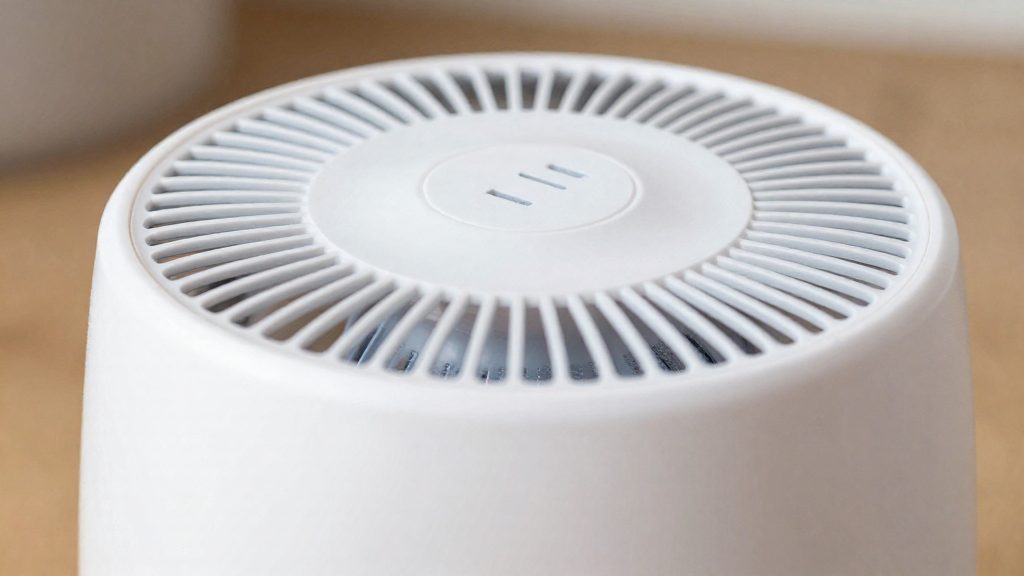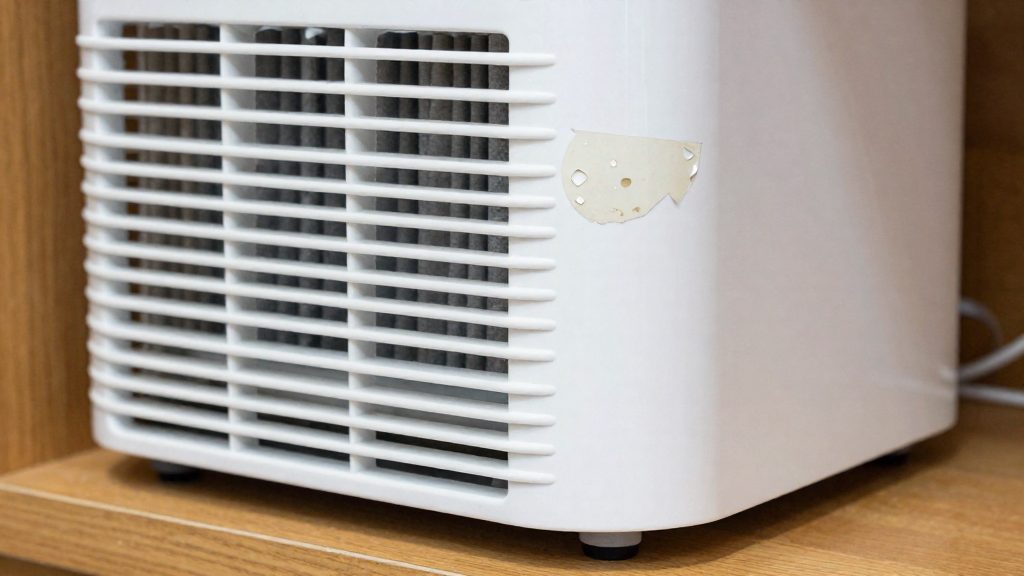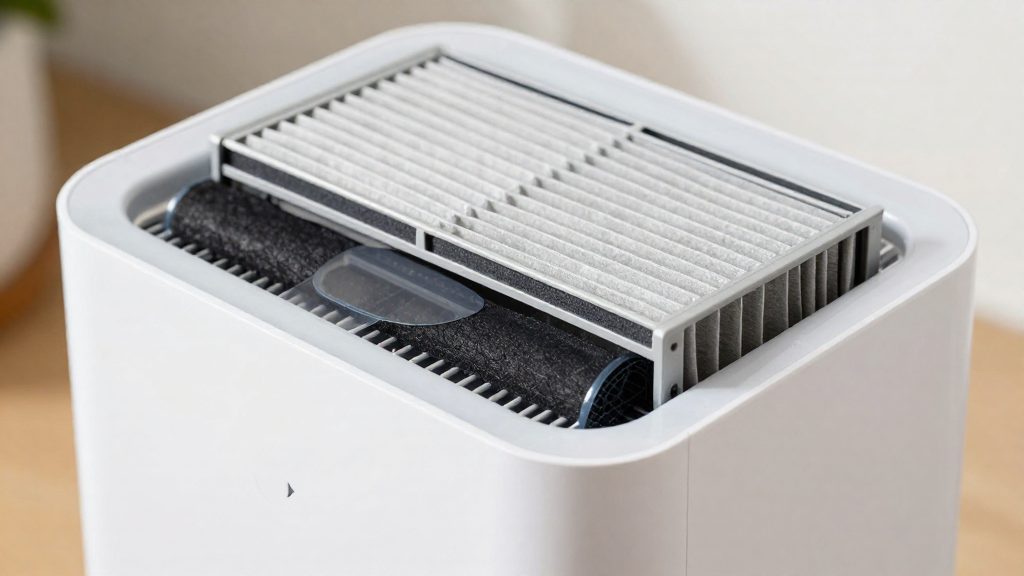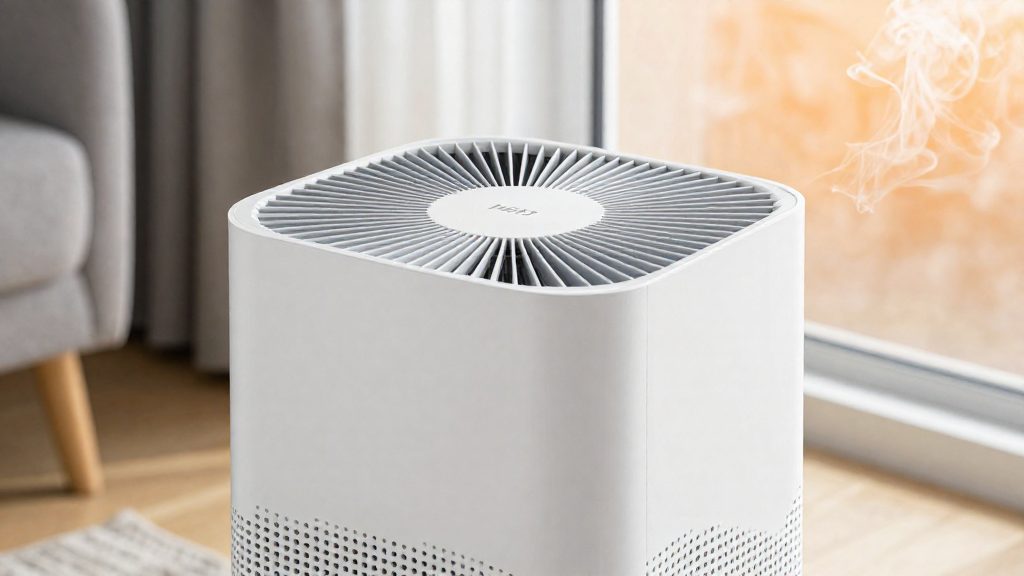
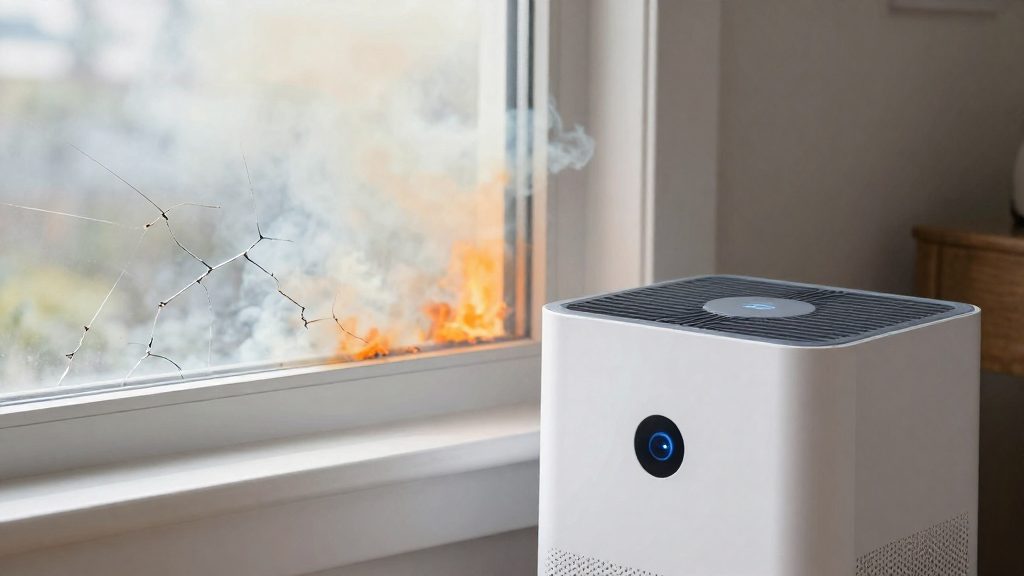
Wildfire smoke reaches indoor air mainly as fine particles that move with outdoor air through open windows, doors, and ventilation openings, so indoor air quality tends to follow outdoor conditions. Health Canada (2026-10-06) notes that portable air purifiers often reach a high Clean Air Delivery Rate (CADR) thanks to a HEPA filter, and that both airflow and filter efficiency affect performance. In practice, pair a correctly sized purifier with reduced outdoor air intake during smoke events.
Why Wildfire Smoke Gets Indoors
Smoke from wildfires contains many fine particles, which are small enough to stay suspended in air and travel with it. Because the particles follow air movement, any gap or opening that admits outdoor air can carry smoke inside. Typical routes include open windows and doors, unsealed gaps around frames, and ventilation systems that draw in outdoor air.
A purifier only removes particles that pass through its filter, so its capacity must match the space it serves. Health Canada (2026-10-06) gives the following guidance for choosing a unit:
| Guidance (Health Canada, 2026-10-06) | What it means in practice |
|---|---|
| Choose the unit with the highest tobacco smoke CADR the budget allows | Tobacco smoke is the reference test used to rate fine-particle removal |
| The CADR should be at least two-thirds of the room area | Minimum CADR is roughly room area × two-thirds |
| Listed room areas assume an 8 ft ceiling | Higher ceilings require a unit rated for a larger room |
| Look for AHAM certification | The label states the CADR and recommended room size |
Ozone and Gas-Removal Filters
Health Canada (2026-10-06) advises avoiding devices that produce ozone, because ozone can harm health. The California Air Resources Board (CARB) publishes a list of devices tested for ozone emissions. Activated carbon or other adsorbent filters can help remove gases such as VOCs.
What does a HEPA filter do against wildfire smoke?
A HEPA filter captures fine particles, and it is one of two factors that determine how well a portable air purifier clears smoke indoors, the other being airflow. According to Health Canada (2026), many portable air purifiers reach a high Clean Air Delivery Rate (CADR) because they use a HEPA filter. Two factors drive performance: the volume of air the unit moves and how efficiently the filter captures particles. A purifier with a good filter that moves little air will clean a room slowly, so both must be considered together.
Smoke also contains gases, such as volatile organic compounds (VOCs), that a particle filter does not address. Health Canada (2026) notes that activated carbon or other adsorbent filters can help remove these gases. No widely used performance rating exists for these filters, so a label or marketing claim is harder to compare than a CADR figure.
Matching the unit to the room
For fine particles, Health Canada (2026) advises choosing the unit with the highest tobacco-smoke CADR that your budget allows. The approximate rule is that the CADR should be at least two-thirds of the room’s floor area.
| Selection factor | Health Canada (2026) guidance |
|---|---|
| CADR for particles | Highest tobacco-smoke CADR within budget |
| Minimum CADR | At least two-thirds of room floor area |
| Ceiling height | Room areas assume an 8 ft ceiling; higher ceilings need a unit rated for a larger room |
| Certification | Look for AHAM certification; the label shows CADR and recommended room area |
Placement and maintenance
Follow the manufacturer’s instructions for placement and servicing. Do not point the unit at people, do not block its airflow, and clean or replace the filter at the intervals the manufacturer recommends.
How to Read the CADR and Choose the Right Size
The CADR (Clean Air Delivery Rate) is the rate at which a purifier delivers filtered air, and it is the most practical figure for comparing portable HEPA units. Health Canada (2026-10-06) notes that portable purifiers often reach a high CADR because of their HEPA filter, and that both airflow and filter efficiency influence performance. A CADR figure therefore reflects the combination of fan output and filter capture, not the filter alone.
Step 1: Check the Certification Label
Health Canada recommends choosing an AHAM-certified unit. According to Health Canada (2026-10-06), the label shows the CADR and the recommended room area, so you can compare models directly without calculating airflow yourself.
Step 2: Match the Tobacco-Smoke CADR to Fine Particles
For fine particles, Health Canada advises selecting the unit with the highest tobacco-smoke CADR that your budget allows. Its approximate rule is that this CADR should be at least two-thirds of the room area. Applied as a formula, room area × two-thirds gives the minimum CADR:
| Room area (sq ft) | Minimum tobacco-smoke CADR (room area × two-thirds) |
|---|---|
| 150 | 100 |
| 300 | 200 |
| 450 | 300 |
Use the result as a floor, not a target. Health Canada advises choosing the highest tobacco smoke CADR the budget allows.
Step 3: Adjust for Ceiling Height
Stated room areas assume an 8 ft (2.4 m) ceiling. Health Canada (2026-10-06) specifies that higher ceilings require a unit rated for a larger room. Measure the ceiling before reading the label. If it is taller than 8 ft (2.4 m), choose a unit rated for a larger room.
Step 4: Do Not Read CADR as a Gas Rating
CADR measures particle removal. Health Canada (2026-10-06) notes that activated carbon and other sorbent filters can help remove gases such as VOCs, but no widely used performance rating exists for them. A high CADR therefore says nothing about gas removal.
Why to Avoid Ozone-Producing Air Purifiers
Some air purifiers emit ozone, a gas that Health Canada (2026-10-06) identifies as a risk to health. Ozone output is therefore a selection criterion in its own right. Strong performance figures, such as a high CADR or an efficient HEPA filter, do not offset it. A unit can move a large volume of air and still add a pollutant to the room. When comparing models, the question is not only how well a device removes particles, but also whether it avoids creating a new problem indoors.
How to Check a Model’s Ozone Emissions
Health Canada (2026-10-06) directs buyers to the CARB list published by the California Air Resources Board, which names air cleaners tested for ozone emissions. A practical check follows these steps:
- Search the CARB list for the exact model name and model number printed on the unit.
- Confirm the listing matches the product you intend to buy, not a similar model from the same brand.
- Treat a model that does not appear on the list as untested. Its ozone output is unverified, so choose a listed alternative.
Is Activated Carbon Useful Against Odours?
Activated carbon, also called activated charcoal, is an adsorbent material. It captures gas molecules on its porous surface rather than trapping particles in a mesh. According to Health Canada (2026-10-06), activated carbon or other adsorbent filters can help remove gases such as volatile organic compounds (VOCs). Activated carbon is the filter type the sources associate with gas removal, but they give no performance rating for it. A HEPA filter captures particles, so it does little against gaseous odours on its own.
Carbon filtration has a clear limit: its performance is hard to compare between products. Health Canada (2026-10-06) notes that no widely used performance rating system exists for these filters. Unlike the CADR, which lets you compare particle removal across air purifiers, you cannot rely on a standard number to judge how much odour a carbon filter removes. Look for the amount of carbon in the filter and the manufacturer’s stated use, and treat marketing claims with caution.
Odour control also depends on the source. Carbon works best on the gases it is designed for, and it cannot remove a source that keeps producing odour, such as mould growth or a damp area. Address the source first, then use carbon to reduce what remains.
Carbon filters need replacement, and a saturated filter stops adsorbing effectively. Follow the manufacturer’s schedule for cleaning or replacing the filter, and do not block the airflow through the unit.
Where to Place the Purifier and When to Change the Filter
Place a portable HEPA air purifier where it can draw in and release air without obstruction, and follow the manufacturer’s placement instructions. Health Canada (2026) advises not to point the unit at people, not to block its airflow, and to clean or replace the filter according to the manufacturer’s recommendations. Health Canada also notes that the room areas listed on purifiers are calculated for an 8 ft (2.4 m) ceiling, so a higher ceiling calls for a unit rated for a larger room.
Placement Rules
- Airflow clearance: Keep the intake and outlet free of furniture, curtains, and other objects, since blocking airflow reduces how much air the unit moves through its filter.
- Direction: Do not aim the outlet at people, especially at a seated or sleeping person.
- Room fit: Match the unit to the room’s floor area and ceiling height. Health Canada’s rule of thumb is that the CADR for tobacco smoke should be at least two-thirds of the room area, and the stated room areas assume an 8 ft ceiling.
- Manufacturer instructions: Follow the setup guidance in the owner’s manual, because placement requirements can vary by model.
When to Change the Filter
| Task | Guidance | Source |
|---|---|---|
| Filter cleaning or replacement | Follow the manufacturer’s recommended schedule | Health Canada (2026) |
| Carbon or adsorbent filters | Replacement timing depends on the manufacturer; no widely used performance rating exists for these filters | Health Canada (2026) |
Check the manufacturer’s manual or filter indicator for the schedule that applies to your model.
Complementing Ventilation and Sensors
During a smoke event, a HEPA air purifier should be paired with reduced outdoor air intake, not with extra ventilation that brings outdoor air in. Health Canada (2026-10-06) notes that the air flow and the filter’s efficiency together determine how well a portable unit performs, and advises choosing the highest tobacco smoke CADR the budget allows for fine particles. During a smoke event, outdoor air is the source of the smoke particles, so ventilation that brings it in works against the purifier. Keep outdoor air intake low and let the purifier clean the indoor air in the room where it runs. Use a gas-phase filter only where gases such as VOCs are the concern.
Selection checks before you buy
| Criterion | Guidance (Health Canada, 2026-10-06) |
|---|---|
| Tobacco smoke CADR | Choose the highest value the budget allows, for fine particles |
| Minimum CADR | Rough rule: at least two-thirds of the room’s area |
| Ceiling height | Area figures assume an 8 ft ceiling; higher ceilings need a unit rated for a larger room |
| Certification | Look for an AHAM-certified label showing the CADR and recommended room area |
| Ozone | Avoid units that produce ozone |
Placement and airflow
Follow the manufacturer’s placement instructions. Keep the unit away from people, since it should not be pointed at them, and never block its air flow with furniture, curtains or walls. Position it so air can reach the intake and leave the outlet freely. During a smoke event, limit outdoor air coming in through open windows and ventilation openings, because the purifier only cleans the air that passes through its filter.
Gas-phase filters
Activated carbon or other adsorbent filters can help remove gases such as VOCs. Compare the product documentation and avoid relying on a CADR figure, which applies to particle filtration.
Maintenance and monitoring
Clean or replace the filter on the schedule the manufacturer recommends. A hygrometer or CO2 monitor does not measure smoke particles, so it cannot show whether the purifier is removing smoke. Rely on correct sizing, certified CADR figures and the manufacturer’s maintenance schedule.
Frequently asked questions
Does a HEPA purifier protect me from wildfire smoke if my windows stay open?
Not fully. A purifier only removes particles that pass through its filter, so smoke that keeps entering through open windows, doors and ventilation openings is not captured at the point of entry. Limiting outdoor air intake during a smoke event is what allows the purifier to work on the air that is already inside.
How do I know whether a purifier is big enough for my room?
Look for the highest tobacco smoke CADR your budget allows, because Health Canada (2026-10-06) uses tobacco smoke as the reference test for fine-particle removal. Its guidance is that the CADR should be at least two-thirds of the room area, and that listed room areas assume an 8 ft (2.4 m) ceiling, so a higher ceiling calls for a unit rated for a larger room.
Is an ozone-producing air purifier a good choice for smoke?
Health Canada (2026-10-06) advises avoiding devices that produce ozone, because ozone can harm health. The California Air Resources Board (CARB) publishes a list of devices tested for ozone emissions, which you can check before buying a model.