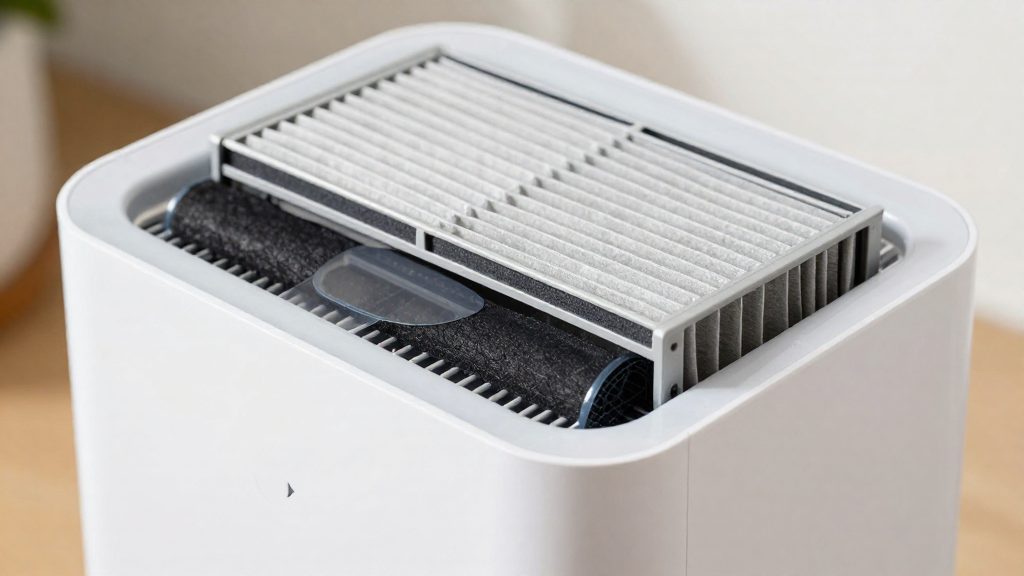
An air purifier filter has no fixed lifespan. According to IQAir, typical residential replacement intervals are about 6–12 months for HEPA filters, but the actual replacement interval depends on how often the unit runs and what it captures. Health Canada (2024) notes that filters may need changing more often depending on use and conditions, so the interval printed on a box is a starting point, not a guarantee.
How long does an air purifier filter last?
Replacement intervals by filter type
| Filter type | IQAir typical residential interval | Sunbeam Canada interval |
|---|---|---|
| HEPA | 6–12 months | 12–18 months |
| Carbon (gas and odour) | 3–12 months | 3–6 months |
IQAir also lists 3–18 months for pre-filters. Sunbeam Canada’s figures cover carbon and HEPA filters only. The two sources give different ranges, so the manufacturer’s guidance for a specific model should take priority.
Factors that shorten filter life
Several conditions consume a filter faster, according to IQAir:
- Smoke or high outdoor PM2.5 levels
- Cooking, candles, smoking and indoor fireplaces
- Pets
- Carpeting
- Long daily runtime and high fan speeds
IQAir also states that HEPA filters need replacing sooner during wildfire smoke, heavy dust or when pets are present. High humidity can affect gas media, according to IQAir, so carbon filters in damp rooms may need earlier checks.
Signs a filter needs replacing
Check the following indicators, which IQAir identifies as signs of a worn filter:
- Reduced airflow at the same fan setting
- Increased noise during operation
- Returning odours
- A filter-life prompt on the display or app
- Particle readings that do not drop while the unit runs
Lifespan by Filter Type: HEPA, Carbon, Pre-filter
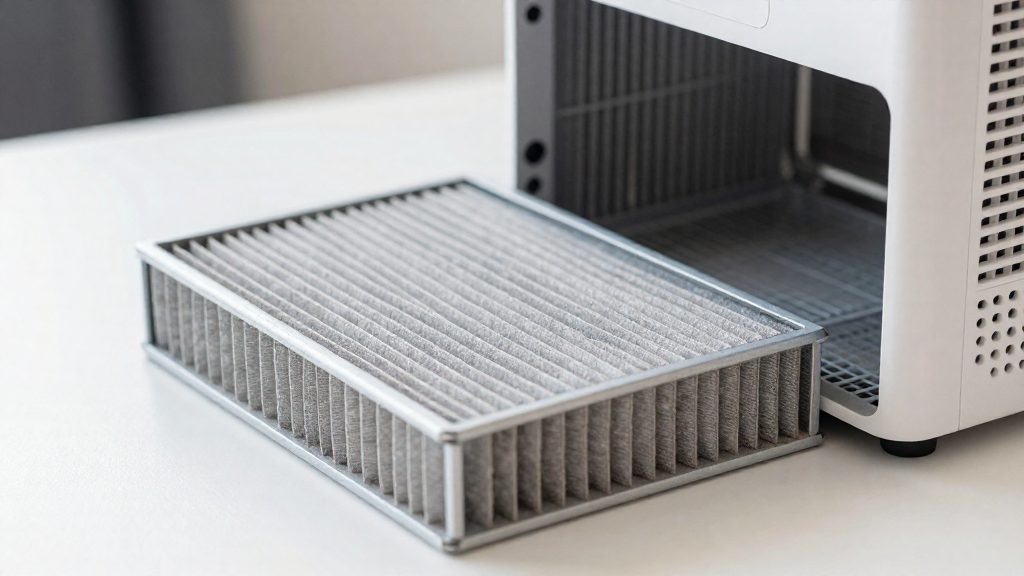
Replacement intervals depend on the filter media, so a single schedule does not fit every unit. IQAir gives typical residential ranges of about 6–12 months for HEPA filters, 3–12 months for activated carbon filters (gas and odour) and 3–18 months for pre-filters. Sunbeam Canada publishes its own intervals for its carbon and HEPA filters: its carbon range (3–6 months) falls within IQAir’s range, and its HEPA range (12–18 months) is longer than IQAir’s.
| Filter | IQAir typical residential interval | Sunbeam Canada interval |
|---|---|---|
| HEPA | 6–12 months | 12–18 months |
| Activated carbon | 3–12 months | 3–6 months |
HEPA filters
Health Canada recommends certified portable air cleaners with HEPA filtration to remove fine particles, and notes that filters may need changing more often depending on use and conditions. IQAir advises replacing HEPA media sooner during wildfire smoke, heavy dust or when pets are present. Check the manufacturer’s stated interval first, then shorten it if the room is dusty or smoky.
Activated carbon filters
Carbon media handles gases and odours. Sunbeam Canada gives a shorter interval for carbon (3–6 months) than for HEPA (12–18 months), while IQAir’s carbon range (3–12 months) overlaps its HEPA range (6–12 months). IQAir notes that high humidity can also affect gas media, so units used in damp rooms such as bathrooms or laundry areas may need earlier replacement. Cooking, candles, smoking and fireplaces indoors also shorten carbon life.
Pre-filters
Pre-filters catch large particles and protect the finer media behind them. IQAir gives a typical range of 3–18 months, with the wide spread reflecting how dusty the environment is. Sunbeam Canada’s washable foam pre-filter is cleaned rather than replaced: wash it in warm soapy water and let it dry completely before reinstalling it. The sources consulted do not specify a replacement interval for washable foam filters, so follow the unit’s manual for that part.
What factors wear out a filter faster?
A filter’s service life depends on how much material it captures and how long the unit runs. IQAir lists the main accelerators: outdoor smoke and high PM2.5, indoor combustion sources, pets, carpeting, long daily runtime and high fan speeds. Health Canada (2024) adds that filters may need changing more often depending on use and conditions, so a fixed schedule is only a starting point.
Outdoor and indoor particle loads
- Wildfire smoke and high outdoor PM2.5 load the filter quickly. IQAir states that HEPA filters need replacing sooner during wildfire smoke and heavy dust.
- Indoor combustion and particle sources include cooking, candles, smoking and fireplaces. These are listed as factors that shorten filter life, but the sources consulted do not specify how much each one reduces it.
Household conditions
- Pets shed dander and hair into the airflow. IQAir links them to faster HEPA replacement.
- Carpeting releases fibres and dust that reach the filter. It is listed as a shortening factor without a stated quantity.
Runtime, fan speed and humidity
| Factor | Filter type affected (per source) |
|---|---|
| Wildfire smoke, heavy dust, pets | HEPA filter (IQAir) |
| High humidity | Gas media (IQAir) |
| Cooking, candles, smoking, fireplaces, carpeting, long runtime, high fan speed | Filter type not specified in the sources consulted |
Long daily runtime and high fan speeds increase wear on all stages. High humidity is the one factor that IQAir ties specifically to gas media, so controlling indoor moisture helps protect carbon and odour filters.
How to Tell When Your Filter Needs Changing
A filter change is best judged by how the purifier performs, not only by the calendar. IQAir lists five signs that a filter needs replacing: reduced airflow at the same fan setting, more noise than usual, returning odours, a filter-life prompt on the display or app, and particle readings that don’t drop during operation. Health Canada notes that filters may need changing more often depending on use and conditions, so a single schedule won’t fit every home.
Performance Signs to Check
| Sign | Simple check |
|---|---|
| Reduced airflow at the same fan setting | Compare the outlet airflow at the same speed with how the unit performed when the filter was new |
| Increased noise | Run the unit at the same speed and listen for a change in fan sound |
| Returning odours | Note whether smells come back shortly after the room was cleared |
| Filter-life prompt | Check the display or app for a replacement alert |
| Particle readings not dropping | Compare readings with the unit off and running, if your device reports them |
Treat the prompt as one input, not the only one. A prompt that appears while airflow and readings remain normal may still be a reminder to check the filter, while a clogged-feeling filter with no prompt still warrants inspection.
Conditions That Shorten Filter Life
IQAir identifies several high-use conditions that wear filters faster:
- Outdoor smoke or high outdoor PM2.5
- Indoor cooking, candles, smoking and fireplaces
- Pets
- Carpeting
- Long daily runtime and high fan speeds
- High humidity, which can affect gas (carbon) media
Homes with several of these conditions should check filters more often than the baseline suggests.
Washable Foam Pre-Filters
Some units use a washable foam pre-filter, which is a different case from disposable media. Sunbeam Canada states that the foam filter can be washed in warm soapy water and must dry completely before reinstallation. Reinstalling a damp filter is the main thing to avoid with this type.
Can You Wash or Clean an Air Purifier Filter?
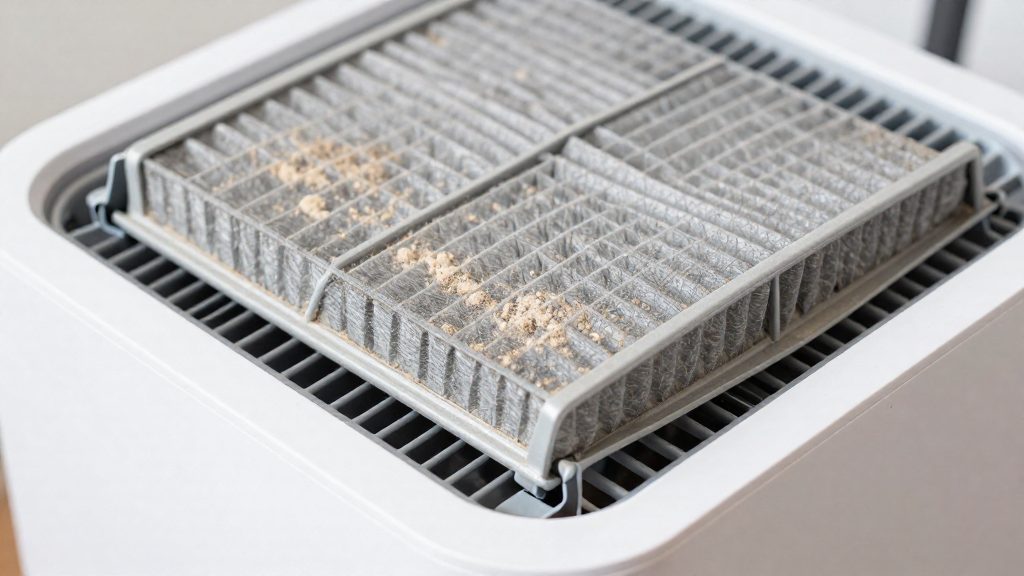
Only some air purifier filters can be washed. Sunbeam Canada gives cleaning instructions for its washable foam filter, which can be washed in warm soapy water. Its carbon and HEPA filters have replacement intervals but no cleaning instructions. The official sources consulted do not specify whether HEPA or carbon media can be washed, so the manufacturer’s manual should be the reference for any filter that is not described as washable.
Washing a Foam Pre-Filter
- Warm soapy water: Sunbeam Canada specifies warm soapy water as the washing solution for its foam filter.
- Full drying: The filter must dry completely before it goes back in the unit. Reinstalling a damp filter is the main error this instruction is meant to prevent.
- Removal first: Take the filter out according to the manual before washing, and check that it is fully seated again after drying.
Cleaning Versus Replacement
Washing a foam filter does not replace the other filters in the unit. Sunbeam Canada gives a carbon filter replacement interval of 3–6 months and a HEPA filter interval of 12–18 months, depending on usage. IQAir lists typical residential HEPA replacement at about 6–12 months. Health Canada notes that filters may need changing more often depending on use and conditions, so a washed foam pre-filter should be checked alongside these other components rather than treated as a substitute for them.
What Health Canada says about air purifier maintenance
Health Canada’s guidance on air purifier upkeep is brief but specific. According to Health Canada (2024), the recommended choice for removing fine particles is a certified portable air cleaner with HEPA filtration, and its filters may need to be changed or replaced more often depending on use and conditions. The agency does not give a single replacement date. The interval depends on how hard the unit works, which is why manufacturer figures vary.
Avoiding ozone-producing units
Maintenance cannot fix a unit that generates the wrong pollutant. Health Canada advises avoiding ozone-producing units, because ozone is a lung irritant. For selection, the agency points to the California Air Resources Board (CARB) list of air cleaners that passed ozone emission testing (Health Canada, 2024). Checking a model against that list before purchase is a practical step, since filter changes do not remove ozone emissions.
Typical replacement intervals by filter type
The following ranges come from manufacturer and industry publishers. They describe typical use, not a fixed schedule.
| Publisher | Filter type | Typical interval |
|---|---|---|
| IQAir | HEPA | 6–12 months |
| IQAir | Carbon (gas and odour) | 3–12 months |
| IQAir | Pre-filter | 3–18 months |
| Sunbeam Canada | Carbon | 3–6 months |
| Sunbeam Canada | HEPA | 12–18 months |
Usage factors that shorten filter life
According to IQAir, filter life drops with outdoor smoke or high outdoor PM2.5, and with indoor sources such as cooking, candles, smoking and fireplaces. Pets, carpeting, long daily runtime and high fan speeds also shorten it. HEPA filters need earlier replacement during wildfire smoke, heavy dust or when pets are present. High humidity can also affect the gas media in carbon filters.
Signs a filter needs replacing
IQAir lists five indicators that a filter is due:
- Airflow drops at the same fan setting.
- The unit becomes noticeably louder.
- Odours return after the room has been cleaned.
- The display or app shows a filter-life prompt.
- Particle readings do not fall during operation.
Washing washable pre-filters
Sunbeam Canada states that its washable foam filter can be cleaned in warm soapy water. Washing does not replace a HEPA or carbon filter. The sources consulted do not say whether these can be washed, so follow the manufacturer’s manual.
How to Choose a Safe Air Purifier (HEPA, Ozone-Free)?
According to Health Canada (2024), the safest choice is a certified portable air cleaner with HEPA filtration that does not produce ozone. Health Canada advises avoiding air cleaners that produce ozone and points to the California Air Resources Board (CARB) list of air cleaners that passed ozone emission testing. Selection therefore comes down to two checks: confirm the filtration type, then confirm the unit’s ozone status. Both can be verified from the product documentation and public listings before purchase.
Step 1: Verify the HEPA claim
Check that the specifications state the filter is HEPA, and that the device is certified as a portable air cleaner. Health Canada (2024) recommends certified portable air cleaners with HEPA filtration to remove fine particles, so check that the specifications actually state HEPA filtration. A HEPA filter captures particles. Gases and odours need a separate carbon stage, which IQAir describes as distinct from HEPA media.
Step 2: Rule out ozone emissions
Search the exact model name on the California Air Resources Board (CARB) list of air cleaners that passed ozone emission testing, which Health Canada points to as a reference (it is a California list, not a Canadian certification). A model that does not appear on that list is not confirmed by that list as having passed CARB’s ozone emission testing; the list is one check among others, including the product documentation. Use the model number, not the brand name, because a manufacturer can sell several models under one brand with different emission behaviour.
Step 3: Read the product documentation
Use the manufacturer’s specifications to map each filter stage, then match the stages to your needs:
| Check | What to verify | Reference |
|---|---|---|
| Particle filtration | HEPA stage stated in the specifications | Health Canada (2024) |
| Ozone status | Model listed on the CARB ozone-testing list | Health Canada (2024) |
| Gas and odour control | Separate carbon stage listed | IQAir |
| Pre-filter | Coarse pre-filter stage stated | IQAir |
The official sources consulted do not specify a single ozone threshold that applies to every model, so the CARB listing remains the practical verification step.
Frequently asked questions
Can I wash my air purifier filter instead of replacing it?
Sunbeam Canada says its washable foam filter can be rinsed in warm soapy water, but it must dry completely before going back into the unit. The official sources consulted do not specify whether HEPA or carbon filters can be washed, so check the manufacturer’s documentation before cleaning any non-foam filter.
How can I tell a filter is worn before its scheduled date?
According to IQAir, a filter that is wearing out delivers less airflow at the same fan setting and makes the motor sound louder. If particle readings stop falling while the unit runs, the filter media is likely no longer capturing particles effectively, and the filter should be inspected or replaced.
Does my home environment change how fast the filter wears out?
According to IQAir, smoke, cooking, candles, pets, carpeting and long runtime at high fan speeds all shorten filter life. IQAir also notes that high humidity can affect gas media, so carbon filters in damp rooms may need earlier inspection.