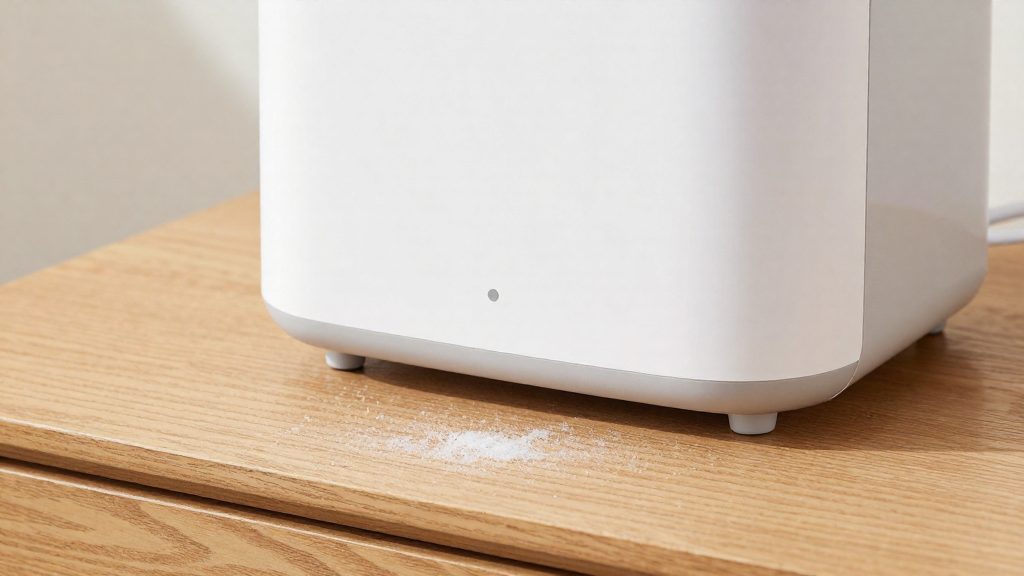
White dust around a humidifier is mineral scale, the same material that forms scale inside kettles. It consists mainly of calcium and magnesium dissolved in the water. Ultrasonic and impeller (turbine) humidifiers spread these minerals into the mist, and the harder the water, the more dust is produced. According to Health Canada (2016-12-06), most people face no risk from this dust.
Where does white dust from a humidifier come from?
Minerals carried by hard water
Water contains dissolved minerals. When the water is turned into vapour or mist, the minerals do not evaporate with it. They remain as solid particles. The main minerals involved are calcium and magnesium, which are the same minerals that build up as scale in kettles. According to HVAC.com (2024-12-17), these two minerals are the main source of the white powder.
How the device releases the particles
Not every type of humidifier releases the same amount of dust. The following distinctions apply:
- Ultrasonic humidifiers use high-frequency vibration to create a fine mist. This mist carries the dissolved minerals into the room.
- Portable impeller (turbine) humidifiers throw water into the air with a rotating disc, which also disperses the minerals.
- Evaporative humidifiers do not disperse white dust, according to HVAC.com (2024-12-17), but they are noisier than the other two types.
Factors that change the amount of dust
The quantity of particles depends mainly on the water used. Health Canada (2016-12-06) compares the two common options:
| Water used | Particles released into the air |
|---|---|
| Distilled water | Much lower |
| Tap water | Higher; generally suitable if the water is changed and the unit is cleaned regularly |
HVAC.com (2024-12-17) adds that the harder the water, the more dust the device releases. Water hardness therefore changes the result even when the same humidifier is used.
Why this matters for surfaces
The dust settles on nearby furniture because the mineral particles are carried by the mist and deposited as the droplets evaporate. Health Canada (2016-12-06) states that most people face no risk from the dust, so its effect is mainly visible on surfaces rather than on health.
Why does hard water leave a deposit on furniture?
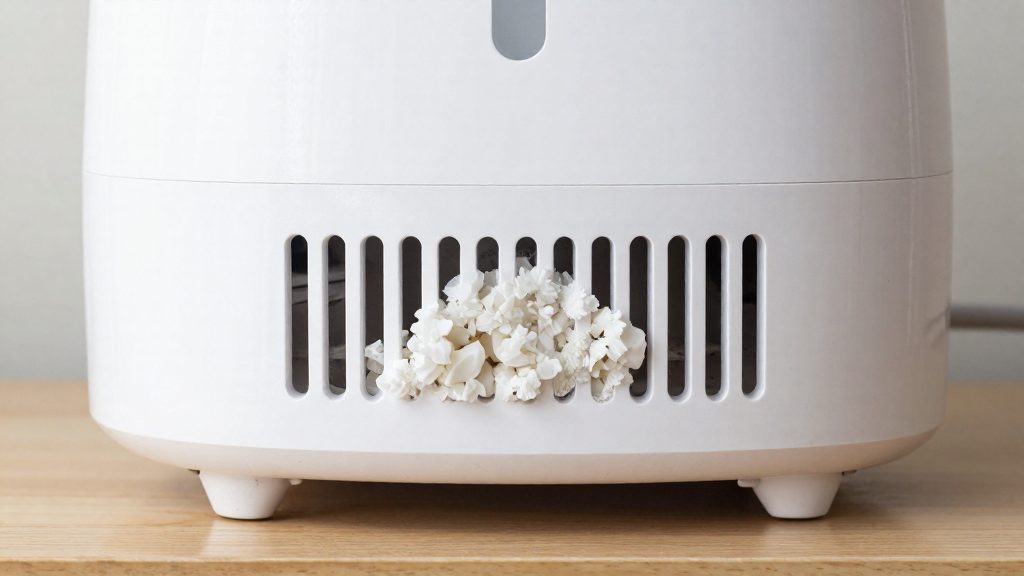
White dust on furniture comes from the minerals dissolved in the water a humidifier uses. According to Health Canada (2016-12-06), this dust contains the same minerals that form limescale in kettles, and most people face no risk from it. The main sources are calcium and magnesium in hard water. A humidifier does not filter these minerals out. It releases them into the air, where they settle on nearby surfaces as a fine white powder.
HVAC.com (2024-12-17) identifies ultrasonic and impeller humidifiers as the types that spread the most dust, because they turn water into a mist that carries the dissolved minerals into the room. The harder the water, the more dust is produced. Evaporative humidifiers do not disperse white dust, but they are noisier, according to HVAC.com (2024-12-17).
The amount of deposit depends on two factors: the mineral content of the water and the way the device aerosolises it. Changing the water addresses the first factor. Changing the device type addresses the second.
| Option | Effect on white dust | Source |
|---|---|---|
| Distilled water | Much lower release of particles into the air | Health Canada (2016-12-06) |
| Hard tap water | More dust as hardness increases; generally acceptable if the water is changed and the unit is cleaned regularly | Health Canada (2016-12-06); HVAC.com (2024-12-17) |
| Demineralisation cartridge | Treats water before it enters the tank | HVAC.com (2024-12-17) |
| Evaporative humidifier | Does not disperse white dust; noisier in operation | HVAC.com (2024-12-17) |
Better ventilation and regular dusting of surfaces also reduce the visible build-up, according to HVAC.com (2024-12-17).
Is White Dust Dangerous to Health?
According to Health Canada (2016), most people face no health risk from white dust. The powder is made of the same minerals that form limescale in kettles, mainly calcium and magnesium carried into the air by ultrasonic and impeller humidifiers. Harder water produces more of it. The health question therefore depends less on the mineral dust itself than on what the humidifier does with the water in its tank.
The more relevant concern is bacteria. Health Canada notes that bacteria can multiply in standing water, and that a cool-mist humidifier does not kill them. Regular cleaning and disinfection of the tank, following the manufacturer’s instructions, addresses this risk. Distilled water releases far fewer particles into the air than tap water, though Health Canada considers tap water generally suitable if the water is changed and the unit is cleaned regularly.
Excess moisture is a separate issue. Health Canada recommends an indoor humidity of about 50 % in summer and about 30 % in winter to prevent mould. A hygrometer is used to measure it. The humidity targets below are the reference values for each season.
| Season | Recommended indoor humidity (Health Canada, 2016) |
|---|---|
| Summer | About 50% |
| Winter | About 30% |
Measuring with a hygrometer shows whether a humidifier keeps levels within these ranges, and it helps avoid the mold risk that comes from air that is too humid.
Eau distillée ou eau du robinet
The white dust that settles on furniture is made of the same minerals that form limescale in kettles. Health Canada (2016) notes that most people face no risk from it. The dust mainly comes from calcium and magnesium dissolved in hard water. Ultrasonic and impeller (turbine) humidifiers break these minerals into the mist they release, so the harder the water, the more dust appears on surfaces. HVAC.com (2024) confirms that these two types are the main sources of the problem.
The choice of water changes how much dust reaches your room:
| Option | Effect on white dust | Practical notes |
|---|---|---|
| Distilled water | Releases far fewer particles into the air | Removes the mineral source at the origin |
| Tap water | Releases more particles than distilled water | Generally suitable if you change the water daily and clean the unit regularly (Health Canada, 2016) |
| Demineralisation cartridge | Reduces mineral content in the water | Compatible with tap water, according to HVAC.com (2024) |
| Evaporative humidifier | Does not disperse white dust | Quieter than ultrasonic models is not the case: HVAC.com (2024) notes it is noisier |
Whichever water you use, the tank needs regular care. Health Canada (2016) advises cleaning and disinfecting the reservoir according to the manufacturer’s instructions. Stagnant water can host bacteria that multiply between uses, so the remaining water should be emptied after each session.
Finally, better ventilation and routine dusting of surfaces help limit the visible deposit, according to HVAC.com (2024). These measures reduce the effect of the dust but do not remove its source, which is the mineral content of the water.

Demineralization cartridge: useful or not?
White dust is made of the same minerals that form limescale in kettles, mainly calcium and magnesium from hard water. Ultrasonic and impeller humidifiers release these minerals into the mist, and according to HVAC.com (2024-12-17), the harder the water, the more dust is produced. A demineralization cartridge works on this mineral load before it reaches the mist, so it addresses the source of the problem rather than the symptom on furniture. Health Canada (2016-12-06) notes that most people face no health risk from the dust itself, which makes this mainly a question of cleaning effort and comfort.
How the options compare
Here is how the options compare:
| Approach | Effect on white dust | Source |
|---|---|---|
| Distilled water | Releases far fewer particles into the air than tap water | Health Canada (2016-12-06) |
| Tap water, with regular water changes and cleaning | Generally suitable, provided the tank is changed and the unit cleaned regularly | Health Canada (2016-12-06) |
| Evaporative humidifier | Does not disperse white dust, but is noisier | HVAC.com (2024-12-17) |
What the cartridge does not settle
A demineralization cartridge’s real benefit depends on the hardness of your local water, which you cannot judge from the dust alone. Where water hardness is high, a cartridge is a logical step to test. Where it is low, the gain is likely to be small.
Measures that apply whatever the water source
Whichever option you choose, the following steps remain necessary:
- Clean and disinfect the tank regularly, following the manufacturer’s instructions (Health Canada, 2016-12-06).
- Empty the remaining water after each use, because bacteria can multiply in standing water (Health Canada, 2016-12-06).
- Improve ventilation and dust surfaces regularly, which HVAC.com (2024-12-17) identifies as helpful complements.
Which Humidifier Type to Choose to Avoid White Dust?
White dust comes from the same minerals that form limescale in kettles, mainly calcium and magnesium carried by hard water, so the water you use matters as much as the device. According to HVAC.com (2024-12-17), ultrasonic humidifiers and portable impeller humidifiers disperse these minerals in their mist, and the harder the water, the more dust they produce. Choosing a model therefore means weighing how it creates moisture against the water it will use.
| Option | Behaviour with white dust | Trade-off noted by sources |
|---|---|---|
| Ultrasonic or impeller humidifier | Disperses the minerals in the mist; output rises with water hardness | Source of the dust problem with hard water (HVAC.com, 2024) |
| Evaporative humidifier | Does not disperse white dust | Noisier (HVAC.com, 2024) |
| Unit run on distilled water | Releases far fewer particles into the air | Requires buying distilled water (Health Canada, 2016) |
| Tap water with regular maintenance | Generally suitable if the water is changed and the unit is cleaned regularly | Needs routine upkeep (Health Canada, 2016) |
Health Canada (2016-12-06) recommends cleaning and disinfecting the tank regularly according to the manufacturer’s instructions, and emptying leftover water after each use, since bacteria can multiply in standing water. Health Canada also notes that most people face no risk from white dust itself.
To limit dust without changing device type, HVAC.com (2024) lists better ventilation and regular dusting of surfaces. Health Canada (2016) also recommends an indoor humidity of about 50% in summer and 30% in winter to help prevent mould, measured with a hygrometer.
Maintenance and ideal humidity
Keeping indoor humidity in the right range and maintaining the unit limit both mould and white dust. Health Canada (2016-12-06) recommends about 50% indoor humidity in summer and about 30% in winter to prevent mould, and a hygrometer is the tool used to check it.
Target humidity by season
| Season | Recommended indoor humidity | Measured with |
|---|---|---|
| Summer | About 50% | Hygrometer |
| Winter | About 30% | Hygrometer |
Tank cleaning and water changes
- Clean and disinfect the tank regularly, following the manufacturer’s instructions.
- Empty leftover water after each use, because bacteria can multiply in standing water.
- A cold-vapour humidifier does not kill bacteria, so cleaning matters even when the unit does not heat the water.
Choosing water to limit dust
White dust consists of the same minerals that form scale in kettles. HVAC.com (2024-12-17) reports that these minerals are mainly calcium and magnesium from hard water, and that ultrasonic and impeller humidifiers disperse them into the mist. The harder the water, the more dust is released.
Health Canada (2016-12-06) reports that distilled water releases far fewer particles into the air. Tap water is generally acceptable if you change it and clean the unit regularly. A demineralisation cartridge is another option for limiting mineral release.
Ventilation, surface dusting and humidifier type
Better ventilation and regular dusting of furniture reduce visible deposits, according to HVAC.com (2024-12-17). An evaporative humidifier disperses no white dust but operates more noisily than ultrasonic or impeller models.
Frequently asked questions
Is the white dust from my humidifier harmful to my health?
According to Health Canada (2016-12-06), most people face no risk from this dust, since it is made of the same mineral scale found in kettles. Stagnant water is the real health concern: bacteria can multiply in it, so the tank should be emptied after each use and cleaned and disinfected as the manufacturer advises.
Does distilled water stop white dust, or is tap water acceptable?
Distilled water releases far fewer particles into the air than tap water, according to Health Canada (2016-12-06). Tap water is generally acceptable if you change it often and clean the unit regularly. The harder your water, the more dust is produced, a point HVAC.com (2024-12-17) links to water hardness; a demineralisation cartridge is another option.
Should I switch to a different type of humidifier to avoid white dust?
Yes, if dust is a persistent problem. HVAC.com (2024-12-17) notes that an evaporative humidifier does not disperse white dust, although it runs noticeably louder than ultrasonic or impeller models. Improving room ventilation and dusting nearby surfaces regularly also reduces the amount of residue that settles on furniture.