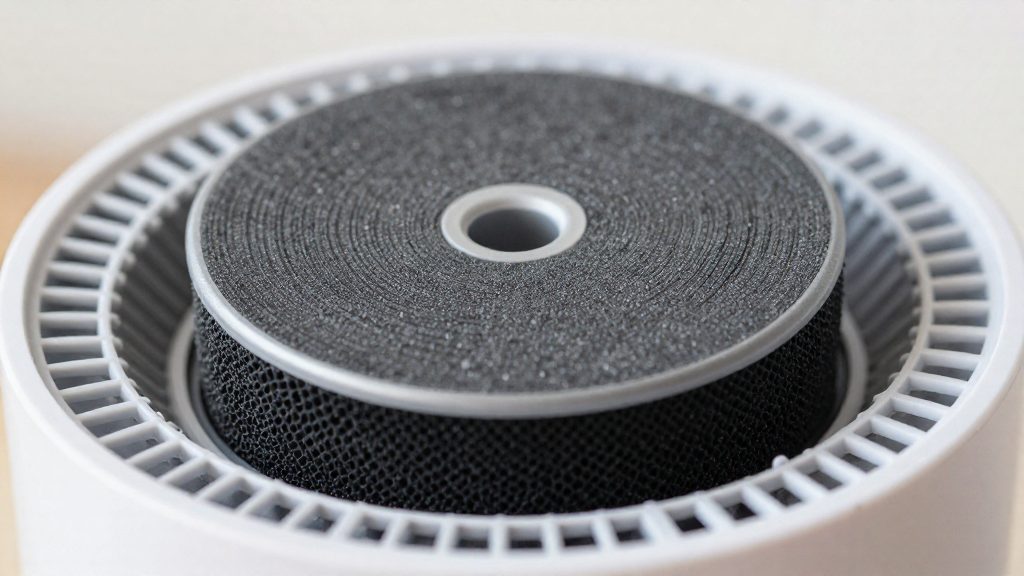
An activated carbon filter in a portable air cleaner can help remove gases such as volatile organic compounds (VOCs), according to Health Canada (2024). Unlike particle filters, it has no widely used performance rating, so its odour-removal capacity cannot be compared with the CADR figure on most devices. Buyers therefore need to check how the filter is described and maintained rather than relying on a single headline number.
What Does an Activated Carbon Filter Actually Do on Odours?
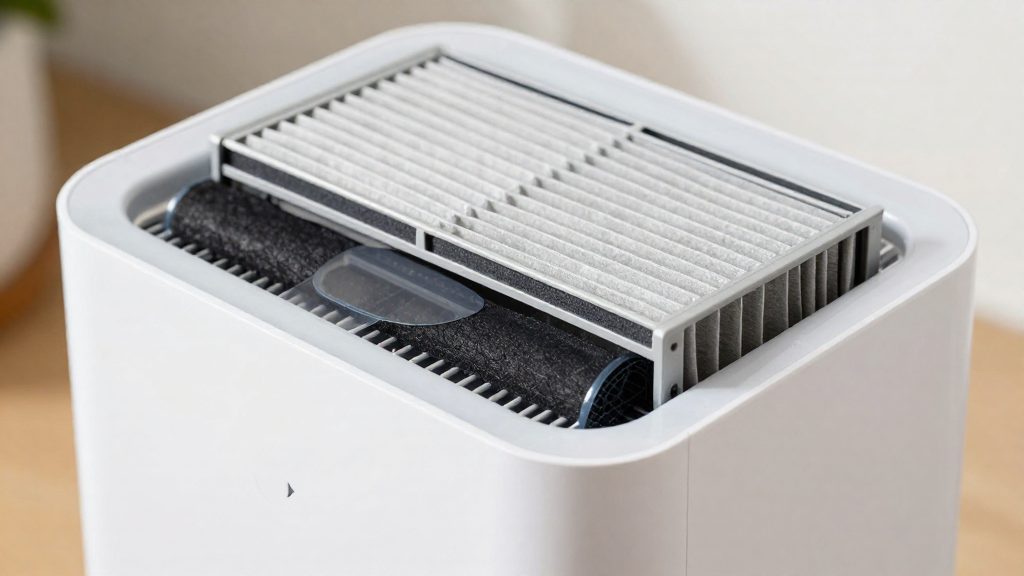
Activated carbon is a porous material. Its filtering works through adsorption: gas molecules attach to its internal surface instead of being blocked by size, as dust and pollen are. Health Canada’s guidance calls this an “absorbent” filter, but the mechanism described here is adsorption, which is why it targets gases rather than particles.
The CADR (Clean Air Delivery Rate) measures how well a device reduces tobacco smoke, dust and pollen. Gases are not covered by a comparable standard:
| Pollutant | Covered by CADR | Practical implication |
|---|---|---|
| Tobacco smoke | Yes | Health Canada advises choosing the highest smoke CADR that fits your budget |
| Dust | Yes | Rated through the CADR |
| Pollen | Yes | Rated through the CADR |
| Gases such as VOCs | No widely used system | Carbon performance cannot be compared with a CADR |
Because the odour performance of carbon filters is not rated on a common scale, you cannot rank models by a single figure. Health Canada advises a smoke CADR of at least two-thirds of the room’s floor area, which applies to particle performance only.
Carbon adsorption is limited by the surface available. Once that surface is occupied, the filter stops capturing gases effectively, so replacement timing matters. Health Canada advises cleaning or replacing the filter as the manufacturer recommends, and that schedule is the most reliable guide for the filter’s remaining life.
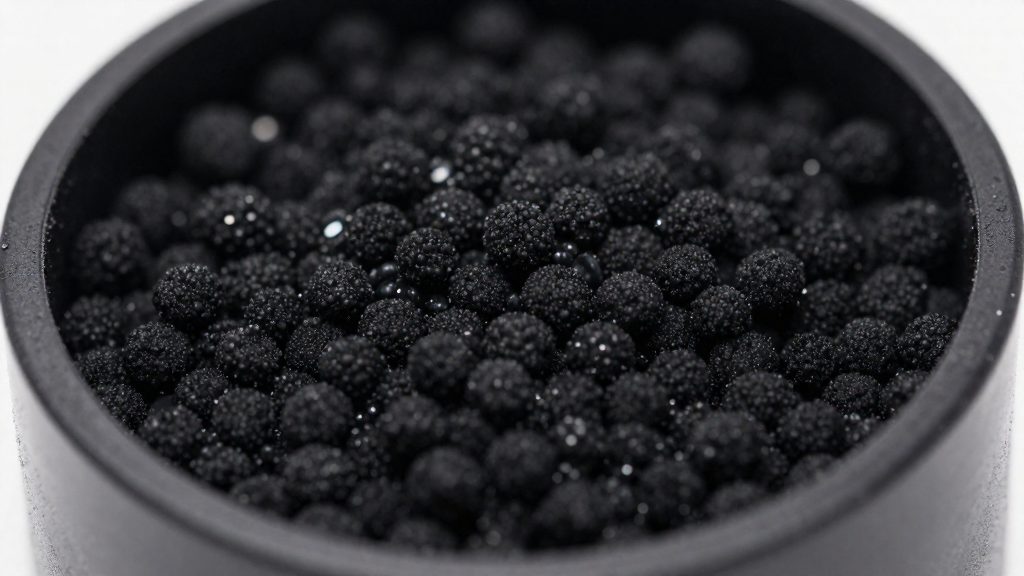
Activated carbon vs HEPA: what’s the difference?
Activated carbon and HEPA filters remove different kinds of pollutants, so they are not interchangeable. Activated carbon targets gases and odours, while HEPA-type filters capture airborne particles. Health Canada (2024) notes that some portable air cleaners include an activated carbon or other absorbent filter, which may help remove gases such as VOCs. For odours caused by gases, such as some VOCs, the carbon layer is the component that may help. It does not remove the source of the smell.
| Feature | Activated carbon filter | Particle filter (HEPA-type) |
|---|---|---|
| Main target | Gases and odours, including VOCs | Airborne particles |
| Performance rating | No widely used rating system exists for gas-removal filters | Particle performance is described by the CADR |
| CADR relevance | Carbon performance on odours cannot be compared with a CADR-type rating | CADR describes reduction of tobacco smoke, dust and pollen |
Carbon filters adsorb molecules onto a porous surface and have a finite capacity. Because no widely used rating system exists for gas-removal filters, you cannot compare two carbon filters’ odour performance by a single published figure. Judge a model by the manufacturer’s documented filter specification and replacement guidance instead.
Health Canada advises choosing the highest smoke CADR that fits your budget, and a smoke CADR of at least two-thirds of the room’s floor area, when selecting a particle-focused cleaner (Health Canada, 2024). For combined odour and particle problems, a unit with both a particle filter and an absorbent layer covers both pollutant types.
Does an Air Purifier Remove All Odours?
No. A standard air purifier does not remove every odour, and what it can do depends on the filter it contains. According to Health Canada (2024-05-31), some portable air cleaners include an activated carbon or other absorbent filter, which may help remove gases such as volatile organic compounds (VOCs). Many odours come from these gases, so carbon is the relevant technology. The wording is “may help,” not a guarantee.
The main limitation is measurement. Health Canada notes that there are no widely used performance rating systems for filters designed to remove gases. Carbon performance on odours therefore cannot be compared with the CADR (Clean Air Delivery Rate), which only describes how well a device reduces tobacco smoke, dust and pollen. A high CADR says nothing about odour removal.
| Aspect | Particle filtration (CADR) | Activated carbon (gases and odours) |
|---|---|---|
| Pollutants covered | Tobacco smoke, dust, pollen | Gases such as VOCs |
| Standardised comparison | Available through the CADR | No widely used rating system |
When comparing models for odours, look for the carbon filter’s specification in the manufacturer’s documentation rather than relying on the CADR. Clean or replace the filter as the manufacturer recommends, since the filter’s performance depends on regular maintenance.
How to choose by room size (CADR)
The Clean Air Delivery Rate (CADR) is the rating that links a purifier to room size, but it only covers certain pollutants. According to Health Canada (2024), the CADR describes how well a device reduces tobacco smoke, dust and pollen. For sizing, the relevant figure is the smoke CADR. Odour removal by an activated carbon filter is a different matter: Health Canada notes that no widely used performance rating systems exist for gas-removal filters, so carbon performance on odours cannot be compared with a CADR-type rating. A high smoke CADR therefore tells you about particle removal, not how well a unit will handle smells.
Matching the smoke CADR to floor area
Health Canada (2024) gives two selection rules:
- Choose the highest smoke CADR that fits your budget.
- Select a unit whose smoke CADR is at least two-thirds of the room’s floor area.
To apply the second rule, use this method:
- Measure the room’s floor area in the same unit system that Health Canada’s guidance and the manufacturer’s smoke CADR rating use, and check those units before calculating.
- Calculate the minimum target: floor area × two-thirds.
- Compare the manufacturer’s smoke CADR against that target.
- Among units that meet it, pick the highest smoke CADR your budget allows.
| Selection question | Basis |
|---|---|
| Which unit to buy? | Highest smoke CADR within budget |
| Is it large enough? | Smoke CADR ≥ floor area × two-thirds |
| Can odour performance be compared? | No; no comparable CADR-type rating exists for carbon filters |
Smoke CADR only addresses particles, so for odour-focused buying, check the carbon filter’s specifications separately, not the CADR.
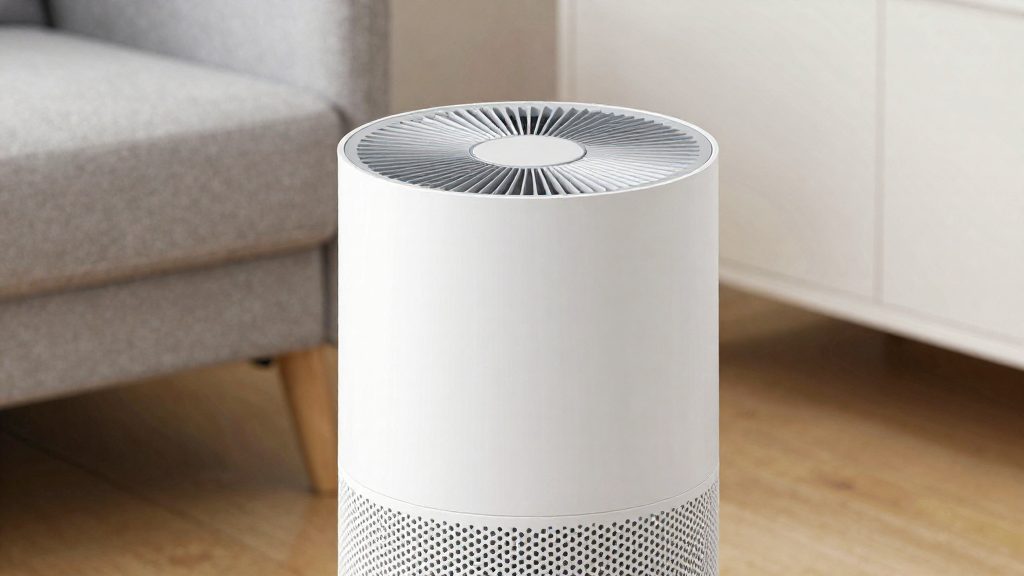
Why avoid ozone-producing devices?
Health Canada advises avoiding air cleaners that produce ozone, because ozone can harm health (Health Canada, 31 May 2024). This matters for odour control because a carbon-based purifier removes odour molecules through its filter. A device that adds ozone to the room introduces a separate airborne pollutant, so it does not provide a safer version of the same function. Some portable air cleaners include an activated carbon or other absorbent filter that may help remove gases such as VOCs, and that filtration is the mechanism to look for.
Checking a model before purchase
The practical approach is to verify the model rather than rely on marketing claims. Health Canada suggests checking the California Air Resources Board (CARB) list of air cleaners tested for ozone emissions.
| Step | Where to find it | Purpose |
|---|---|---|
| Exact model name and number | Product label or manual | Needed to search the list accurately |
| Check the CARB list | California Air Resources Board list | Confirms whether the model was tested for ozone emissions |
| Filter cleaning or replacement schedule | Manufacturer instructions | Health Canada advises following it |
Keeping the filter working
Health Canada advises cleaning or replacing the filter as the manufacturer recommends. Following that schedule is the only maintenance step the official source specifies for keeping the filter in working order. Keep the manufacturer’s documentation with the device so the schedule is available when needed.
When to replace the activated carbon filter?
Health Canada advises cleaning or replacing an air cleaner’s filter as the manufacturer recommends (Health Canada, 2024-05-31). Timing depends on the specific model, how many hours it runs, and how strong the odours are in the room.
Follow the manufacturer’s recommendation
The manufacturer’s instructions are the reference point for replacement. Check the user manual or product page for the stated interval and the exact type of carbon cartridge to use.
- Record the date each carbon filter is installed, so you can compare it against the recommended interval.
- Check whether the unit has a filter-change indicator and whether it resets after replacement.
- Keep a spare cartridge of the same model so the unit is never run without a filter.
Watch for odour return
A common sign that the carbon is saturated is an odour that comes back soon after the unit has been running. Carbon adsorbs gases until its surface is occupied, so once it is saturated, it stops removing new odours effectively. Note how long the air stays fresh after installing a new filter, and use that period as a rough baseline for judging the current one.
Why carbon cannot be compared by a standard rating
Health Canada notes that there are no widely used performance rating systems for gas-removal filters, and that carbon performance on odours cannot be compared with a CADR-type rating. You therefore cannot use a standard figure to predict how long a carbon filter will last across brands. Rely on the manufacturer’s own replacement guidance for each model.
Odour Sources, Ventilation and Humidity
Activated carbon filters target gases, which is why they can help with some odours, but they work best alongside control of the source. Health Canada (2024) notes that some portable air cleaners include an activated carbon or other absorbent filter, which may help remove gases such as VOCs. A purifier does not stop an odour from being produced. Cooking fumes, waste bins, damp materials and pets keep generating smells until the source is reduced or fresh outdoor air replaces the stale indoor air.
Why odour performance is hard to compare
Health Canada states that no widely used performance rating systems exist for filters designed to remove gases, so carbon performance on odours cannot be compared with a CADR-type rating. When comparing models, check the manufacturer’s stated filter specification and replacement schedule instead of relying on a CADR figure, which describes smoke, dust and pollen removal.
Ventilating at the source
Odour control starts with extraction at the point of production:
- Run kitchen extraction during cooking, and bathroom extraction during and after showers.
- Ventilate the room where the smell originates rather than expecting a single unit to clean the whole home.
- Confirm that any mechanical ventilation system in your home, such as a heat- or energy-recovery ventilator, is running and that its air inlets and outlets are not blocked.
Humidity and musty smells
A musty smell often signals a moisture problem. Treating the moisture source comes first, and carbon alone will not fix it. Carbon is aimed at gases, not water vapour, so a damp odour calls for moisture control first: ventilate and dry wet areas, and look for condensation on cold surfaces. If the smell persists after moisture is reduced, the source may be a material that remains damp.
Sizing and filter upkeep
Health Canada’s sizing guidance concerns smoke and particles, not odours. Its recommendations are summarised below.
| Health Canada guidance | Recommendation |
|---|---|
| Smoke CADR | Choose the highest value that fits your budget |
| Room coverage | Smoke CADR of at least two-thirds of the room’s floor area |
| Filter care | Clean or replace the filter as the manufacturer recommends |
Frequently asked questions
Can an activated carbon filter remove cooking or pet odours from a room?
Health Canada (2024) notes that some portable air cleaners use an activated carbon or other absorbent filter, which may help remove gases such as VOCs that carry many everyday smells. Results depend on the device and the amount of odour in the room.
How can I compare odour performance between two purifiers?
No widely used rating system exists for gas-removal filters, so you cannot compare them with the CADR figure used for particles. Look at how each manufacturer describes its carbon filter and its replacement schedule.
Should I avoid any type of air cleaner for odours?
Yes. Health Canada (2024) advises avoiding devices that produce ozone, because ozone can harm health. It suggests checking the California Air Resources Board (CARB) list of air cleaners tested for ozone emissions before you buy.