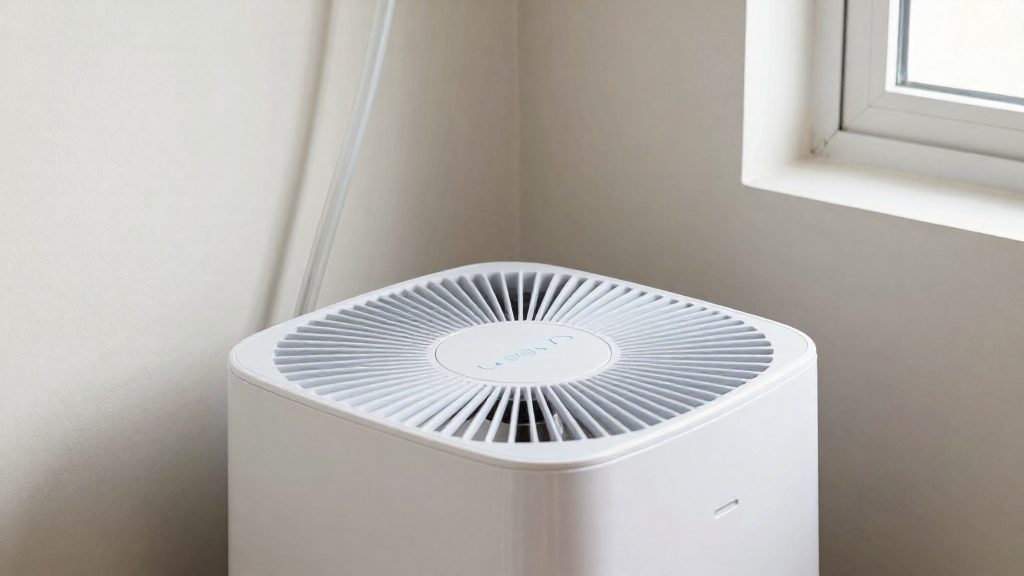
A basement with no floor drain is best served by a dehumidifier with a built-in pump. According to HVACbase (2026), a built-in pump pushes water up a hose to a sink or outdoors, so the unit does not depend on a drain below it. A bucket model also works if you accept emptying it by hand. The alternatives are a removable bucket that you empty by hand or a hose fitting, which only works if a floor drain or sump pump is available. The volume of water, the full-reservoir shutoff, and the route the water takes all depend on that choice.
Why a basement with no drain needs a pump or a bucket
Daily condensate volume
Condensate is the water the unit pulls out of the air, and its daily volume depends on how damp the space is. The unit runs for much of the day in a damp basement, so the reservoir or hose fills continuously rather than in bursts.
Overflow and automatic shutoff
Most portable units use a removable bucket with an automatic shutoff that stops the compressor when the bucket is full, according to ENERGY STAR (EPA/DOE) (2026). This prevents spillage, but the unit stops removing moisture until the bucket is emptied. The room’s humidity then climbs back toward damp levels.
Water flow path from unit to disposal
The route the water takes depends on the drain option the unit supports:
| Drain option | Where the water goes | Requirement |
|---|---|---|
| Removable bucket | Stored in the tank | Manual emptying (HVACbase, 2026) |
| Hose fitting | Through a hose to a floor drain or sump pump | Floor drain or sump pump (ENERGY STAR, 2026) |
| Built-in pump | Pumped up a hose to a sink or outdoors | Pump in the unit (HVACbase, 2026) |
| Gravity drain | Flows down to a drain | Floor drain below the unit (HVACbase, 2026) |
In a basement with no drain, the realistic choices are the bucket or a built-in pump routed to a sink or outside. A hose fitting only helps if a floor drain or sump pump is available.
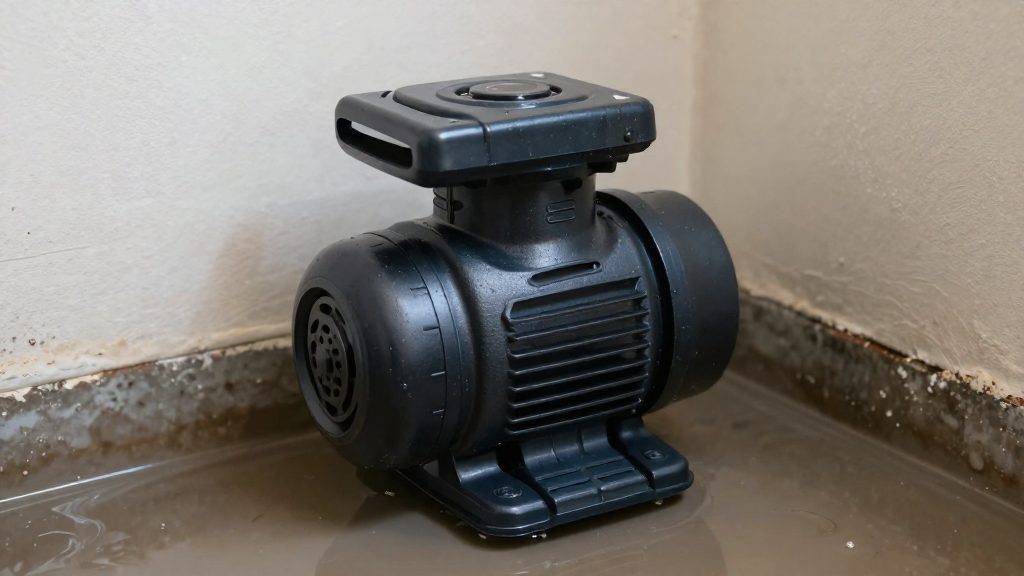
Which dehumidifier type works with no floor drain?
A basement without a floor drain needs a dehumidifier with a built-in pump. According to HVACbase (2026), a basement with no floor drain needs a dehumidifier with a built-in pump, while bucket models need manual emptying. Because the pump moves water upward, the unit does not depend on gravity to remove it from the room.
Other designs fail this test for different reasons:
| Design | Water exit | Suitable without a floor drain? |
|---|---|---|
| Built-in pump | Hose pushes water up to a sink or outdoors | Yes |
| Gravity drain | Hose runs downhill to a floor drain or sump | No, a floor drain must sit below the unit |
| Bucket only | Removable tank, emptied by hand | Yes, but requires manual emptying |
Identifying pump-equipped models
Check the product specification for explicit pump wording before buying. A pump model is described as one that pushes water upward, so a product page that only lists a “drain hose” without mentioning a pump should be treated as unconfirmed.
Hose fittings on portable units
Some portable dehumidifiers have a hose fitting, which lets water drain to a floor drain or sump pump instead of the bucket, according to ENERGY STAR (EPA/DOE, 2026). A fitting alone does not confirm a pump. Check the manufacturer’s specifications to see whether a given model includes one. The removable bucket serves as the fallback when no hose is connected.
Ruling out gravity-drain units
If a basement has no floor drain, eliminate any gravity-drain model immediately. A gravity-only design installed in a drainless space has nowhere to send its water.
How many pints does your basement need?
ENERGY STAR sizes portable dehumidifiers by how many pints of water they remove per day, and it sets the minimum capacity from two inputs: floor area and dampness. For a space under 2,000 sq ft, the minimum is 20-30 pints/day when the basement is slightly to moderately damp, 25-40 pints/day when it is very damp, and 30-50 pints/day when it is wet, according to ENERGY STAR (EPA/DOE, 2026). These figures are minimums, so a unit rated at the bottom of a band may run almost continuously in a severely damp room.
Sizing bands under 2,000 sq ft
To find your number, measure the basement’s floor area in square feet, judge its dampness, then read the matching row:
| Dampness level | Minimum capacity, space under 2,000 sq ft |
|---|---|
| Slightly to moderately damp | 20-30 pints/day |
| Very damp | 25-40 pints/day |
| Wet | 30-50 pints/day |
Larger spaces above 2,000 sq ft
For spaces of 2,000 sq ft or more, ENERGY STAR gives these minimums:
- 30+ pints/day
- 40+ pints/day
- 50+ pints/day
For large basements, match the tier to the dampness you observe and treat the lowest figure as a floor, not a goal.
The size-up rule
ENERGY STAR advises that when in doubt, size up. This applies when a basement falls between two bands, when its dampness is difficult to classify, or when the floor area sits near the 2,000 sq ft boundary. A larger unit gives more margin than the minimum of a band, so choosing the higher tier is the safer decision.
Built-in pump vs. bucket vs. gravity hose
For a basement without a floor drain, the three water-removal methods differ mainly in where the collected water goes. A gravity hose depends on water flowing downhill to a floor drain or sump pump. A bucket model collects water in a removable tank that you empty by hand.
| Method | Drain required | Where water goes | Manual emptying | Interruption risk |
|---|---|---|---|---|
| Built-in pump | None | Up through a hose to a sink or outdoors | Not needed while the pump runs | Pump or hose failure stops drainage |
| Gravity hose | Floor drain or sump pump below the unit | Downhill to the drain | Not needed | Blocked or sagging hose stops drainage |
| Bucket | None | Stays in the tank | Required | — |
Pump lift and discharge routing
The main difference is lift. A pump-equipped unit pushes water up a hose to a sink or outdoors, while a gravity hose needs a floor drain below the unit. Check the manufacturer’s manual for maximum lift height and hose length before choosing a route. Route the hose to a sink or outdoors with no kinks, and avoid dips where water can sit and block the line.
Manual emptying frequency for bucket models
To set a routine, record how often the bucket fills during the first week in your basement, then empty it before that point.
Pump failure and overflow scenarios
A pump or hose failure is a possible risk for pump-equipped units. Check the manual for what happens if the hose blocks or the pump fails. Confirm in the manual whether built-in pumps have an overflow sensor. For gravity hoses, check that the floor drain is clear, because a blocked drain stops flow in the same way.
Running interruptions in cold basements
Cold conditions can make a compressor coil frost up regardless of drainage method. See the cold basements section for auto-defrost and desiccant options.
What humidity level should you aim for?
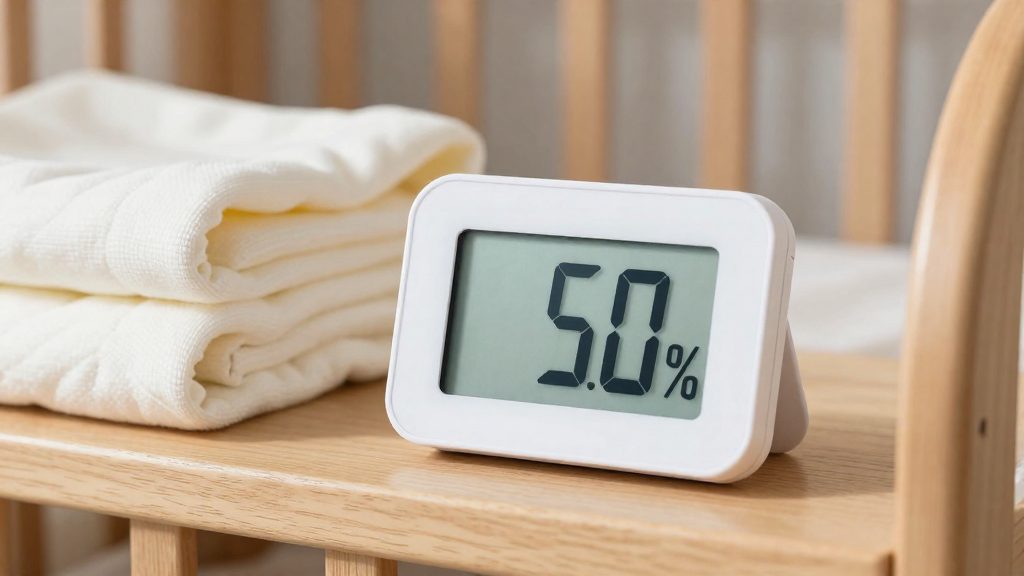
The U.S. EPA (2026) advises keeping indoor relative humidity (RH) below 60% at all times, and ideally between 30% and 50%. Basements are cool and in contact with the ground, so they can run damp, and the 60% ceiling is the limit to watch. The goal is not to push the reading as low as the unit can go, but to hold it inside the target band.
Winter requires a different figure. ENERGY STAR (EPA/DOE, 2026) recommends 30% to 40% RH in cold climates during the heating season to limit window condensation. Warm air can hold more moisture, but window glass stays cold and cools the air touching it, so water condenses on the glass when the room’s humidity is too high.
| Condition | Target RH | Source |
|---|---|---|
| Upper limit, any season | Below 60% | U.S. EPA (2026) |
| Ideal band, general living spaces | 30% to 50% | U.S. EPA (2026) |
| Heating season, cold climates | 30% to 40% | ENERGY STAR (EPA/DOE, 2026) |
To hold these bands:
- Set the built-in humidistat to the 30% to 50% range for most of the year.
- Lower the setpoint into the 30% to 40% range during the heating season in cold climates.
- Keep the setpoint within the band rather than at its lowest value, so the unit does not run longer than needed.
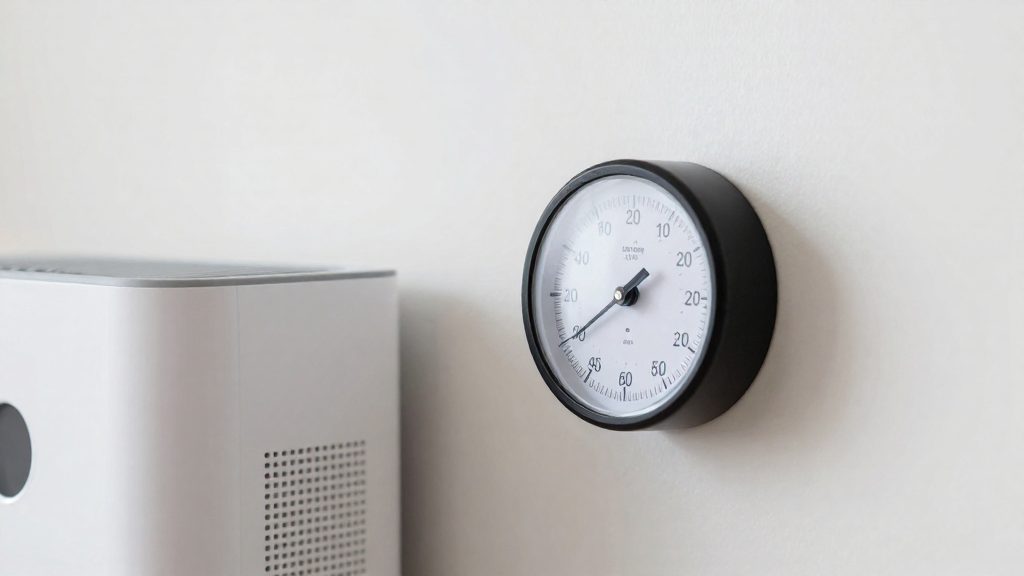
Cold basements: auto-defrost or desiccant?
Cold basements change which dehumidifier technology works. A standard compressor unit cools air across a coil to condense moisture, so the coil must run colder than the room air. When the room is cold, that coil can frost, and frost blocks airflow and stops water collection. HVACbase (2026) advises that for basements often below about 65°F, you should choose an auto-defrost model, because compressor units can frost up in cold spaces. A desiccant model is the alternative for these conditions.
Coil icing and defrost behaviour
An auto-defrost unit detects frost buildup on the coil and runs a defrost cycle to melt it, so the unit can keep dehumidifying in cool conditions. Units without this feature are the ones HVACbase (2026) warns about for cold basements. Check the trigger temperature, defrost interval, and length of each cycle in the manufacturer’s specification before buying, and confirm that the defrost function is listed.
Desiccant rotor: energy use and heat output
A desiccant model removes moisture with an absorbent rotor instead of a cold coil, and HVACbase (2026) names it as the alternative for cold basements. The consulted sources give no figures for the energy consumption of a desiccant rotor or for its heat output. To compare units, read the rated power input on each label and check whether the specification lists exhaust heat. Divide the rated power by the pints removed per day to compare energy use per unit of water.
Operating temperature thresholds
| Technology | Guidance (HVACbase, 2026) | Limit stated |
|---|---|---|
| Auto-defrost compressor | Choose for basements often below about 65°F | Standard compressor units can frost up in cold spaces |
| Desiccant | Alternative for the same cold conditions | No temperature threshold given in the consulted sources |
| Mini/Peltier | Suits only small, mildly damp spaces | Not suitable for larger or very damp basements |
Is a dehumidifier enough to stop mold?
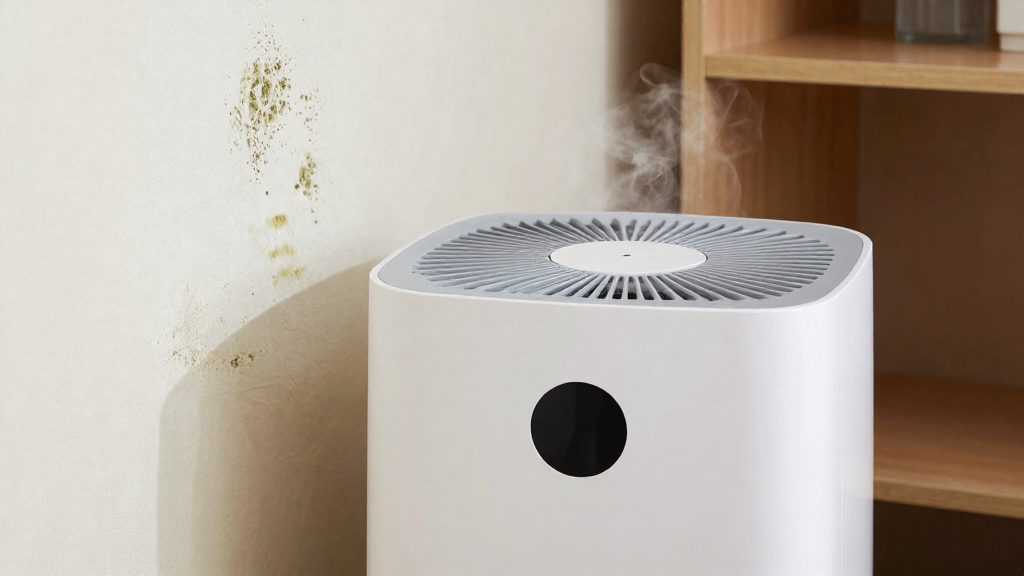
No. A dehumidifier lowers moisture in the air, but it cannot stop mold by itself while water is still entering the basement. Mold needs a damp surface to establish, so the deciding factor is how quickly wet materials dry after water intrusion. According to the U.S. EPA (2026), if water-damaged areas are dried within 24-48 hours after a leak or spill, mold usually will not grow. A dehumidifier is one tool in that drying process.
The 24-48 hour drying window
The drying window starts when the water event happens. Remove wet items, run the dehumidifier in the affected room, and check that carpet, drywall, and stored materials are actually drying. Materials still wet after 48 hours fall outside the window the U.S. EPA (2026) identifies, so mold growth can no longer be ruled out.
Why cleaning without fixing moisture fails
Scrubbing visible mold removes the growth but not the moisture that feeds it. The U.S. EPA (2026) states that cleaning mold without fixing the water problem means it will likely return. A dehumidifier running beside a wall that still seeps keeps the surface damp, so the mold comes back. Treat the water source first, then clean and dry the affected area.
Limits when a source leak persists
A dehumidifier removes water vapor from the air. It cannot stop liquid water entering through walls or floors. The table below summarises how the unit’s role changes depending on the situation.
| Situation | What the dehumidifier does | Source |
|---|---|---|
| Surface dried within 24-48 hours | Helps meet the drying window | U.S. EPA (2026) |
| Water still entering the basement | Lowers airborne moisture only; intrusion continues | U.S. EPA (2026): cleaning mold without fixing the water problem means it will likely return |
Placement, hygrometer and maintenance
Placement, hygrometer choice and routine cleaning all affect how well a drainless basement dehumidifier performs. For wall-clearance distances and other dimensions, the manufacturer’s manual takes priority. A basic hygrometer costs roughly $10-$50 and is sold at many hardware stores, according to U.S. EPA (2026), so checking the unit’s readings independently is inexpensive.
Unit positioning and airflow clearance
- Keep the air intake and outlet grilles free of obstructions. Do not place the unit flush against a wall, behind shelving or beneath stored boxes.
- Position the unit so air can circulate across the basement rather than into a closed corner.
- Keep the area around the unit clear of items that could be damaged by moisture or be blocked by water if the bucket overflows.
Hygrometer selection and placement
- ENERGY STAR (EPA/DOE, 2026) advises using a separate hygrometer when the unit shows no humidity reading. The built-in humidistat sets the target in that case, so the separate meter confirms it.
- Place the meter in open air, away from the unit’s outlet, so it measures the room rather than the discharged air.
- Compare the meter with the unit’s display at intervals. A consistent difference between the two suggests that one of them should be checked.
Routine maintenance
- Clean the air filter and coil according to the manual. The consulted sources do not give a fixed cleaning interval.
- Check the coil for frost during cold periods.
Frequently asked questions
Can I run a dehumidifier in a basement that has no floor drain?
Yes. Choose a unit with a built-in pump, which lifts collected water through a hose to a nearby sink or outside, according to HVACbase (2026). If the unit has no pump, you will need to empty its bucket by hand.
How do I choose the right capacity for a damp basement?
For spaces under 2,000 sq ft, ENERGY STAR (EPA/DOE) (2026) lists a daily removal range of 20-30 pints for slightly damp conditions, 25-40 pints for very damp, and 30-50 pints for wet. Larger spaces need higher ratings. If you are unsure which category applies, choose the higher capacity.
Will a dehumidifier work in a cold basement?
It can, but a standard compressor model may frost up in cold conditions. HVACbase (2026) advises choosing an auto-defrost model for basements that are often below about 65°F. A desiccant dehumidifier is the alternative for cold spaces, while mini or Peltier units suit only small, mildly damp rooms.