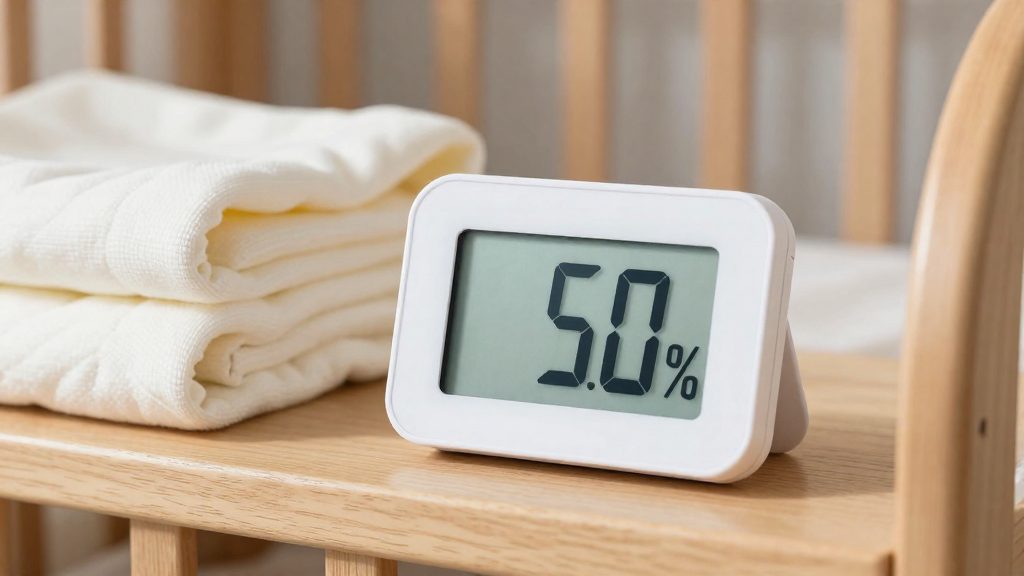
For a baby nursery, Stadler Form, a humidifier manufacturer, recommends 40–60% relative humidity in a child’s room, with a room temperature of about 18–20 °C (about 64–68 °F). Humidity and temperature should be read together, because the same relative humidity value represents different amounts of water vapour at different temperatures.
What is the ideal humidity for a baby nursery?
The 40–60% target range
Stadler Form’s recommendation of 40–60% is a manufacturer guideline for children’s rooms (Stadler Form, 2022-09-29). The official sources consulted do not specify a separate regulatory limit for nurseries, so this range is best treated as a practical target rather than a legal standard. Staying inside it keeps the air neither too dry nor too damp for a room where a baby sleeps for long periods.
The 18–20 °C temperature context
Stadler Form also suggests a nursery temperature of about 18–20 °C. The two targets are linked: relative humidity changes with temperature even when the amount of moisture in the air stays constant.
Relative humidity and dew point
Relative humidity is the amount of water vapour in the air expressed as a percentage of the maximum the air could hold at that temperature. Warmer air can hold more vapour, so relative humidity drops when the room warms, and rises when it cools, without any change in moisture content.
Dew point is the temperature at which the air becomes saturated (100% relative humidity) and water vapour begins to condense. Surfaces that fall to the dew point, such as external walls or window panes, are where condensation forms. Knowing the dew point explains why condensation can still occur in a room within the target settings: any surface colder than the dew point of the room air, such as a window pane or an exterior wall, can collect moisture.
Why the EPA range is 30–50%
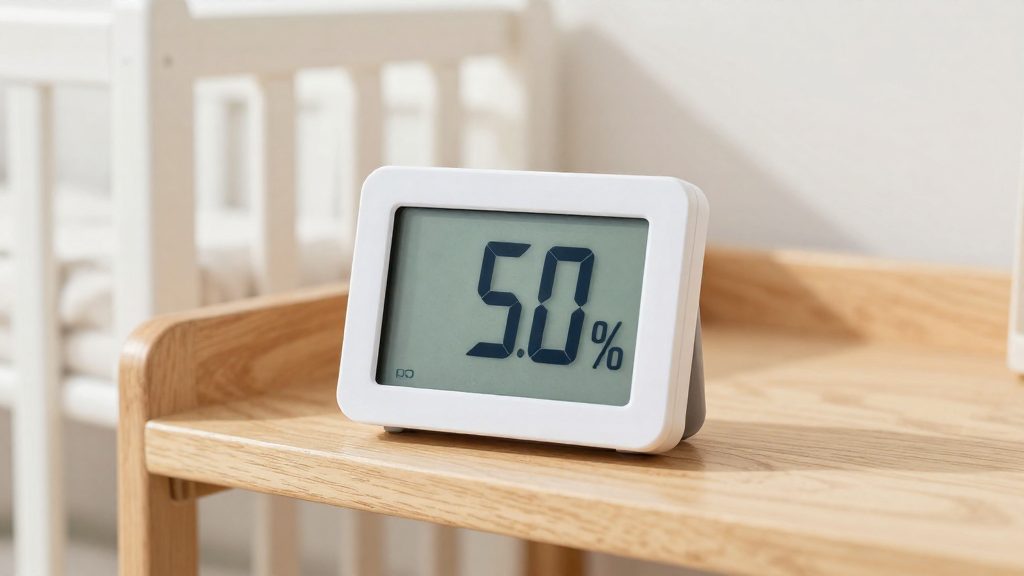
The U.S. Environmental Protection Agency (EPA) sets two levels for indoor air. Keep indoor relative humidity below 60 percent, and ideally between 30 and 50 percent if possible (U.S. Environmental Protection Agency, Mold Course Chapter 2). The 60 percent figure is the relative humidity ceiling, the limit the EPA asks households not to exceed. The 30–50 percent band is the target band, the range the agency considers preferable when it can be reached.
The official sources consulted do not explain in detail why the band sits at 30–50 percent, and they do not tie that range to a specific mold risk threshold. What they do establish is the structure of the guidance: the ceiling is the firm boundary, and the band is the goal inside it. The “if possible” wording indicates that the band is not a requirement in every building or climate.
General guidance versus infant-specific guidance
The EPA recommendation applies to indoor air in general. It does not address nurseries or infants. The official sources consulted do not provide an EPA humidity figure for infants. The only infant-specific guidance in the consulted material comes from Stadler Form, a humidifier manufacturer (2022-09-29). That is commercial product guidance, not a public health standard, and it should be read as such when comparing it with the EPA figures.
Measuring against the thresholds
The EPA states that humidity can be measured with a humidity gauge or meter, and that combined temperature and humidity monitors are widely sold. Use one of these instruments to compare the room’s reading with the 60 percent ceiling and the 30–50 percent band. The official sources consulted do not specify how many readings, or at what times of day, are needed to judge whether a room stays within these levels.
Signs the nursery air is too humid
Visible signs are the quickest way to spot excess moisture in a nursery because they appear on surfaces before any instrument is read. Most can be checked during a routine walk-through of the room. They appear in three places: the window glass, the walls, and the textiles the baby sleeps on.
Condensation on window glass
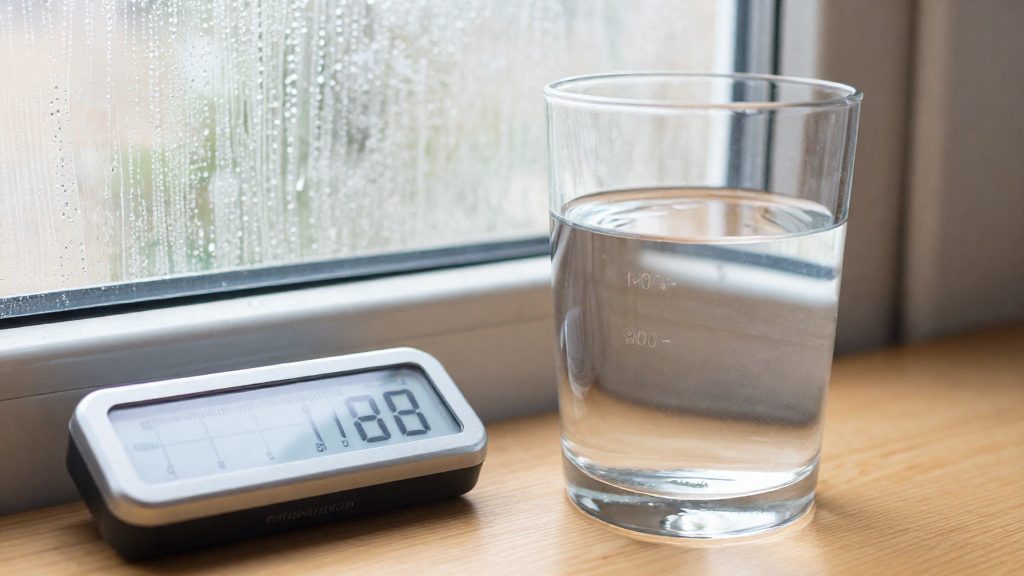
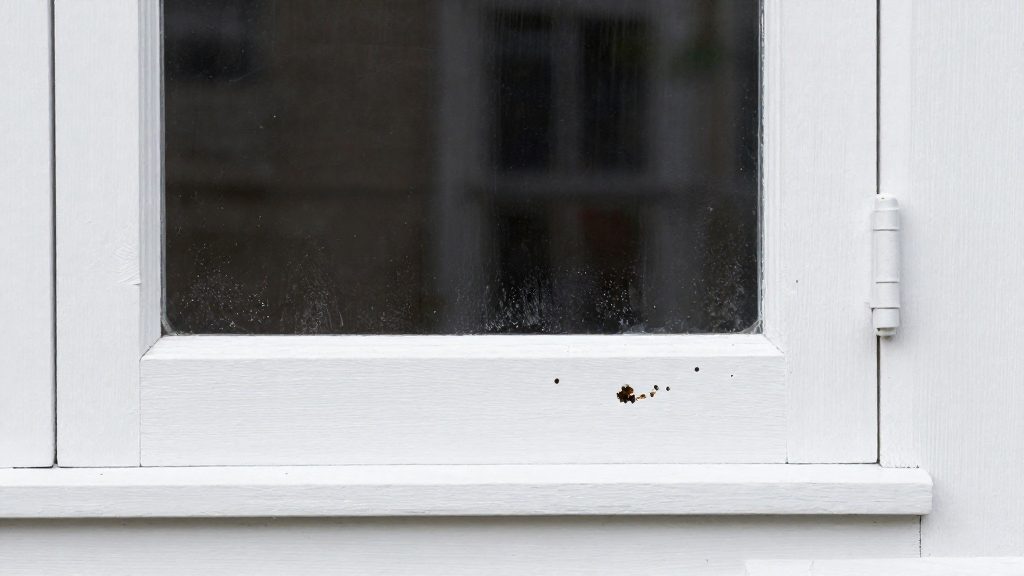
Condensation on the inside of the window pane is the most common visible warning. It usually shows first in the morning, when the glass is coldest. Check the lower part of the pane and the frame, where water collects and runs down. Repeated drips on the sill, or dark staining on painted or wooden frames, indicate that condensation is persistent rather than occasional.
Musty smell and mold on walls
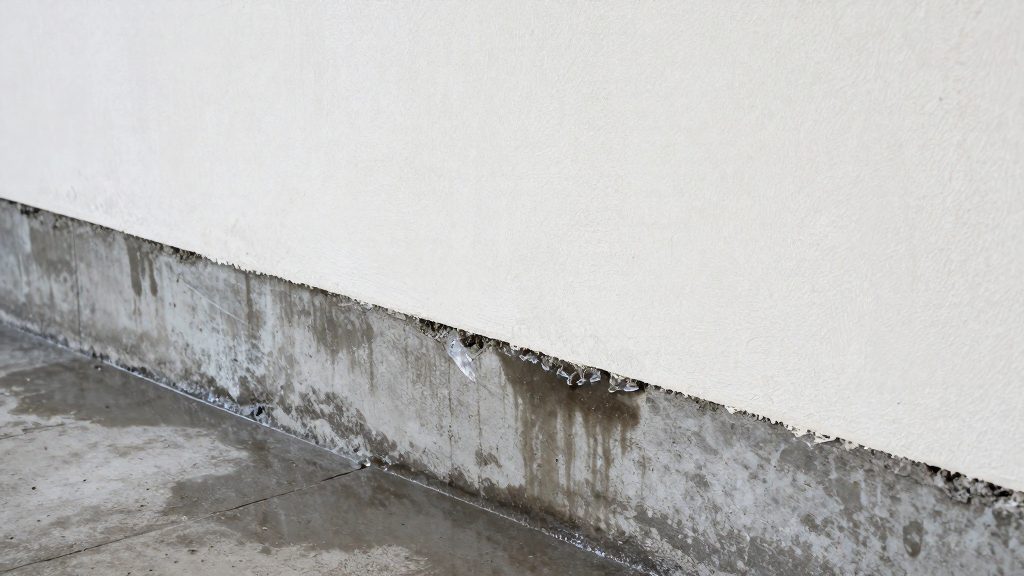
A stale, earthy odour that persists after the room has been aired is often the first sign of mold growth. Inspect the corners of exterior walls, the area behind wardrobes placed against them, and the window reveals. Black, grey or greenish spots, peeling paint, and wallpaper lifting from the wall show that moisture has reached the surface. Visible mold is a symptom of a moisture problem, so cleaning the surface alone does not resolve the cause.
Damp mattress, cot sheets and soft furnishings
Textiles absorb moisture from the air and hold it. Press the back of your hand against the mattress and under the cot sheet. A cold or clammy feel, or a faint musty smell when the bedding is lifted, signals excess moisture. Check curtains, rugs, soft toys and stored blankets as well. A stiff or musty texture on these items is a reason to review the room’s moisture balance.
| Location | Observable sign | Where to check |
|---|---|---|
| Window glass | Droplets, film or runoff on the lower pane and frame | Inside face of the glass and the sill |
| Walls | Musty odour, dark spots, lifting paint or wallpaper | Exterior-wall corners, behind furniture |
| Bedding and textiles | Cold, clammy or musty feel | Mattress, cot sheet, curtains, stored blankets |
Is dry air a problem for babies?
Low humidity in a nursery is mainly a comfort and skin-barrier concern. The official sources consulted do not quantify its effects on infant skin, airways or sleep. The practical question is whether the room stays within the target band and whether the baby shows signs that the air is too dry. The risk is highest in winter, when the heating season lowers the relative humidity of indoor air.
Dry skin and nasal irritation in infants
Dry air pulls moisture from the skin surface and the lining of the nose. In babies, this can appear as rough or flaky skin and a dry, irritated nose. The sources consulted do not specify the humidity level at which these effects begin, so the 40–60% range should be treated as a target for a comfortable nursery, not as a threshold for symptoms.
Heating season and dry indoor air
Heating raises the room temperature without adding moisture, so relative humidity falls even when the room feels comfortable. A nursery kept warmer than the target temperature in winter is more likely to drift below the target band. Readings also vary through the day, so a single reading gives an incomplete picture.
Symptoms that suggest air is too dry
Signs that warrant a closer look at the air include:
- Persistently dry or flaky skin on the face or body
- A dry or irritated nose
- Readings that stay consistently below 40%
The sources consulted do not establish a link between dry air and sleep disruption, so frequent night waking should not be attributed to humidity without other evidence. Dry air does not explain every symptom in a baby. Dry air does not explain every symptom in a baby. If your baby has trouble breathing, such as fast or labored breathing, grunting, the chest pulling in, blue or gray lips, or pauses in breathing, call 911 or go to the nearest emergency department immediately. If your baby is feeding poorly or has other symptoms that worry you, call your pediatrician the same day.
How to measure nursery humidity with a hygrometer
A hygrometer gives a useful reading only when it is placed and checked consistently. The U.S. Environmental Protection Agency notes that humidity can be measured with a humidity gauge or meter, and combined temperature and humidity monitors are widely sold. A single device that reports both values is a practical choice for a nursery.
Choosing the placement
Position the hygrometer in the part of the room where the baby sleeps, at a height that matches the cot. Keep it away from windows, where outdoor air and drafts can skew the result, and away from radiators, which warm the air around them and lower the relative humidity measured at that spot. Avoid closets, the space behind furniture, and the area directly in front of a humidifier outlet. A localized plume of moist air reads higher than the room as a whole.
Set the device on a stable surface and let it sit for a while before you read it, so the sensor adjusts to the room air rather than to the temperature of the object it rests on.
Reading frequency
According to Stadler Form (2022), a hygrometer should be checked several times a day rather than once. A single reading captures one moment only, and indoor humidity shifts with heating, ventilation and the number of people in the room. Record each check with its time. A log of several readings shows the daily pattern, while one reading can mislead.
Morning versus evening readings
The same source states that readings are usually higher in the morning than in the evening. Take readings at the same times each day, so that a difference reflects the room and not the moment you happened to look. A morning reading that is consistently higher than the evening one matches the expected pattern, but both readings should still be compared with the 60 percent ceiling.
| Time of day | Typical pattern (Stadler Form, 2022) | What to log |
|---|---|---|
| Morning | Usually higher | Relative humidity (%), temperature (°C), time |
| Evening | Usually lower | Relative humidity (%), temperature (°C), time |
Should you use a humidifier or dehumidifier?
The choice depends on one measurement: the relative humidity in the nursery. As a practical rule based on the manufacturer’s 40–60% range, consider adding moisture when the reading falls below 40 percent, and removing moisture when it rises above 60 percent, which is the EPA ceiling. The EPA’s preferred band is 30–50 percent where achievable.
| Measured relative humidity | Action | Reference |
|---|---|---|
| Below 40% | Use a humidifier | Lower limit of the nursery range (Stadler Form, 2022-09-29) |
| 40–60% | No device needed to meet the manufacturer range; 50–60% is above the EPA’s preferred 30–50% band but under its 60% ceiling | Nursery range (Stadler Form, 2022-09-29); EPA ceiling and band (U.S. Environmental Protection Agency) |
| Above 60% | Use a dehumidifier | EPA upper limit (U.S. Environmental Protection Agency) |
When a humidifier fits
A reading under 40 percent means the air is drier than the target band. Run the humidifier until the reading returns to the 40–60% band. Continuing to run it after that pushes the room toward the upper limit, which is the opposite of the goal.
When a dehumidifier fits
The 60 percent value is both the EPA’s upper limit and the top of the nursery range, so a reading above it puts the room outside both references. The official sources consulted do not specify a set run time or output setting for nursery use.
Ultrasonic versus evaporative technology
Two humidifier technologies are widely sold, and they add moisture in different ways:
| Technology | How it adds moisture |
|---|---|
| Ultrasonic | A vibrating element converts water into a fine mist |
| Evaporative | A fan draws air through a wet pad, and water evaporates into the airflow |
The official sources consulted do not specify performance differences between the two types for nursery use.
How do you keep a humidifier safe and clean?
A nursery humidifier stays safe when its water, tank and filter are maintained on a fixed routine. The tasks below limit the build-up of mineral deposits and the growth of microorganisms in the water reservoir, which is where a humidifier can otherwise become a source of contamination.
Daily water change and tank cleaning
Each day, empty the tank completely rather than topping up the existing water. Rinse the tank, wipe the interior with a clean cloth to remove residue, then refill it with fresh water. Stale water left in the tank can allow microorganisms to grow and can release contaminants into the room air.
Regular descaling against mineral deposits
Mineral deposits, or limescale, form as water evaporates and accumulate on the tank walls and internal parts. Descale the unit at regular intervals using a descaling product compatible with the model, and follow the manufacturer’s instructions for dilution and contact time. The official source does not specify an exact descaling interval, so set one based on how hard your local water is and how visible the deposits become.
Filter replacement schedule
Replace the filter every two to three months, as Stadler Form recommends. Replacing it on schedule keeps the unit working as designed; a filter that is kept past its replacement point can no longer perform its role effectively.
Maintenance schedule at a glance
| Task | Frequency | Source |
|---|---|---|
| Change water and clean tank | Daily | Stadler Form (2022-09-29) |
| Descale mineral deposits | Regularly (no fixed interval specified) | Stadler Form (2022-09-29) |
| Replace filter | Every 2–3 months | Stadler Form (2022-09-29) |
Ventilation and condensation tips
Ventilation is the main way to stop moisture from building up in a nursery. Humid air from breathing, bathing, drying laundry indoors and warm radiators has to leave the room. Air exchange is the practical tool for reaching the target band. Three habits work on different parts of the problem: extracting air mechanically, airing in short bursts, and keeping furniture clear of the coldest walls.
Mechanical ventilation extraction and air exchange
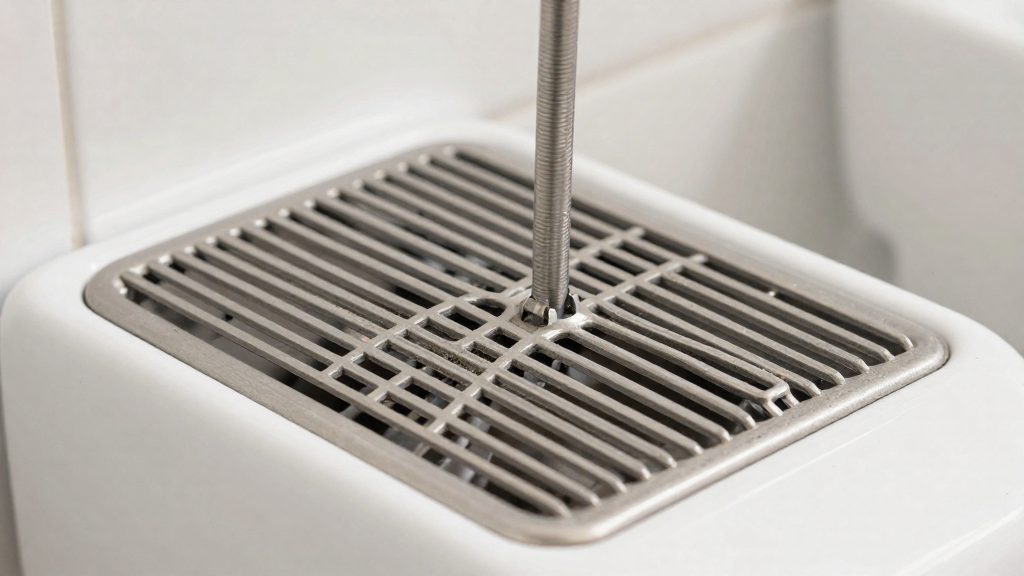
A mechanical ventilation system extracts humid air from wet rooms, for example through bathroom exhaust fans, and brings in fresh air. For a nursery, the extraction only works if the path is clear:
- Keep the outlet unobstructed. Curtains, cots, bins or furniture placed over or near a ventilation grille block the airflow.
- Clean the grille and cover. Dust reduces the airflow the system can deliver.
- Keep the system running when the room is in use. A unit switched off or set to a low speed lets humidity accumulate.
- Allow air to circulate. Leaving the nursery door open to a corridor gives the air a route between the room and the extraction point.
Short daily airing and cross-ventilation
Brief, full airing is more effective than a window left slightly open. A short opening replaces the room’s air quickly, while a window ajar for hours mainly cools the surrounding surfaces and removes little moisture.
Cross-ventilation means opening the nursery window and a window or door elsewhere in the dwelling at the same time. Air then moves through the room and carries humid air out faster than a single opening does.
Airing is most useful right after moisture-producing activities such as bathing or drying laundry indoors. Because a nursery is kept at a steady temperature, rapid cooling should be limited, so airing should be short enough to avoid a sharp drop in room temperature.
Furniture placement away from cold external walls
Cold external walls are where condensation most often forms, because their surface temperature falls below that of the room air. Moist air condenses on these surfaces first.
Furniture pushed flat against an exterior wall traps a layer of still, moist air and blocks the warming effect of the room. This raises the risk of damp patches and mould behind the furniture. To reduce that risk:
- Leave a gap between large furniture, such as a wardrobe or bookcase, and an external wall.
- Keep the cot away from exterior walls, and avoid storing textiles, stuffed toys or cardboard boxes directly against them.
- Check the wall behind large furniture at least once a season for dark marks or a musty smell.
Frequently asked questions
What relative humidity should a baby’s nursery have?
Stadler Form, a humidifier manufacturer, recommends 40–60% relative humidity in a child’s room, at about 18–20 °C (64–68 °F) (Stadler Form, 2022). The U.S. Environmental Protection Agency keeps its ceiling at 60% and its preferred band at 30–50%, so readings between 50% and 60% are acceptable but sit above that preferred band.
Can a humidifier in the nursery affect air quality if it is not cleaned?
Yes. Water that stays in the tank can let microorganisms multiply, and these can be released into the room air with the mist. Stadler Form advises emptying and cleaning the tank daily, descaling regularly, and replacing the filter every 2–3 months (Stadler Form, 2022).
When should I contact a doctor about my baby’s breathing or feeding?
Fast or labored breathing, grunting, chest pulling in, blue or gray lips, or pauses in breathing need immediate emergency care: call 911 or go to the nearest emergency department. Poor feeding or other symptoms that worry you warrant a same-day call to your pediatrician, and the room’s humidity alone should not be assumed to be the cause.