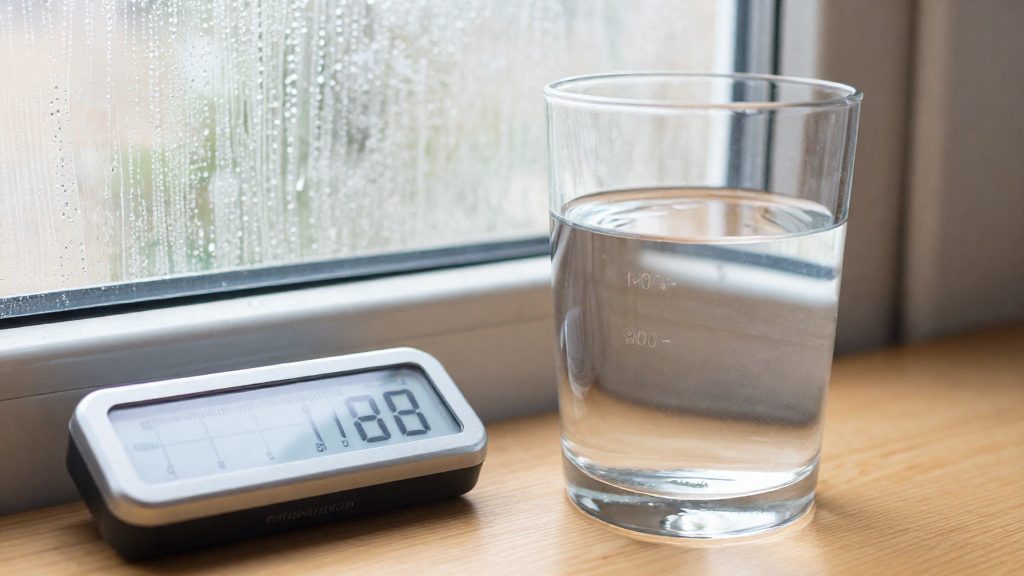
Partly. Observation can reveal likely problems such as condensation, stuffy air, musty smells and mold, but it cannot tell you how much moisture or carbon dioxide is in the air. Equipment-free checks are a screening step: they show where a problem may exist and whether it needs measuring. They do not produce a reading.
Can you test indoor air quality without equipment?
What observation can establish
Several signs are visible or noticeable without instruments:
- Condensation on windows, walls or pipes, which the U.S. EPA says can be a sign of high humidity.
- Stuffy air, moisture condensation on cold surfaces, and mold or mildew growth, which EPA lists as signs of inadequate ventilation.
- Persistent musty odors and dust buildup near vents, which Popular Science lists as observational signs.
- Signs of dry air (nosebleeds, warped wood) or excess moisture (mold around vents or HVAC), also per Popular Science.
- Visible mold, condensation or standing water, dirty filters, stored solvents and new carpet, as described in HouseFresh’s visual inspection method.
Each sign shows that a condition exists in a given place. It does not show its size or cause.
Where observation stops
A sign identifies a condition, not a concentration. Condensation on a window can result from cold glass or from humid indoor air, and nothing on the surface tells you which. Symptoms such as sneezing, coughing or headaches also overlap with many unrelated causes, so they cannot confirm a specific air problem on their own. Popular Science notes that consumer monitors are useful for trends but less precise than professional equipment, which means that any numerical result, even from a consumer device, has a margin of error.
Screening versus measurement
| Approach | What it can establish | What it cannot establish |
|---|---|---|
| Visual and sensory checks | Presence of likely problems such as condensation, mold or musty odor | Exact humidity or gas levels |
| Symptom journal kept for a few weeks | Whether symptoms cluster in particular rooms or improve away from home | The cause or the concentration of anything in the air |
| Hygrometer | A relative humidity reading for a given spot | Air quality beyond humidity |
Logical order for a home air check
- Start with a visual inspection.
- Record where condensation appears and on which surfaces.
- Review ventilation habits. Noting whether fans and windows are used during showers and cooking gives context for what you see.
- Keep a symptom journal for a few weeks, noting the room and whether symptoms improve when you are away from home.
- Move to measurement only when signs persist or you need numbers.
Signs your air is bad: smell, condensation and mold
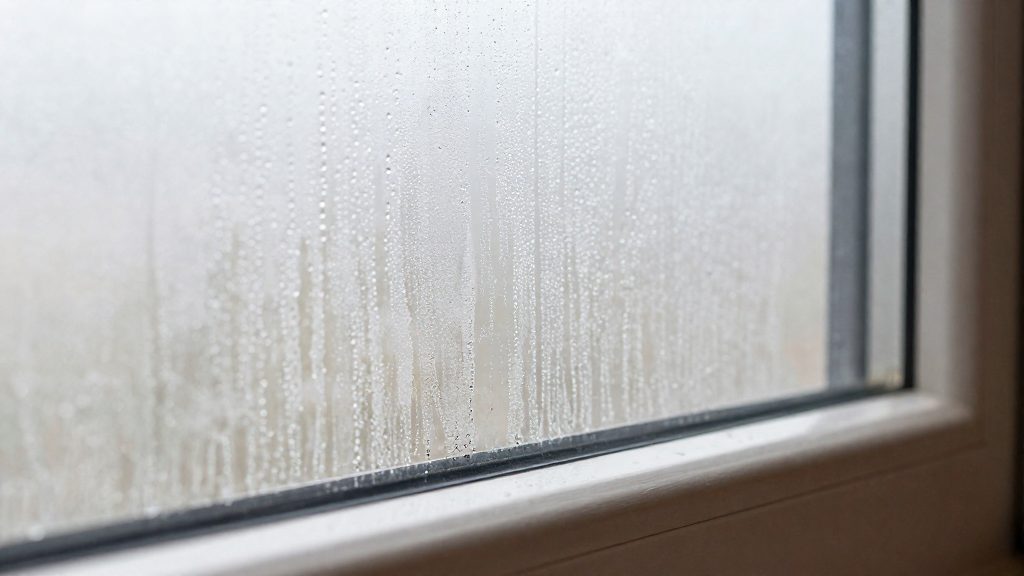
Three observable signs point to excess indoor moisture: a persistent smell, water on cold surfaces, and visible growth. Each one has a physical cause that tells you where to look.
Musty odour as a microbial signal
A persistent musty smell can accompany excess moisture, and mold or mildew growth on damp materials is a possible source. Because the compounds are released from the growth itself, the smell is strongest close to the source. A smell that returns after you air out a room suggests the moisture source is still present.
Dew point and condensation staining
Condensation forms when a surface is colder than the dew point of the air touching it, so water vapour turns to liquid on that surface. Check the lower part of window glass, wall corners, exterior walls and uncovered pipes. Repeated condensation leaves water beads, streaks or darkened patches that persist between wet episodes.
Visible mold: colour, texture and location
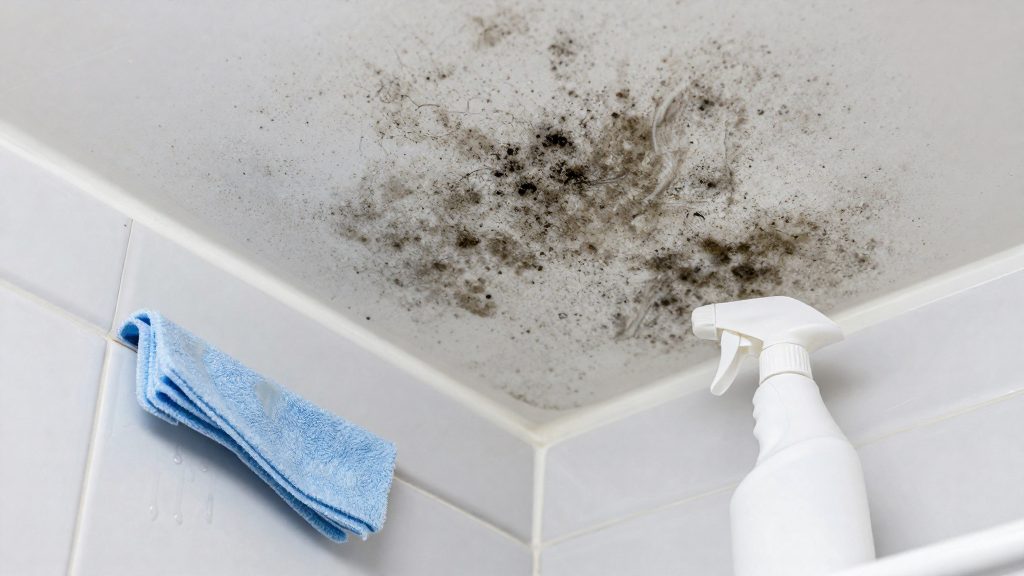
Visible growth is the most direct sign of a moisture problem. Note three features:
- Colour: Colour alone cannot identify the organism, so treat all visible growth as evidence of moisture rather than a diagnosis.
- Texture: Growth can look fuzzy, powdery or slimy, or appear as a flat stain on the surface. Record which form you see and whether it is raised or flush with the material.
- Location: Check cold corners, the backs of furniture placed against exterior walls, and areas near windows where condensation forms.
Summary of signs and what they indicate
| Sign | What it physically indicates | Where to check |
|---|---|---|
| Persistent musty odour | Microbial growth releasing volatile compounds | Carpets, corners, stored fabrics, near vents |
| Condensation beads or streaks | Surface colder than the air’s dew point | Window glass, wall corners, pipes |
| Visible mold or mildew | Growth on damp material | Around vents or HVAC, cold corners, behind furniture |
Dust buildup near vents points to airflow and filtration rather than moisture alone, so interpret it separately.
What symptoms can point to an indoor air problem?
Symptoms point toward indoor air when they follow a pattern in time and place. Headaches, fatigue and a feeling of stuffiness that appear at home and fade when you leave suggest that the building environment may be involved. Because EPA says carbon monoxide causes headaches, dizziness, disorientation, nausea and fatigue and can be fatal at high levels, make sure a working CO alarm is installed. If the alarm sounds or you suspect CO, get everyone outside to fresh air and call 911. Eye, nose and throat irritation is a second cluster to track. Popular Science lists sneezing, coughing and headaches among the symptoms worth noting.
Headache, fatigue and stuffiness
A heavy, close feeling in a room can be a sign of inadequate ventilation, as EPA lists stuffy air among such signs, but it does not prove it. It is most noticeable in bedrooms with closed windows and no running fan, and after activities that add moisture, such as showering or drying clothes indoors. Note whether the complaint is worst in one room, at certain hours, or after those activities.
Irritation of eyes, nose and throat
Sneezing, coughing and irritated eyes, nose or throat can accompany an indoor problem. Record each episode with its time and room.
Symptoms that ease away from home
This is the most useful test for separating an environmental cause from other causes. Keep a symptom journal for a few weeks, noting the date, time, room, and whether symptoms improved during time away, such as a weekend elsewhere. A pattern that repeats over several weeks is more meaningful than a single episode. A journal does not replace medical advice: see a doctor if symptoms persist or worsen. If you have severe symptoms such as dizziness, confusion or difficulty breathing, get outside to fresh air and call 911 or seek emergency care immediately, because carbon monoxide can be fatal.
| Pattern | What to record | Possible indoor link |
|---|---|---|
| Headache or fatigue worst in one room | Room, hour, ventilation state | Stuffy air, inadequate ventilation |
| Eye, nose or throat irritation | Room, activity, dust near vents | Dust buildup near vents |
| Symptoms easing away from home | Location and length of absence | Suggests an environment-linked cause |
| Musty smell or visible moisture | Location, timing after showers or cooking | Excess moisture |
A room-by-room visual inspection checklist
A walk-through of each room is the core of an equipment-free check. The first step is to confirm that each fan and exhaust route exists, works, and is used.
| Room or spot | What to check | Sign to note |
|---|---|---|
| Bathroom | Fan or window use during showers | Condensation on windows, walls or pipes |
| Kitchen | Exhaust fan use during cooking and dishwasher runs | Stuffy air that lingers after cooking |
| Dryer route | Whether the dryer vent leads outdoors | Dust buildup near the vent opening |
| Basement | Odors, damp surfaces, standing water | Persistent musty smell, mold |
| Cupboards | Back walls, corners, stored items | Mold or mildew growth |
| Behind furniture | Surfaces against exterior or cold walls | Mold, mildew, or condensation on cold surfaces |
Bathroom and kitchen extraction fans
Start with the two rooms that produce the most moisture and cooking byproducts. According to the U.S. EPA, the bathroom fan should run during showers, or a window should be opened, and exhaust fans should be used when cooking or running the dishwasher. Check whether the fan is actually switched on during these activities, then look around the fan housing and ceiling for mold or mildew growth. Note whether stuffy air remains after use.
Dryer venting and laundry drying routes
The U.S. EPA recommends venting dryers outdoors. Trace the exhaust duct from the appliance to its termination point. If the duct ends in the room or in a void rather than outside, that is a finding to record. Inspect the area around the duct and any vent openings for accumulated lint or dust.
Basements, cupboards and behind furniture
These spots are easy to overlook. In a basement, note persistent musty odors and condensation on cold surfaces. In cupboards and behind furniture, examine back walls, corners and the undersides of shelves for mold or mildew. Check any vent grille located in these hidden areas.
Is your humidity too high or too low?
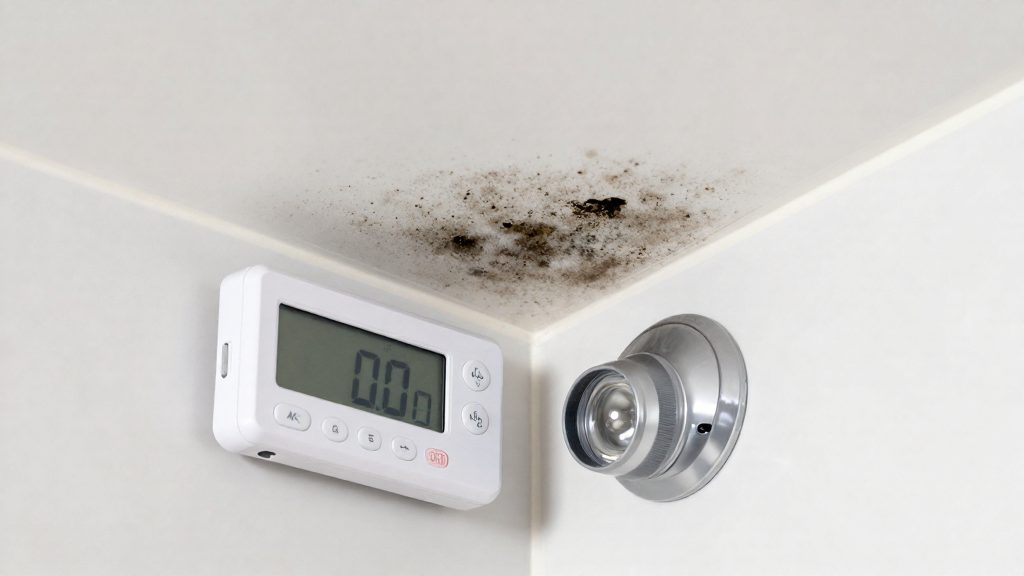
Physical cues can suggest whether indoor humidity is too high or too low, but only a hygrometer can show where you sit against the EPA target range. The U.S. EPA advises keeping indoor relative humidity below 60 percent, ideally between 30 and 50 percent. Dry air and damp air leave different traces, so start by identifying which side of that range your home appears to sit on. Popular Science notes that equipment-free checks are observational only, so treat these signs as indicators, not measurements.
Dry-air cues
Several signs point to air that is drier than the 30 to 50 percent ideal:
- Warped wood, which Popular Science lists among possible signs of dry air.
-
- Nosebleeds, which Popular Science lists among possible signs of dry air, though they have many other causes.
Excess-moisture signs
Other signs may point to excess moisture, which a hygrometer can confirm:
- Condensation on windows, walls or pipes.
- Mold or mildew growth.
- Persistent musty odors.
Humidifier overuse
A humidifier running at high output can push indoor humidity past the target range, and the excess-moisture signs then appear. If condensation or musty odors start after you begin using a humidifier, reduce its use and check humidity with a hygrometer against the EPA range.
Comparing observations with the target
| Observation | What it suggests |
|---|---|
| Static shocks, cracking or warped wood, nosebleeds | Air likely drier than the 30 to 50 percent ideal range |
| Condensation on windows, walls or pipes | Possible high humidity or inadequate ventilation; confirm with a hygrometer |
| Mold or mildew | Excess moisture; measure humidity to confirm |
| Persistent musty odors | Possible excess moisture; measure humidity to confirm |
What can’t your senses detect?
Some of the most serious indoor hazards give no warning through smell or sight. Radon, carbon monoxide and carbon dioxide buildup each need a specific test, alarm or ventilation response. According to the U.S. EPA, radon is the second leading cause of lung cancer overall and cannot be detected by the senses, so its presence can only be confirmed by measurement.
Radon: test, then escalate if needed
Radon is a gas, and a home’s radon level is known only after testing. The EPA recommends a do-it-yourself test kit. If the result is high, it recommends a qualified mitigation specialist. If the result is high, EPA recommends a qualified radon mitigation specialist rather than a do-it-yourself fix.
Carbon monoxide: alarms and appliance checks
Carbon monoxide (CO) is also undetectable by the senses. According to the EPA, it can be fatal at high levels, and it recommends installing a CO alarm and having fuel-burning appliances, such as boilers and gas stoves, inspected regularly. EPA recommends a CO alarm, so treat it as essential equipment, not an optional extra.
Carbon dioxide buildup in closed rooms
Carbon dioxide (CO2) accumulates in rooms with little air exchange, especially when occupied for long periods. Readings should be compared against your own baseline rather than a fixed figure.
| Hazard | Detection method | Required action |
|---|---|---|
| Radon | DIY test kit | Qualified mitigation specialist if the result is high |
| Carbon monoxide | CO alarm | Regular inspection of fuel-burning appliances |
| CO2 buildup | Consumer monitor, tracked over time | Ventilate, for example by opening a window or running an exhaust fan |
When should you buy a monitor or call a pro?
Whether you need an instrument or a professional depends on two things: how much area is affected and whether the question is about moisture or contamination. According to the U.S. EPA, a moldy area of about 10 square feet or less can usually be handled by the homeowner, while larger areas call for a professional. Moisture is the starting point for both cases. EPA states that mold cleanup is not finished until the water or moisture problem is fixed.
Buying a hygrometer
A hygrometer is the right purchase when your concern is humidity. EPA describes it as a small, inexpensive instrument, priced at $10 to $50, that is sold at many hardware stores. Consider buying one if condensation keeps appearing on windows, walls or pipes, or if stuffy air and musty odors persist despite regular ventilation. Read consumer-device values as relative indicators rather than laboratory measurements.
Deciding between DIY cleanup and a professional
Use the following thresholds to decide who handles the problem:
| Situation | Condition | Action |
|---|---|---|
| Visible mold | About 10 square feet or less | Homeowner cleanup can usually be handled |
| Visible mold | Larger than about 10 square feet | Call a professional |
| Water or moisture source | Not yet fixed | Cleanup is not finished, regardless of area |
| Condensation or stuffy air | Persists after ventilation changes | Measure humidity with a hygrometer |
Protective equipment for small-area cleanup
For mold cleanup within the small-area threshold, EPA recommends an N-95 respirator, gloves and goggles. This gear protects you during removal, but it does not address the cause. If the moisture source remains, mold will return, and the equipment does not change that.
Frequently asked questions
Can I check indoor air quality at home without any equipment?
Only partly. Visual and sensory checks can flag likely problems, such as condensation on cold glass or visible mold, but they cannot measure how much moisture or carbon dioxide is in the air. The U.S. EPA describes a hygrometer as an inexpensive tool that measures indoor humidity, which is the step that turns a suspicion into a number.
Which home signs need immediate action rather than a later check?
Headaches, dizziness, nausea or fatigue that ease when you leave the home can point to carbon monoxide, which the U.S. EPA says can be fatal at high levels. Confirm that a CO alarm is installed and working. If it sounds or you suspect CO, move everyone outside to fresh air and call 911.
Do nosebleeds or warped wood prove that my air is too dry?
No. Popular Science lists both among possible signs of dry air, but each has other causes, so they only suggest a closer look. To check, measure relative humidity with a hygrometer and compare the result with the EPA’s ideal range of 30 to 50 percent, keeping it below 60 percent.