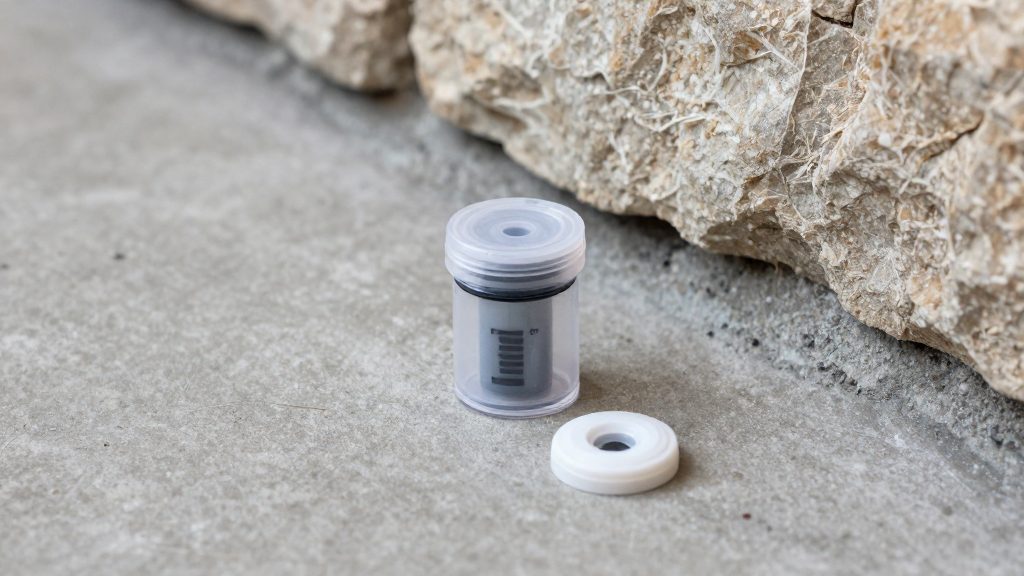
Radon is a colorless, odorless radioactive gas that the U.S. Environmental Protection Agency links to lung cancer. According to the EPA (2026-06-24), radon causes about 21,000 lung cancer deaths per year in the United States, with an uncertainty range of 8,000 to 45,000. Basements sit closest to the ground, so they are where soil-derived radon is most likely to collect in a home. A basement test is the practical way to measure the exposure in the space where people spend the most time below ground level.
Why test basement air for radon?
The health stakes
Radon is the second leading cause of lung cancer after smoking, and the leading cause among people who have never smoked. The EPA estimates that about 2,900 of its annual radon-related lung cancer deaths occur among people who never smoked (EPA, 2026-06-24). Because the EPA states there is no known safe level of radon, its guidance is framed as a level at which action is recommended, not a threshold below which exposure is harmless.
The EPA gives lifetime risk estimates for a lifetime exposure of 4 pCi/L:
| Group | Estimated lung cancer cases per 1,000 people over a lifetime |
|---|---|
| Smokers | About 62 |
| Never-smokers | About 7 |
These figures show that smoking multiplies the risk, but they also show that a non-smoker is not free from risk at this level (EPA, 2026-06-24).
How radon reaches a basement
Radon forms in soil and rock and moves upward as a gas. It can enter a house through cracks and openings in the foundation, such as floor-wall joints and gaps around pipes. A measurement is the only reliable way to judge a specific home.
Action levels
The EPA recommends fixing a home when radon reaches 4 pCi/L (150 Bq/m³) or more. It also recommends that homeowners consider fixing homes with levels between 2 and 4 pCi/L (EPA, 2026-10-13).
What does a radon test kit measure?
A radon test kit measures the activity concentration of radon-222, a radioactive gas that forms from the decay of uranium in soil and rock and can seep into a building through floor slabs, cracks and sump openings. The result is the amount of radon present per unit volume of air, reported as picocuries per liter (pCi/L) in the United States and as becquerels per cubic meter (Bq/m³) in most other countries. The reading is an average over the test period, not an instantaneous value, which is why the duration of the test matters for the result.
Units used on kit labels
| Unit | Full name | Meaning | Where used |
|---|---|---|---|
| pCi/L | picocuries per liter | “pico” means one trillionth of a curie, per liter of air | U.S. kits and EPA guidance |
| Bq/m³ | becquerels per cubic meter | One becquerel is one radioactive disintegration per second, per cubic meter of air | Metric-based guidance and international labs |
Converting pCi/L to Bq/m³
The two units describe the same quantity at different scales. The EPA figure of 4 pCi/L is listed with its metric equivalent of 150 Bq/m³ (U.S. Environmental Protection Agency, 2026-10-13). The EPA’s 150 Bq/m³ is a rounded equivalent of 4 pCi/L. The exact conversion factor is 37 Bq/m³ per pCi/L, so 4 pCi/L is about 148 Bq/m³. The conversion is:
- Bq/m³ = pCi/L × 37
- pCi/L = Bq/m³ ÷ 37
Using the exact factor of 37, a kit reporting 2 pCi/L corresponds to about 74 Bq/m³. Always check which unit a report uses before comparing it to a threshold, because a value in Bq/m³ looks about 37.5 times larger than the same value in pCi/L.
How the detector registers radon
Radon-222 decays by emitting alpha particles, which are helium nuclei with a short range in air. Most radon test devices do not detect the gas atoms directly. They detect the alpha emissions or the decay products that form afterwards, and convert those events into an estimate of the radon concentration. Passive devices, such as alpha-track detectors, record the damage that alpha particles leave in a plastic film over the exposure period. Active electronic monitors count alpha events inside a sealed sensor chamber and report them as a running concentration. Because the count depends on how many decays occur during the exposure, the kit’s stated test period and the lab’s calibration determine how the count is turned into a final pCi/L or Bq/m³ value.
Short-term or long-term radon test kit?
The two kit types differ mainly in how long they run. According to the Oregon Health Authority, short-term tests run 2 to 90 days, and long-term tests run 91 days to 1 year. A short-term result reflects only the days it was running, so it is a snapshot of conditions during that window. A long-term test covers a much longer period, so its result averages out changes over time. Because the Oregon Health Authority advises starting with a short-term test, it is the usual first step when a quick answer is needed.
The choice depends on what the result must show. A short-term kit delivers a faster answer and is the more common starting point. A long-term kit suits situations where the result needs to represent a longer period rather than a few days. Check the unit on the report: in the United States, results are usually given in pCi/L, so they can be compared against the same reference values.
| Kit type | Test duration | Key practical point |
|---|---|---|
| Short-term | 2 to 90 days | Mail-in kits usually include prepaid postage |
| Long-term | 91 days to 1 year | Result averages conditions over a longer period |
For mail-in short-term kits, the timing of return matters as much as the test length. The lab must receive the kit within a strict window after the test ends.
How do you place a kit in a basement?
Place the kit in the lowest livable area of the home. According to the Oregon Health Authority, this is the basement if it is used often, and otherwise the first floor. Choose a room people occupy regularly, such as a finished family room or workshop, rather than a storage bay or a seldom-entered corner. The reading then reflects the air people breathe in the space they actually use.
Use the following guidance when choosing the exact spot:
| Location or condition | Guidance |
|---|---|
| Basement used often | Preferred test location |
| Basement used rarely | Use the first floor instead |
| Drafts | Avoid |
| High heat | Avoid |
| High humidity | Avoid |
| Exterior walls | Avoid |
| Kitchens, bathrooms, laundry rooms | Avoid |
Closed-building conditions during the test
A representative result depends on keeping the building closed. Once the kit is in place, closed-building conditions should apply for the whole test period:
- Keep all windows closed.
- Keep outside doors closed, opening them only for normal entry and exit.
- Keep the kit where it was placed, away from drafts and heat sources, and do not move it between rooms.
Practical setup
Before placing the kit, confirm that the room is one you will keep in its normal state. Opening windows for ventilation or propping doors during the test changes the air exchange with outdoors and can make the reading unrepresentative of ordinary conditions. If the basement has exterior walls, the Oregon Health Authority guidance still directs you to avoid them, so position the kit toward the interior of the room, away from those walls.
What does your radon result mean?
Radon results are compared against the action level set by the U.S. Environmental Protection Agency: 4 picocuries per liter (pCi/L), equal to 150 becquerels per cubic meter (Bq/m³). According to the EPA (2026-10-13), a home should be fixed when radon is at or above this level. The EPA also recommends that homeowners consider fixing homes with levels between 2 and 4 pCi/L, because no safe level of radon is known. A reading in the 2 to 4 pCi/L range therefore calls for a considered decision, while a reading of 4 pCi/L or above is the threshold for action.
Retest decision after an initial result at or above 4
The Oregon Health Authority advises starting with a short-term test and retesting if the result is 4 pCi/L or higher. A single short-term result at or above that level is a signal to confirm, not a final verdict.
Short-term results versus annual average exposure
Test duration determines what a result actually describes:
| Test type | Duration | Role in the decision |
|---|---|---|
| Short-term | 2 to 90 days | Initial screening; retest if the result is 4 pCi/L or higher |
| Long-term | 91 days to 1 year | Covers a longer window and is the better basis for judging long-term exposure |
A short-term result describes only the days it covers. It cannot show how radon behaves over a full year, so it is best read as a screening value. A long-term test spans a much longer period, which makes it the closer match when the question is average exposure over time.
Does humidity affect radon test accuracy?
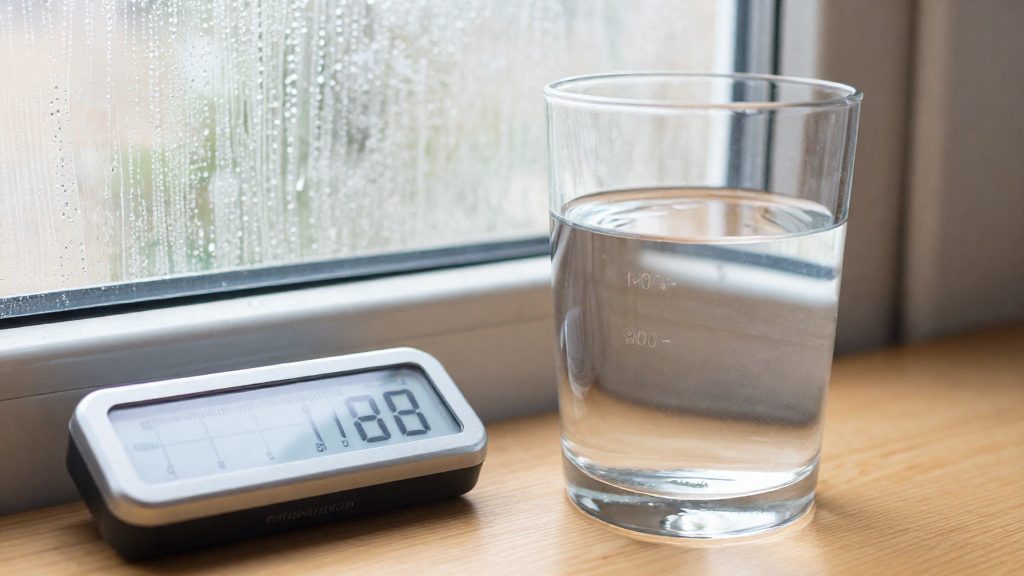
Avoid placing a kit in high-humidity locations, such as bathrooms and laundry rooms. Confirm how moisture is handled with the kit supplier and the lab rather than assume the result is adjusted.
Basements are the area where moisture is most likely to be a concern. Use the steps below to document conditions and reduce uncertainty.
- Read the kit instructions for any statement about temperature, humidity or moisture limits, and follow them exactly.
- Ask the lab whether reported results include any moisture adjustment, and request that answer in writing if you need it for a decision.
- Record conditions during the test, such as visible dampness, condensation on surfaces, or recent water events in the room.
- Check the device after the test for visible moisture or damage, and note it on the submission if the lab form allows.
What to do if levels are high
After an elevated result is confirmed by a retest, the standard fix is a mitigation system rather than further testing. The main option is sub-slab depressurization. A suction pipe is inserted through the concrete slab into the soil or gravel beneath it, and a fan draws soil gas from that space and vents it outside, usually above the roofline. This keeps the pressure under the slab lower than the pressure inside the house, so radon is pulled out before it can enter through cracks, joints and sump openings. Because the system depends on pressure differences, its performance depends on the slab, the soil and the layout of the building, which is why a site assessment comes before installation.
When to engage a qualified professional
Hire a qualified radon professional once a result at or above 4 pCi/L is confirmed by a retest. For confirmed results between 2 and 4 pCi/L, consider mitigation, as the EPA recommends. Before signing, check the following:
| Check | What to verify |
|---|---|
| Certification | Current credential from a recognized radon program |
| Experience | Prior work on your foundation type |
| Written proposal | Pipe layout, fan location and exhaust point |
| Post-installation test | A documented retest result |
Rely on the written proposal rather than general estimates.
Retesting after mitigation
A retest confirms that the system has actually reduced levels. Use the same protocol and location as the original test.
Frequently asked questions
How long does a basement radon test take, and which kind should I start with?
Short-term kits run for 2 to 90 days, while long-term kits run from 91 days to 1 year. Begin with a short-term test, and if a mail-in kit reaches the lab more than eight days after the test ends, the result may be invalid.
Where should I place the kit in my basement?
Put it in the lowest livable area, which is the basement if you use it regularly and the first floor if you do not. Keep windows and outside doors shut apart from normal entry, and avoid spots near drafts, heat sources, exterior walls, kitchens, bathrooms, and laundry rooms, since humid areas can skew the reading.
What should I do if my result is 4 pCi/L or higher?
Treat it as a reason to retest before deciding on mitigation, because a single short-term reading at or above 4 pCi/L (about 148 Bq/m³) is considered elevated only once confirmed. If the confirmed level remains at or above 4 pCi/L, the action level set by the EPA recommends fixing the home, and levels between 2 and 4 pCi/L also merit consideration.