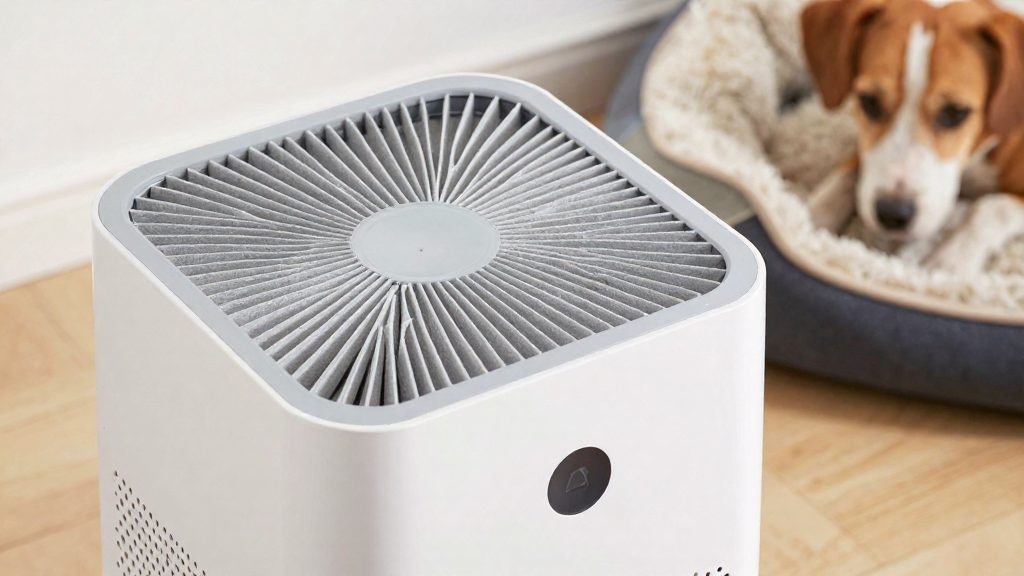
A HEPA filter captures pet dander mainly because dander particles are larger than the 0.3-micron size used to rate HEPA performance. According to U.S. EPA (2025), a HEPA filter can theoretically capture at least 99.97% of airborne particles at 0.3 microns, and larger and smaller particles are trapped with even higher efficiency. The rating therefore sets a minimum, and pet dander falls into the range where capture is most reliable.
How does a HEPA filter handle pet dander?
What the 0.3-micron rating means
The 99.97% figure is a theoretical minimum for particles at 0.3 microns. U.S. EPA (2025) calls this the worst case because particles of that size are the hardest to trap. The rating is a laboratory benchmark for the filter media, not a guarantee of how much dander a room will lose in daily use.
Capture mechanisms
A HEPA filter uses a dense mat of fibers, and airborne particles are caught through several mechanical processes:
- Impaction: larger particles cannot follow the air around a fiber and collide with it.
- Interception: particles that follow the airflow still touch a fiber because they pass within their own radius of it.
- Diffusion: very small particles move erratically and collide with fibers. This matters mainly below 0.3 microns.
Pet dander is larger than the rating size, so impaction and interception do most of the work.
Why larger particles are trapped more efficiently
| Particle size relative to 0.3 microns | Capture efficiency according to U.S. EPA (2025) |
|---|---|
| About 0.3 microns | At least 99.97% (theoretical minimum) |
| Smaller than 0.3 microns | Higher than 99.97% |
| Larger than 0.3 microns, including animal dander | Higher than 99.97% |
What HEPA purifiers can’t do for pet allergies
A HEPA purifier captures particles that are moving through the air, but pet dander behaves differently. According to the U.S. EPA (2025), larger particles such as animal dander mostly settle on surfaces, so a cleaner generally cannot capture them unless they are stirred back into the air. A purifier therefore addresses only the airborne fraction of the allergen load, not the material already resting in the room.
Dander that has already settled
Once dander lands, it accumulates on floors, upholstery and bedding. A purifier running in the same room has no direct access to these surfaces. The settled material stays in place until it is physically removed, This means settled dander mostly stays outside the reach of the filter unless it is stirred back into the air.
Resuspension during everyday movement
Activity lifts settled dander back into the air, and this is the only route by which a cleaner can capture it. Walking across a room, sitting on a sofa or moving bedding can release particles into the airflow.
Allergen carried in on clothing and hair
Dander can also enter a home on clothing and in hair after contact with animals elsewhere. Dander carried in this way reaches the air only after it is shed or disturbed indoors.
| Dander location | Can a HEPA purifier capture it directly? |
|---|---|
| Airborne, passing through the unit | Yes, when it reaches the intake |
| Settled on floors, upholstery or bedding | No, unless it is stirred back into the air |
| Re-released by movement | Yes, while it remains airborne near the intake |
| Carried in on clothing or hair | Only after it is released into the air indoors |
What CADR and room size should you look for?
Clean Air Delivery Rate (CADR) measures how much contaminant-free air a portable air cleaner delivers, expressed in cubic feet per minute (cfm). According to the U.S. EPA (2017), it is the figure to check when judging a unit’s capacity. A higher cfm value means more filtered air is returned to the room each minute.
Matching CADR to floor area
CADR only means something relative to the space being cleaned. The practical method is:
- Measure the room’s length and width in feet.
- Calculate the floor area as length × width, in square feet.
- Compare that area with the room size the manufacturer states for the unit, and confirm the cfm rating supports it.
A unit rated for a smaller room is unlikely to deliver meaningful clean air across a larger one. If the room is open-plan or divided by partial walls, measure the full area the cleaner needs to serve.
Why CADR ratings miss large particles
The U.S. EPA (2017) states that most portable cleaners lack a CADR high enough to effectively remove large particles such as pollen. A high CADR figure therefore does not confirm that a unit handles every airborne allergen.
Animal dander sits in a different category. The U.S. EPA (archived 2017 snapshot) notes that mechanical filters capture larger airborne particles, including dander, but these particles settle quickly. The same source notes that some controversy exists over whether air cleaners reduce allergic reactions to larger particles such as dander.
Why ozone and ionizer purifiers are a poor choice
Ozone-producing electronic cleaners are a poor fit for pet dander allergies for two reasons. According to the U.S. EPA (archived 2017 snapshot, 2017-01-19), ozone is a lung irritant, and ozone generators have little effect on most indoor contaminants at concentrations that meet public health standards. The EPA also notes that some electronic air cleaners produce ozone, so a mechanical HEPA unit is the safer choice. The concern is therefore twofold: these devices add an airway irritant to the room, and the pollutant they add does not reliably remove the particles that trigger symptoms.
Ozone as an airway irritant
Ozone irritates the lungs, which makes it the main health concern when comparing purifier technologies. Exposure is a direct consequence of running the device, so the risk applies to every occupant of the room, including people who do not have allergies. For a home with pets, the practical rule is to avoid any device whose operation adds ozone to occupied air.
Limited effect on indoor contaminants
Producing ozone does not translate into cleaner air. Ozone generators have little effect on most indoor contaminants at concentrations that meet public health standards. Mechanical filtration is the safer approach because ozone is a lung irritant and some electronic air cleaners also produce it. Surface cleaning is needed alongside any purifier, and an ozone device does not replace it.
Identifying ozone-producing models before purchase
Check the product before buying, since the EPA’s guidance points to the device technology rather than the brand. The EPA neither certifies nor recommends particular brands of home air cleaning devices.
| Check | What it indicates | Action |
|---|---|---|
| Product described as an ionizer or ion generator | Electronic technology; the EPA notes some electronic cleaners produce ozone | Look for an ozone statement in the documentation |
| Manufacturer states ozone output | Direct evidence of ozone production | Reject the model for pet households |
| No ozone statement and only a mechanical filter described | Filtration without an electronic ozone-producing function | Prefer for pet dander |
Where should you place a purifier at home?
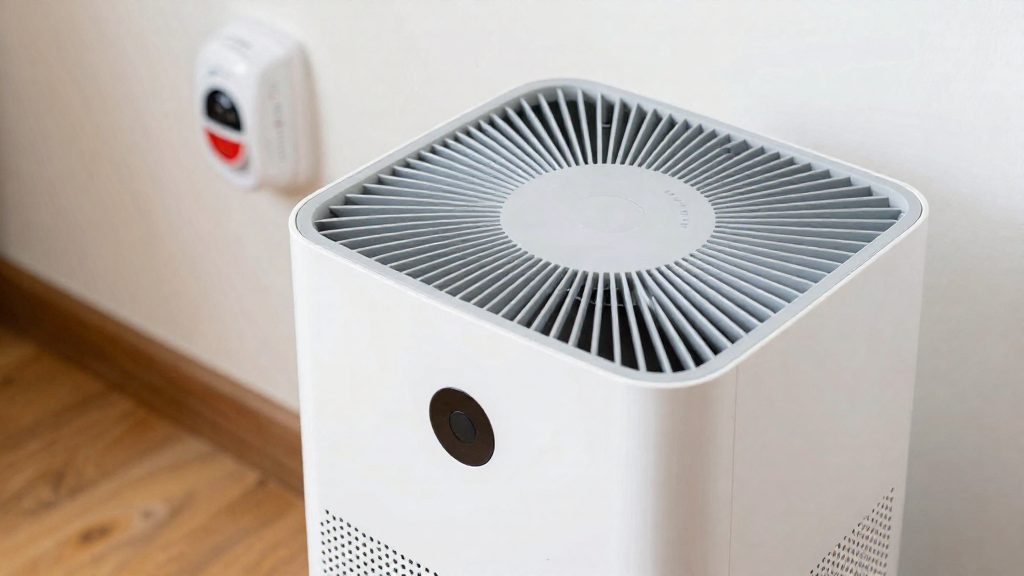
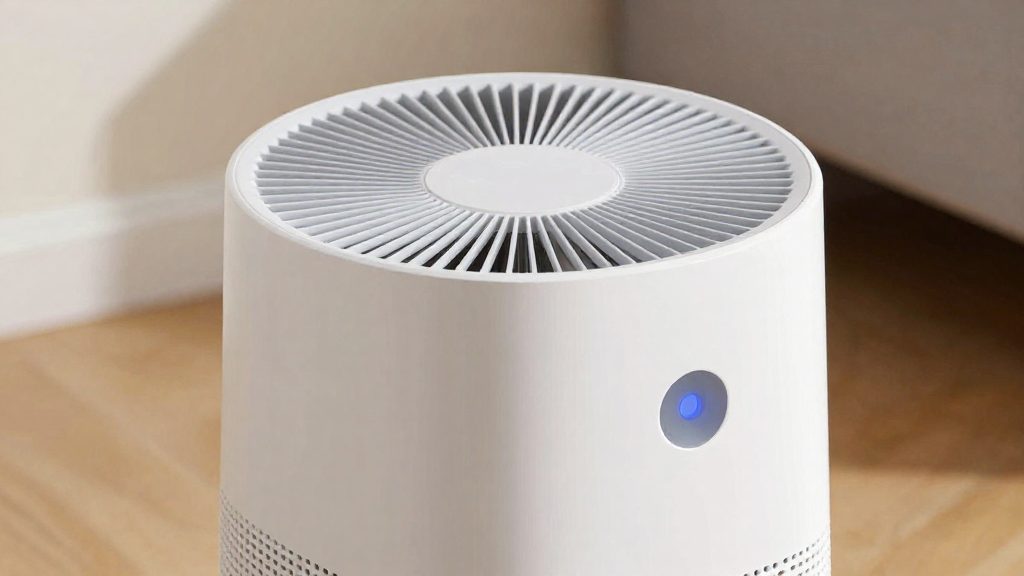
Placement may affect how much airborne dander reaches a mechanical HEPA air purifier. The aim is to position the air purifier where the pet rests and where room air flows past those zones, so that dander released into the air is drawn toward the filter.
Distance from pet beds, sofas and sleeping areas
Place the unit close enough to the pet’s main resting spots that a clear path of air runs from the bed or sofa to the intake. Base the decision on the room layout rather than a fixed measurement. Avoid placing the unit on the far side of a room from where the pet sleeps, and keep walls and furniture out of the line between them.
Keeping intake and outlet free of furniture
Airflow is what brings particles to the filter. Keep both the intake and outlet clear of curtains, bedding, boxes and cushions. A blocked intake reduces the volume of room air passing through the filter, and a blocked outlet disrupts the air leaving the unit. Check the manufacturer’s manual for the clearance required around the casing.
Single room versus whole-home placement
Choose a single-room placement when the pet is confined to one area, such as a bedroom, and place the unit there. Choose a whole-home approach only when the pet has access to several rooms, because one unit covers only the space around it. The table below summarizes the two options.
| Scenario | Placement focus | Main limitation |
|---|---|---|
| Pet confined to one room | Unit in that room, near the bed or favorite resting spot | Other rooms receive no filtration |
| Pet roams the whole home | Units in the main living areas and sleeping zones | Each unit covers only its own space |
Placement works alongside the cleaning routines described below.
Cleaning habits that matter as much as the filter
Cleaning reduces the amount of pet dander available to become airborne, which lowers the load on any air cleaner in the room. The U.S. EPA (2017) recommends three routines: washing sheets weekly, vacuuming often, and dusting. These routines work on the particles that have already landed, so they complement filtration rather than replacing it.
| Routine | Recommended interval | Where to apply it | Practical point |
|---|---|---|---|
| Washing sheets | Weekly (U.S. EPA, 2017) | Bed linens | Strip the bed on a fixed day each week |
| Washing pet bedding | Not specified by EPA; weekly is a practical choice matching sheets | Pet beds, blankets, cushions | Wash the covers as well as the filling where the label allows |
| Vacuuming | “Often” (U.S. EPA, 2017); no fixed interval given | Floors, carpets, upholstery, pet beds | Use a vacuum fitted with a HEPA filter |
| Dusting | Regular | Shelves, ledges, hard furniture, electronics | Work from high to low surfaces |
Weekly washing of sheets and pet bedding
Weekly washing is the only routine with a specific interval in the EPA guidance. Strip the bed, wash the sheets, and wash pet bedding on the same day so that the cycle is easy to remember. Follow the care label for water temperature and drying, and dry items fully before reusing them, since damp bedding is a moisture problem in its own right. Wash pet blankets and removable covers separately from the rest of the laundry when possible.
Frequent vacuuming with HEPA-filtered vacuums
EPA advises vacuuming often, and the HEPA filter on the vacuum determines whether the cleaning actually removes the particles. A vacuum without an effective filter can return fine particles to the room through its exhaust. Use upholstery and crevice attachments on sofas, pet beds, and the edges of rooms, where dander accumulates.
Dusting surfaces to capture settled allergen
Dusting targets the surfaces where dander settles and remains until it is disturbed. Dust before vacuuming, so that particles knocked loose by the cloth are collected by the vacuum rather than falling back onto the floor. A damp cloth holds particles better than a dry one, which tends to move them into the air. Work from the highest surfaces downward so that debris falls onto areas you have not yet cleaned.
Does an air purifier really relieve pet allergies?
The evidence is weaker than marketing often suggests. According to the U.S. EPA (archived 2017 snapshot, 2017-01-19), the evidence is weak that air cleaners reduce asthma symptoms tied to small airborne cat dander. Mechanical filters do capture larger airborne particles, including animal dander, but those particles settle quickly, so a purifier intercepts only part of the exposure a sensitive person faces. EPA also states that removing particles does not by itself show reduced health effects, so a lower particle count does not prove symptom relief.
Where the evidence is contested
According to the U.S. EPA (2025), there is some controversy over whether air cleaners reduce allergic reactions to larger particles such as animal dander.
Capacity and realistic expectations
- CADR (Clean Air Delivery Rate), measured in cubic feet per minute, indicates how much clean air a portable cleaner delivers.
- A purifier is best treated as one measure among several, not a standalone fix for pet allergy.
Measuring whether it works
To check results in your own home, compare a baseline period with the purifier off against a period with it running, keeping pet access and cleaning habits as constant as possible.
| Method | What it records | Limitation |
|---|---|---|
| Symptom diary | Daily symptoms, such as nasal congestion or wheezing, and medication use | Subjective |
| Allergen sampling (airborne or dust) | Dander levels in the room, before and after running the unit | A single sample varies |
Record the diary for at least the same number of days in each period so the two sets of results can be compared fairly.
Frequently asked questions
Will a HEPA purifier clean the dander already settled on my furniture?
Not by itself. According to U.S. EPA (2025), dander mostly settles on surfaces, and a portable air cleaner generally cannot capture it unless it is stirred back into the air. Removing settled dander takes physical cleaning, so the filter works best on the dander that is still floating.
What does the CADR rating tell me when I choose a purifier?
CADR (Clean Air Delivery Rate) measures how much clean air a portable cleaner delivers, in cubic feet per minute. According to U.S. EPA (archived 2017 snapshot, 2017-01-19), most portable cleaners lack a CADR high enough to effectively remove large particles such as pollen.
Will a HEPA purifier stop my pet allergy symptoms?
The evidence is not established. According to U.S. EPA (archived 2017 snapshot, 2017-01-19), the evidence is weak that air cleaners reduce asthma symptoms tied to small airborne cat dander. EPA also notes that removing particles does not by itself show reduced health effects, so a purifier should be treated as one part of a broader approach.