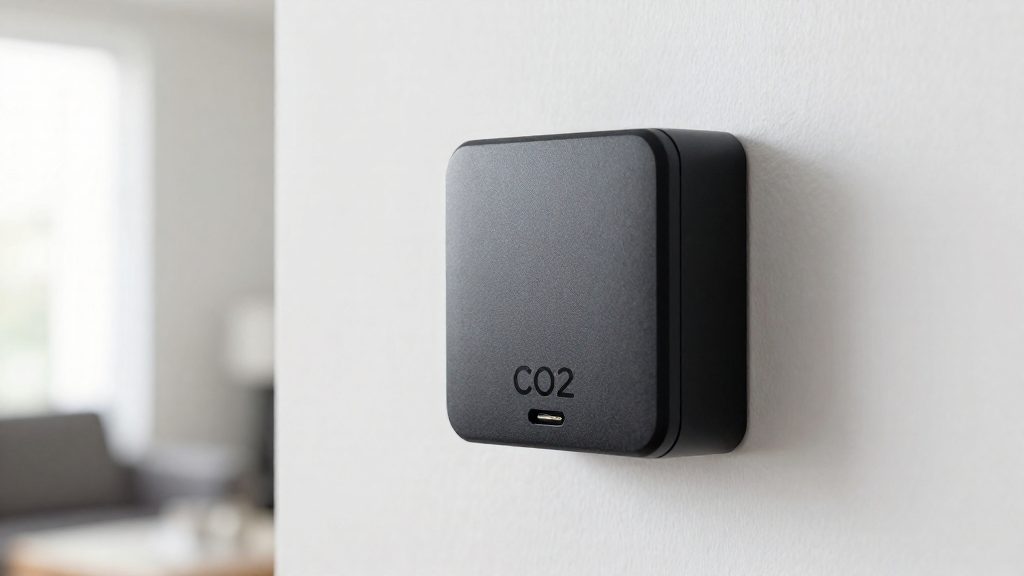
Place the CO2 monitor where people spend most of their time in the room, at a spot that represents the air they actually breathe. Don’t fix it by default on the nearest shelf. Identify the occupied zone, test two or three candidate positions, and keep the one whose readings best match how the room is used.
Where should a CO2 monitor go in a living room?
Identify the main occupied zone
Start by mapping where people sit for the longest periods. In most living rooms this is a sofa, an armchair or a dining seat, not the whole floor area. Note which seats are used together, such as a sofa and the chair facing it, because the monitor should sit within that group rather than at its outer edge.
An open-plan room that combines a lounge and a dining area is a typical case. Decide whether the room needs one monitor for the main zone or a second one for the other zone.
Test several candidate spots before fixing the monitor
The UK Health and Safety Executive (HSE, 2026), a British reference, advises trying several locations to find the most representative spot; the advice is general and applies to US homes too.
- Choose two or three positions inside the occupied zone.
- Place the monitor at one position and wait until the reading stabilises before noting it.
- Repeat at each position, under the same conditions: same time of day and same number of occupants.
- Compare the readings. If they are close, any spot is representative. If they differ widely, the air in the room is not evenly mixed, and the spot closest to the typical seating position is the more useful one.
HSE (2026) states that readings consistently above 1,500 ppm in an occupied room indicate poor ventilation, and that about 1,000 ppm corresponds to roughly 10 L/s of fresh air per person.
Match placement to daily use patterns
The right position depends on when the room is occupied, not only on where the furniture is.
| Daily use pattern | Zone to test first | Comparison to make |
|---|---|---|
| Evening viewing with several people | Sofa seating line | Sofa centre against sofa end |
| Daytime work from an armchair | Armchair used for work | Armchair position against the dining table |
| Meals and hosting | Dining area | Dining table against lounge seating |
| Room empty for much of the day | Seating used in the evening | Readings during occupied hours against unoccupied hours |
If the room is mostly empty during the day, the readings taken while people are present are the ones that matter for judging ventilation. Keep the monitor in the zone where that occupancy happens most often, so the record reflects real use.
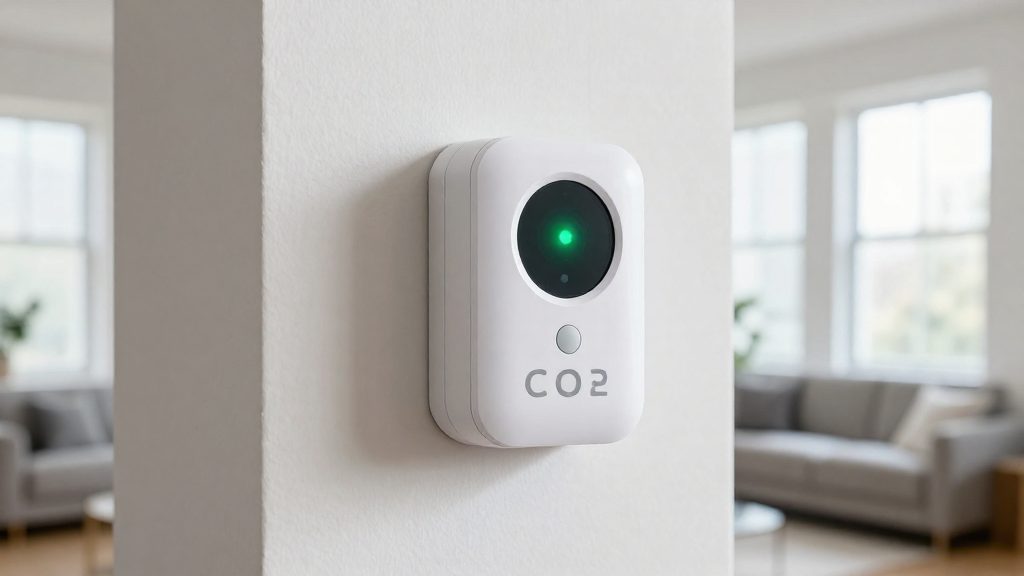
Ideal height: the breathing zone
A CO2 monitor reports what occupants breathe only when it sits in the breathing zone, the layer of air where people are and where air mixes. The UK Health and Safety Executive (HSE) (2026) advises mounting a CO2 monitor at head height. Atlas Scientific (2025) gives a practical range for general indoor spaces: 4 to 6 feet (about 1.2 to 1.8 m) above the floor. A seated head can sit slightly below 4 feet, so treat the band as a general guide, not a strict rule. Mounting the device within that band gives a reading that represents the air occupants actually inhale, rather than air at floor level or at the top of a tall wall.
Head height as the target level
Head height is the primary target. Because a seated occupant’s head sits much lower than a standing occupant’s, choose the height according to how the room is used. In a living room where people sit on a sofa for long periods, choose a mounting point toward the lower part of the 4 to 6 ft band, so the reading stays close to seated head height while remaining within the range. Once the position is chosen, keep it fixed. Moving the monitor between a shelf and a table changes the measurement height, which makes readings taken on different days hard to compare.
Breathing zone of 4 to 6 feet
The 4 to 6 foot band from Atlas Scientific (2025) works as a quick check on any mounting point. A monitor on a low shelf near the floor, or on a tall cabinet above 6 feet, sits outside the range. Because the band spans both seated and standing head heights, it suits rooms where occupants use the space at different heights.
Thermostat height as a home reference
Atlas Scientific (2025) states that, in homes, the breathing zone is about thermostat height. Using the thermostat as a reference avoids measuring each time: mount the monitor at about the same level as the thermostat. A repeatable reference point also makes it easier to reproduce the same mounting when comparing readings over weeks.
| Reference | Height guidance | Source |
|---|---|---|
| Head height | Target mounting level | UK HSE (2026) |
| Breathing zone | 4 to 6 ft (about 1.2 to 1.8 m) above the floor | Atlas Scientific (2025) |
| Thermostat height | About the breathing zone in homes | Atlas Scientific (2025) |
How far from people, windows and vents?
Keep a CO2 monitor more than 50 cm (about 20 in) away from people. The UK Health and Safety Executive (HSE, 2026) notes that exhaled breath contains CO2, so a monitor placed too close can give a misleadingly high reading. The goal is a value that reflects the air of the room, not the breath of the person sitting next to the device.
Why exhaled CO2 inflates nearby readings
Each exhalation releases CO2 into the surrounding air. When the sensor sits within reach of that breath, it records a concentration above the room’s general level. A monitor on a desk or armrest beside a seated person will therefore tend to log higher values than the same device placed farther away. Moving it even a short distance from occupants reduces this effect, which is why the 50 cm threshold is the first clearance to check.
Clearance from windows, doors and supply vents
HSE advises keeping the monitor away from windows, doors and air supply openings, because airflow near these points varies. Choose a spot where incoming air has time to mix with the rest of the room, rather than one where a draught or supply stream passes directly over the sensor.
| Factor | Guidance | Source |
|---|---|---|
| Distance from people | More than 50 cm (about 20 in) | UK Health and Safety Executive (HSE), 2026 |
| Windows and doors | Keep the monitor away; airflow varies | HSE, 2026 |
| Air supply openings | Keep the monitor away; airflow varies | HSE, 2026 |
Testing candidate spots
Shortlist positions that each respect the 50 cm distance from people.
Spots to avoid in the living room
A CO2 monitor reads the air around it, so any fixture that heats, moves or traps air near the sensor skews the result. The living room has several such spots. Atlas Scientific (2025) advises keeping a sensor away from fans, exhausts and direct sunlight, and the spots below fall under those categories.
Direct sunlight and radiators
Direct sunlight on the housing warms the sensor and the air immediately around it, so the monitor reports conditions at the surface rather than in the room. Radiators and electric heaters also create a rising plume of warm air. A sensor placed above or beside one samples that local air instead of the room’s mixed air, so keep the monitor away from heat sources.
Ceiling fans, cooktops and exhaust outlets
A ceiling fan moves air continuously, so a sensor beneath it samples a stream of air that has not yet settled. Readings near a fan can swing from one moment to the next.
Cooktops and exhaust outlets are sources in their own right. Cooking releases combustion products into the air, and a range hood or extractor pulls that air out of the room. A sensor within reach of the cooktop or the hood’s intake therefore measures a local plume. Keep the monitor in a part of the room that is not directly downstream of the cooking area or an exhaust.
Enclosed shelves, cabinets and behind curtains
Air inside a closed shelf, cabinet or behind a curtain barely circulates. Carbon dioxide from the room can build up in that pocket and stay there, so a sensor placed inside one reports stagnant air that does not represent the room. Curtains pressed against a wall or window also block the mixing that the monitor needs to sample. Place the sensor in open air, on a surface with free circulation on all sides.
| Spot | Why it distorts the reading | Practical fix |
|---|---|---|
| Direct sunlight | Heats the sensor and surrounding air | Move the monitor out of the sun’s path |
| Radiator or heater | Samples a rising warm plume | Position it away from heat outputs |
| Ceiling fan | Samples moving, unsettled air | Keep it outside the fan’s airflow |
| Cooktop or exhaust | Samples cooking and extraction air | Keep it out of the cooking and extraction zone |
| Closed shelf or cabinet | Traps stagnant air | Place it on an open surface |
| Behind curtains | Blocks air mixing | Keep it in open room air |
Should you use more than one monitor?
A single CO2 monitor can be enough in a small, compact room, but it can misrepresent air quality in a large or divided space. According to the UK Health and Safety Executive (HSE, 2026), larger spaces usually need several sampling locations, because one reading reflects only the air at one point. Concentrations are rarely uniform across a room, so a single unit may read differently from one corner to another. Deploying more than one unit gives a fuller picture than a single reading taken in one spot.
Open-plan layouts
Open-plan living rooms, kitchen-dining combinations and studio apartments usually contain several areas with different occupancy patterns. A sensor in one area may not represent the others. Where a room is open to other spaces, plan at least one unit for each area where people spend extended time, rather than relying on a single central position.
Comparing two units before relying on them
Before you trust a second monitor, confirm that the two agree. Place both units at the same height, in the same spot, and run them together. This side-by-side comparison shows whether the readings are consistent before you use them to judge different parts of the home. Decide whether any gap is large enough to change your conclusions about ventilation.
Assigning one unit per zone
Once two units agree, assign one unit per zone, such as a seating area and a dining area. Record which unit covers which zone so that readings can be compared by location. Keep each unit at head height in the breathing zone.
What do the CO2 readings mean?
CO2 readings are best read as an indicator of ventilation. According to the UK Health and Safety Executive (2026), a reading of about 1,000 ppm corresponds to roughly 10 L/s of fresh air per person. Readings consistently above 1,500 ppm in an occupied room indicate poor ventilation. These two thresholds give a practical scale: the lower the reading, the more outdoor air is diluting the CO2 produced by the people in the room.
Fresh-air rate per person is the link between the number on the display and the air supply. The 10 L/s figure applies per occupant, so the same reading means something different in a room with two people than in one with six. The monitor does not measure airflow directly. It shows how much exhaled CO2 has accumulated before fresh air dilutes it.
Sustained readings carry more information than brief peaks. A value that spikes when people enter, or when a door is closed, says little on its own. A level that stays above 1,500 ppm over an occupied period points to a ventilation shortfall. Review the trend across the whole period of occupancy rather than reacting to a single value.
| CO2 reading | Interpretation (UK HSE, 2026) |
|---|---|
| About 1,000 ppm | Roughly 10 L/s of fresh air per person |
| Consistently above 1,500 ppm, occupied room | Poor ventilation |
CO2 is a broad guide to ventilation, not proof of safety. The UK Health and Safety Executive (2026) states that CO2 readings do not establish “safe levels.” A CO2 monitor measures only carbon dioxide, so a low reading does not confirm the absence of other airborne contaminants.
CO2 monitor vs. carbon monoxide alarm: what’s the difference?
A CO2 monitor and a carbon monoxide alarm both sense gases in indoor air, but they answer different questions. A CO2 monitor shows how much carbon dioxide has built up in a room, which indicates how well the space is ventilated relative to how many people are using it. A carbon monoxide alarm detects carbon monoxide (CO), a toxic gas produced by incomplete combustion in fuel-burning appliances, and warns occupants of a hazard they cannot perceive by sight or smell.
| Feature | CO2 monitor | Carbon monoxide alarm |
|---|---|---|
| Primary purpose | Indicates ventilation and occupancy | Warns of a combustion hazard |
| Gas sensed | Carbon dioxide (CO2) | Carbon monoxide (CO) |
| Main indoor source | Exhaled breath and occupancy | Incomplete combustion of fuels |
| Role in safety | Broad guide to air exchange | Hazard detection |
What a CO2 reading tells you about occupancy and ventilation
CO2 accumulates when occupants breathe out and when outdoor air does not replace indoor air fast enough. A rising trend therefore shows that a room is being used with limited air exchange, which can help you decide when to open a window or run a ventilation system.
Why a CO2 monitor cannot replace a CO alarm
- Different gas: A CO2 monitor measures carbon dioxide, not carbon monoxide. It does not detect CO, so it cannot warn of CO from a faulty boiler, cooker or heater.
- No inference possible: A low or stable CO2 reading says nothing about whether CO is present. The two gases can behave differently, and the reading does not measure the other.
- Different purpose: A CO2 monitor supports ventilation decisions. A CO alarm exists to alert occupants to a potentially life-threatening exposure, which is a separate safety function.
Frequently asked questions
How high should I mount a CO2 monitor if people sit on a sofa?
Mount the monitor within the 4 to 6 ft band above the floor, which Atlas Scientific (2025) gives as a general range for indoor spaces. A seated head sits near the bottom of that band, so choose a point toward the lower end to keep the reading close to seated breathing height.
How far should the monitor be from people, windows and doors?
Keep it more than 50 cm (about 20 in) from people, because exhaled breath contains CO2 and a monitor placed too close can read high, according to the UK Health and Safety Executive (HSE, 2026). Also keep it away from windows, doors and air supply openings, where airflow changes and the reading becomes less representative.
Does cooking near the living room affect where the monitor should go?
Only when the cooking burns fuel, since that releases combustion products that a range hood or extractor can pull out of the room. Keep the monitor away from fans, exhausts and direct sunlight so it samples the room’s mixed air rather than air being moved by a local source, as Atlas Scientific (2025) advises.