New carpet and fresh paint release volatile organic compounds (VOCs) because these substances evaporate readily from solid and liquid materials into the air. According to the U.S. EPA, paints, paint strippers, solvents, aerosol sprays, cleansers, air fresheners, building materials, furnishings, and glues and adhesives all emit VOCs, and indoor VOC concentrations are often up to ten times higher than outdoor levels. New carpet and paint belong to this group, so a freshly finished room can show a clear rise in VOCs compared with the air outside.
Why new carpet and paint release VOCs
Common VOC sources in new carpet
The EPA does name glues and adhesives as VOC emitters, and installation adhesives are the carpet-specific source in this category. Carpet is installed onto a floor using these adhesives, so they are the component most directly linked to emissions at installation.
- Backings: part of the carpet’s construction.
- Adhesives: named by the EPA as VOC emitters.
- Dyes and finishes: part of the carpet’s construction.
Solvents and binders in paint
Paint is a mixture of pigment, binder and solvent. The solvent keeps the pigment and binder fluid so the paint can be spread, then evaporates as the film dries. That evaporation is the main release route.
Why these compounds evaporate
VOCs are carbon-based compounds with a high vapour pressure at room temperature, meaning they pass from liquid or solid form into the gas phase without heating. Release speeds up with higher temperature, greater surface area and more air movement across the surface.
Indoor versus outdoor VOC levels
The gap between indoor and outdoor levels exists because outdoor air dilutes emissions continuously, while an enclosed room keeps them close to their source. Several sources in the same room, such as carpet, paint and furnishings, add to the total.
How long does new carpet off-gas?
The U.S. EPA does not give a standard duration for carpet off-gassing, so no complete timeline can be stated. The only timing it gives is a practical one: run window fans or mechanical ventilation during and after installation for 48 to 72 hours. That is a ventilation window, not the time at which emissions end.
The general pattern is that emissions are highest when the product is new and decline over time.
Factors the official sources address
| Factor | What the official sources say | What is not specified |
|---|---|---|
| Retailer airing before installation | EPA suggests asking the retailer to air out the carpet before it is installed | How much airing reduces emissions, or for how long |
| Fiber type and backing | Not stated | Whether duration differs by fiber or backing material |
Retailer airing before installation
Airing is the one pre-installation step the EPA names directly. Ask the retailer whether the carpet has been aired before delivery, and record the answer for your own reference. The sources do not quantify the reduction this achieves, so treat it as a way to start with less emitting material in the room, not as a guaranteed outcome.
Symptoms and the current evidence
The EPA states that scientists have not determined whether chemicals from new carpet cause the symptoms some consumers report. Emission timing and symptom links are separate questions, and the sources do not connect the two.
How long does paint off-gas?
The U.S. EPA says elevated VOC concentrations can persist long after an activity such as paint stripping has ended.
Drying versus curing
Drying and curing are separate stages. A paint film can feel dry to the touch before it has fully cured, and some volatile components may still be leaving it.
Persistence after painting ends
The U.S. EPA states that elevated VOC concentrations can persist in the air long after an activity such as paint stripping has ended. A room can thus carry elevated VOC levels once painting is finished, and the end of the work does not mark the end of exposure.
Are VOCs from renovation dangerous?
Renovation materials release volatile organic compounds (VOCs). Whether these emissions cause health problems is less settled than the emissions themselves. The EPA says scientists have not determined whether chemicals from new carpet cause the symptoms some consumers report, and that increasing fresh air reduces exposure to most chemicals released from carpet.
What is documented and what is not
According to the U.S. EPA, scientists have not determined whether chemicals from new carpet cause the symptoms some consumers report. A reported symptom is a real experience, but it does not identify a cause. The consulted EPA material also does not give concentration thresholds at which irritation or respiratory effects begin, so no effect level can be assigned to carpet emissions here.
| Claim | Status in the consulted EPA material |
|---|---|
| Symptoms reported by some consumers after new carpet | Causal link not established |
| Irritation or respiratory effects at high concentrations | Not stated |
Sensitive groups
The consulted EPA material does not single out children, people with asthma, or older adults, so it gives no group-specific exposure figures. Reducing exposure still applies to everyone. Where a household includes someone with a respiratory condition, the EPA’s suggestion to consider being away during and right after installation is the most direct step available. If someone in the household has a respiratory condition such as asthma, consider having them away during and right after installation, and ask their doctor for advice.
Practical steps for lowering exposure
- Run window fans or mechanical ventilation during and after installation for 48 to 72 hours, as EPA suggests.
How to ventilate after install or painting
The U.S. EPA suggests running window fans or mechanical ventilation during and after new carpet installation for 48 to 72 hours. For painting, the agency advises maximum ventilation while the work is underway, using open windows or exhaust fans, and following the precautions on the product label. Ventilation therefore starts before the work begins and continues through the period after it ends.
Ventilation schedule by activity
| Activity | Ventilation method named by U.S. EPA | Timing |
|---|---|---|
| Painting | Open windows and exhaust fans at maximum | During painting |
| New carpet installation | Window fans or mechanical ventilation | During and after installation, 48 to 72 hours |
Run time for painting ventilation should follow the label instructions and the persistence of odours in the room.
Running window fans and mechanical ventilation
The EPA suggests running window fans or mechanical ventilation during and after installation for 48 to 72 hours. U.S. EPA notes that increasing fresh air reduces exposure to most chemicals released from carpet. The same source warns that heavy ventilation can raise energy costs, so the goal is steady, controlled airflow rather than maximum output at all times. A window fan placed in an open window can be set to blow outward so that room air is exhausted and replaced from other openings.
Ventilating during painting
Paints, solvents and adhesives release VOCs (volatile organic compounds). Open windows and run exhaust fans throughout the painting session, and keep the room ventilated until the work and cleanup are complete.
Occupant absence during and after installation
U.S. EPA suggests considering being away during and right after installation. Consider arranging to be away during and right after installation, as the EPA suggests.
Can air purifiers or dehumidifiers help?
Air purifiers and dehumidifiers address only some of the problem with VOC-laden indoor air. Whether a device helps depends on what it is built to capture: particles, gases, or water vapour. VOCs are gases at room temperature, so a device that works only on particles or moisture will not remove them. Activated carbon is the filter technology most commonly used for gases in consumer purifiers, and it has clear limits.
Activated carbon filters
Activated carbon captures gas molecules by adsorbing them onto its porous surface. It is the technology most often used for VOC reduction in consumer purifiers, but its effect depends on the following:
- Adsorption capacity is finite. Once the carbon surface is saturated, it stops capturing gases and can release previously adsorbed compounds back into the room.
- Efficiency varies by compound. Some VOCs adsorb readily and others poorly, so a filter’s performance on one compound does not predict its performance on all of them.
- The quantity of carbon matters. A thin layer in a small unit holds less material than a deeper bed in a larger one.
HEPA filters
HEPA filters trap airborne particles such as dust and fine debris. They do not capture VOCs, because gas molecules pass through the media. A particle-only purifier can reduce dust but leaves the VOC concentration unchanged.
Dehumidifiers
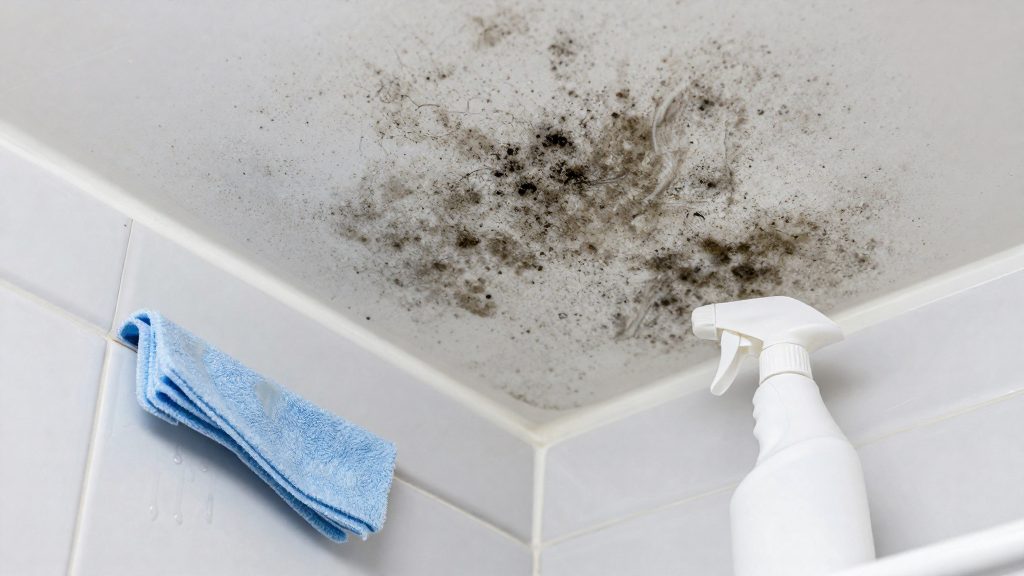
A dehumidifier controls relative humidity by condensing water vapour out of the air. It does not capture VOCs, and running one in a room with new carpet or fresh paint leaves the gas concentration as it was. Its value lies in limiting moisture, which helps reduce condensation and the conditions that favour mould growth. A dehumidifier does not remove VOCs. Bringing in fresh air is the approach the EPA suggests.
| Device | Targets | Removes VOCs? | Main limitation |
|---|---|---|---|
| Activated carbon filter | Gases and odours through adsorption | Partly, depending on the compound | Finite capacity; saturated media can release stored compounds |
| HEPA filter | Airborne particles | No | Gas molecules pass through the media |
| Dehumidifier | Water vapour | No | Captures no gases |
Do heat and humidity change off-gassing?
Temperature and humidity are generally expected to influence emission rates. What matters for planning is how conditions during and after the work affect how long emissions last.
Temperature effect on emission rate
Warmer rooms, direct sun on windows and high heating settings can be treated as conditions that may increase emissions.
- As a precaution, avoid heating a room hard during the first days after work unless you ventilate at the same time. The sources do not quantify the temperature effect.
Relative humidity effect on paint and carpet
Humidity also changes the conditions in which paint dries and carpet off-gasses, but the consulted sources give no specific relative humidity thresholds. Use a hygrometer to record the level before, during and after the work, so you can compare conditions rather than rely on estimates.
Summer versus winter renovation timing
Season changes the trade-off between ventilation and indoor conditions. The energy cost of ventilation matters most in winter, when heating is running. In summer, the main concern is heat and humidity buildup indoors.
| Factor | What the consulted sources establish | What is not quantified |
|---|---|---|
| Temperature | Can raise emission rates (qualitative) | Rate increase per degree |
| Relative humidity | Affects paint and carpet conditions (qualitative) | Emission change per percentage point |
Low-VOC products and certifications
A low-VOC label means the product was tested for volatile organic compound emissions against a published scheme. The label name alone does not show the test method, the limit applied, or which compounds were measured. The practical task is knowing what to ask for and how to read it.
Schemes you will see on carpets, paints and adhesives
The schemes most often printed on these products in the United States are GREENGUARD and the California CDPH Standard Method 01350. European labels such as the EU Ecolabel or the German Blue Angel are uncommon on US products. Each certification scheme sets its own criteria for emissions measured in a controlled test chamber, and each covers specific product categories. A certificate granted for one category does not automatically apply to another, so check the category before assuming coverage.
How to read a product specification
- Confirm the product-level certificate. A certificate number tied to the exact product is stronger than a general brand claim.
- Match the variant. Colour bases, carpet backings and adhesive types can differ in emissions, so the certificate must cover the version you buy.
- Look for a low-emitting adhesive classification. The U.S. EPA suggests using low-emitting adhesives when installing new carpet (U.S. EPA).
- Check the stated VOC content. Paint data sheets should state the VOC content and its unit. Compare it with the scheme’s category rather than relying on words such as “eco” or “natural”.
| Label type | What to verify |
|---|---|
| Product-level certificate | Certificate number, product category and issue date |
| Brand-level claim | Whether a test report for the specific product is available |
| Low-emitting adhesive | Explicit classification on the product data sheet |
Frequently asked questions
How long do VOCs from new carpet and paint stay in a room?
According to the U.S. EPA, elevated VOC concentrations can persist long after the activity that released them has finished, so ventilating only while the work is underway may not be enough.
How should I ventilate during and after installing new carpet or painting?
For carpet, the U.S. EPA suggests running window fans or mechanical ventilation during and after installation for 48 to 72 hours. For painting, it advises maximum ventilation with open windows or exhaust fans and following the product label. Heavy ventilation can raise energy costs, but the EPA notes that more fresh air reduces exposure to most chemicals released from carpet.
Do VOCs from new carpet cause the health symptoms some people report?
Scientists have not determined whether chemicals from new carpet cause the symptoms some consumers report, according to the U.S. EPA. Anyone sensitive to indoor air pollutants may prefer to reduce exposure by choosing low-emitting adhesives and asking the retailer to air out the carpet before installation.