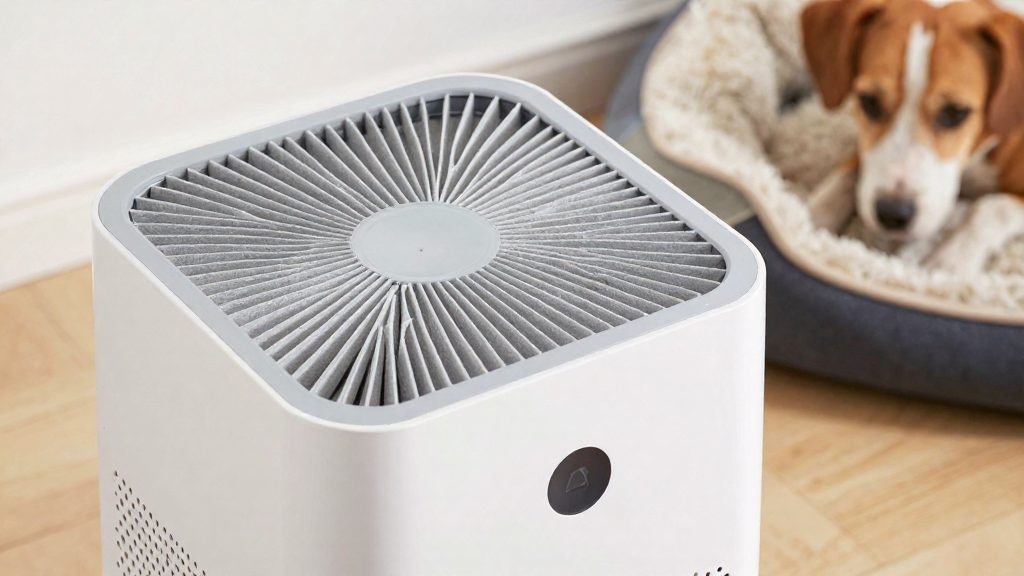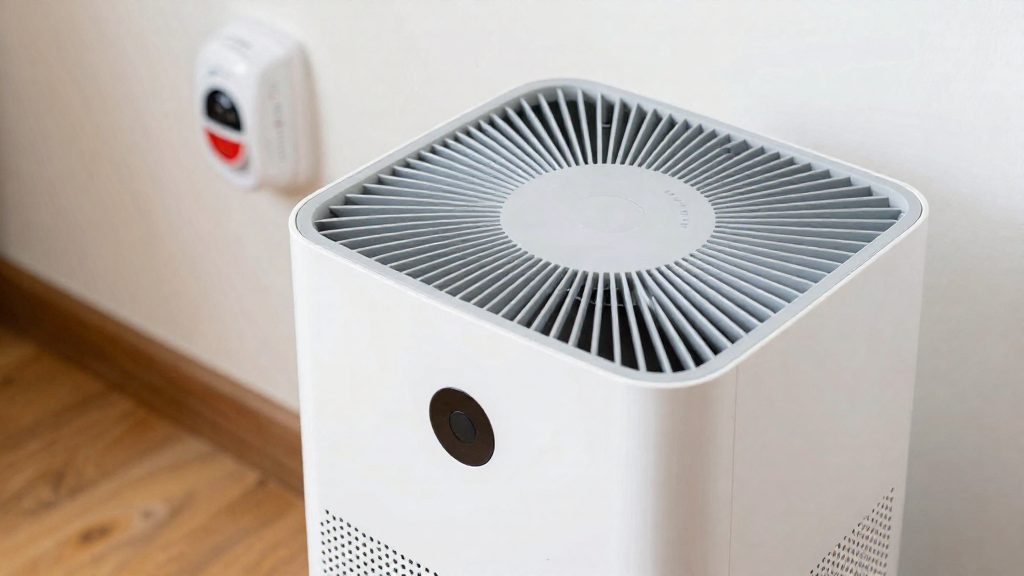
In general, no. Standard consumer air purifiers are built around particle filters, and they do not remove carbon monoxide (CO) from indoor air. CO is a gas, and a particle filter does not capture gas molecules. According to the U.S. EPA (2026-10-01), a portable air cleaner needs an activated carbon filter or another filter designed to remove gases before it can address them. The EPA page does not name CO. Based on the particle-versus-gas distinction, a unit without a gas-removal stage should not be expected to reduce CO. CO safety depends on source control and CO alarms, not on air cleaning.
Do air purifiers remove carbon monoxide?
Gas versus particle removal
A particle filter traps solid or liquid matter, such as dust, pollen and smoke particles, as air passes through its media. Carbon monoxide is a gas, so it is not a particle to be caught. The two contaminant types need different removal mechanisms:
| Contaminant | Physical form | Response of a standard particle filter |
|---|---|---|
| Dust, pollen, smoke particles | Solid or liquid particles | Captured by the filter media |
| Carbon monoxide | Gas molecules | Passes through the filter unchanged |
Why CO passes through standard airflow
A purifier’s fan pulls room air through the filter and returns it to the room. With a particle-only filter, the air leaving the unit carries the same CO concentration as the air entering it. Airdog USA (2025), a manufacturer, states that HEPA filters do not remove CO because the gas passes through the fibers that capture particles. This is a manufacturer claim made in promotional material, but it matches the particle-versus-gas distinction above.
No standard ratings for gas-removal cleaners
The EPA states that there are no widely used performance rating systems for portable air cleaners or filters designed to remove gases. Buyers therefore have no common, independently comparable figure for gas removal. The EPA page does not mention carbon monoxide specifically. When a manufacturer claims gas removal, check whether the test data names CO and what conditions were used, rather than relying on a general statement.
Why HEPA filters don’t stop CO
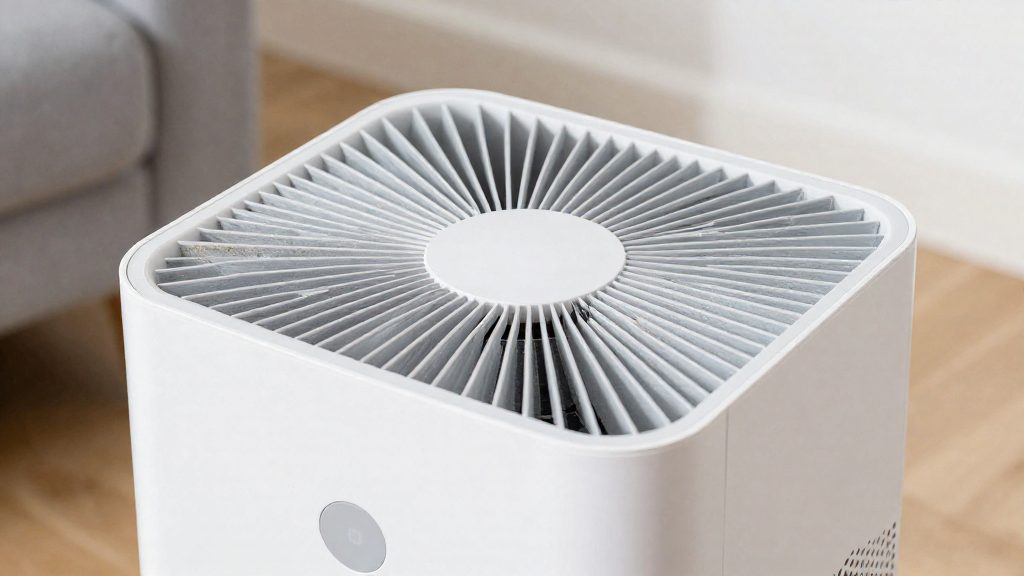
A HEPA filter removes airborne particles through mechanical capture. Air passes through a dense mat of fibers, and particles collide with those fibers and stay trapped. This works for solid and liquid particles such as dust, pollen, and smoke particulates. It does not work for carbon monoxide, which is a gas. Gas molecules are not captured by this mechanism, so CO travels through the filter media with the airflow, as the Airdog USA (2025) manufacturer claim also states.
What the H13 and H14 classes measure
H13 and H14 are HEPA efficiency classes. They describe how effectively a filter captures particles. They say nothing about gas removal, and no particle-capture class indicates whether a filter will reduce CO. A high class therefore does not mean a purifier lowers CO levels.
Filter types matched to the pollutant
| Technology | Primary target | Status in U.S. EPA guidance (2026) |
|---|---|---|
| HEPA | Particles | Captures particles mechanically; not a gas-removal method |
| Activated carbon | Gases | Named by EPA as a required type of filter for gas removal |
| Plasma, photocatalytic oxidation, UV | Gases (claimed) | Not yet shown to remove gases effectively in portable residential cleaners |
Absence of a common performance standard
A purifier’s specification sheet alone does not establish that it handles CO, because the EPA notes there are no widely used rating systems for gas removal.
Can activated carbon filters help with CO?
Standard activated carbon filters can capture only limited carbon monoxide, according to a manufacturer (Airdog USA, 2025), and the carbon saturates over time. The U.S. EPA says, for gases in general and without naming CO, that activated carbon can be effective only if the filter holds a large amount of material. A small carbon layer in a typical portable unit is unlikely to make a meaningful difference to CO levels.
How standard carbon media handles CO
Activated carbon works by adsorption: gas molecules stick to the porous surface of the carbon. CO is a small, weakly adsorbed molecule, so standard carbon captures it poorly compared with larger organic vapours. A manufacturer, Airdog USA (2025), states that activated carbon adsorbs only a limited amount of CO and becomes saturated over time. Once the carbon is saturated, it stops capturing gas.
Catalytic media
A different approach uses a catalytic material such as hopcalite, a mixture of metal oxides that oxidises CO into a less harmful gas rather than holding it on the surface. Hopcalite is a recognised name in CO-related filtration.
| Mechanism | How it acts on CO | Documented limit |
|---|---|---|
| Standard activated carbon | Adsorption onto the carbon surface | Weak CO capture; saturates over time (Airdog USA, 2025) |
| Activated carbon, large mass | Adsorption with more capacity | EPA: effective for gases in general only with a large amount of material; CO not named |
| Hopcalite-type catalytic media | Oxidation of CO | Not stated |
What this means for a filter choice
Before relying on a purifier for CO, check the carbon mass and the type of media. A filter with a thin carbon layer will have limited capacity. Carbon mass and media type do not make a purifier a CO safety device.
Where carbon monoxide comes from at home
Carbon monoxide (CO) forms when fuel burns without enough oxygen to complete the reaction. Any device that burns fuel can release it, so the practical question is which sources sit close enough to living space to affect indoor air. According to the U.S. Consumer Product Safety Commission (CPSC, 2026), CO comes from the incomplete burning of coal, wood, charcoal, oil, kerosene, propane and natural gas.
Fuels that produce CO
Every solid, liquid and gaseous fuel in the CPSC list can produce CO when it burns incompletely:
- Solid fuels: coal, wood and charcoal
- Liquid fuels: oil and kerosene
- Gaseous fuels: propane and natural gas
The fuel itself is not the only variable. What matters is whether combustion is complete, which depends on how the appliance or engine operates.
Typical home sources
The CPSC identifies the following as typical sources in homes:
| Source category | Typical examples (CPSC, 2026) |
|---|---|
| Fuel-burning appliances | Malfunctioning furnaces, water heaters, ranges, room heaters, fireplaces |
| Portable equipment | Portable generators |
| Vehicles | Cars left running in attached garages |
Malfunctioning appliances are the core issue. When a furnace, water heater, range or fireplace does not burn fuel completely, CO can enter the room air. The CPSC lists these units by name because a fault in the burner or flue can cause the problem, not only normal use.
Portable generators and vehicles share the same mechanism: an engine burns fuel and its exhaust carries CO. When either runs in an attached garage, the gas can reach the home’s living space.
What actually protects you from CO?
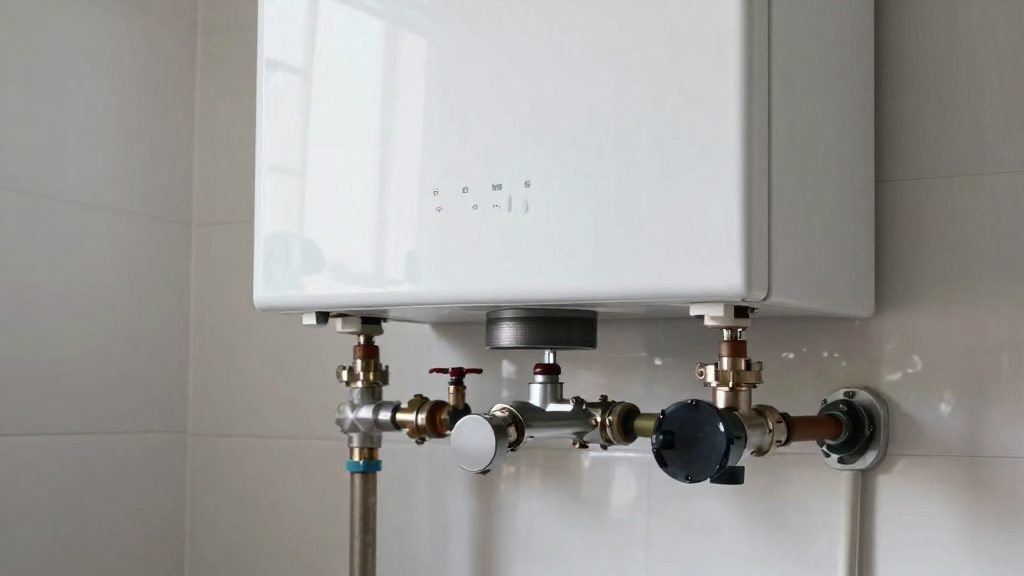
Source control is the most reliable protection against carbon monoxide (CO). The gas forms when fuels burn incompletely. Preventing exposure therefore means keeping every fuel-burning appliance working properly and its exhaust venting outside.
Servicing, flue integrity and combustion air supply
- Servicing: Have furnaces, water heaters, ranges, room heaters and fireplaces inspected and maintained by a qualified technician, since a malfunction is the typical cause named by CPSC (2026).
- Flue integrity: Check that flues and chimneys are continuous, undamaged and unblocked, so exhaust gases leave the building instead of entering living spaces.
- Combustion air supply: Keep the air vents and openings that feed fuel-burning appliances clear and unobstructed. Combustion needs air, and CO is produced when burning is incomplete.
Air purifiers do not address any of these points.
No generators or engines in attached garages
Portable generators and cars left running in attached garages are named by CPSC (2026) as typical home sources of CO. Run generators, cars and other engines only in locations that are not connected to the living space, and never inside an attached garage.
Recognising symptoms and leaving the building
Low-to-moderate CO poisoning resembles flu but occurs without fever, so it is easy to misidentify. Compare the symptoms CPSC (2026) lists:
| Exposure level | Symptoms reported by CPSC (2026) |
|---|---|
| Low to moderate | Headache, fatigue, shortness of breath, nausea, dizziness |
| High level | Confusion, vomiting, loss of coordination, loss of consciousness, death |
If anyone in the home has these symptoms, if several people feel unwell at once, or if symptoms improve when away from the building, treat it as possible CO exposure. Leave the building immediately, move into fresh air, and call 911 from outside. Get urgent medical evaluation for anyone with symptoms. Do not return until emergency responders or a qualified technician have cleared the home and the source has been identified and repaired.
How to place and maintain CO alarms
A carbon monoxide alarm is the main detection layer for CO in a home, so its position, power source and upkeep determine whether occupants get warned in time. The U.S. Consumer Product Safety Commission (CPSC, 2026) gives the core placement rules below.
Coverage: every level and sleeping areas
Install alarms on every level of the home, and outside each area where people sleep. CPSC recommends alarms on every level and outside each sleeping area, so a single alarm in one room leaves other areas unmonitored. Map the floors first, then mark a sleeping zone on each one, so no level or bedroom group is missed.
Placement exclusions
CPSC lists specific positions to avoid, since they cause nuisance alarms or blocked sensors:
| Location | Placement rule (CPSC, 2026) |
|---|---|
| Kitchens | Do not install |
| Above fuel-burning appliances | Do not install |
| Near heating vents | Do not install |
| Where furniture or draperies could cover the unit | Do not install |
Check each spot after furniture is moved or curtains are rehung, because a later change can block the sensor without any visible sign.
Power and interconnection
CPSC recommends that alarms be interconnected, so that when one unit sounds, all units in the home sound. Each alarm should be either battery-operated or fitted with a battery backup, which keeps it working during a power cut. Use the battery type specified by the manufacturer, and replace batteries when the unit signals low power.
Testing and end-of-life replacement
Test each alarm on a schedule set by the manufacturer, and record the test dates. Alarms do not last indefinitely: the unit’s printed end-of-life date or the manufacturer’s stated service life marks when to replace it, even if it still powers on. Use the replacement figure on your own device.
Where do purifiers and air quality monitors fit in?
Air purifiers and air quality monitors help control particles, humidity and carbon dioxide. They do not provide dependable carbon monoxide (CO) detection or removal, so they cannot take the place of a dedicated CO safety device. Confusing these devices is a common mistake, because a purifier or monitor can look like a complete safety product while measuring entirely different pollutants.
Plasma, UV and photocatalytic technologies
Some portable cleaners advertise plasma, ultraviolet (UV) or photocatalytic oxidation. According to the U.S. EPA (2026), these technologies have not yet been shown to remove gases effectively in portable residential cleaners.
Consumer monitors versus certified CO alarms
A certified CO alarm is the device the U.S. Consumer Product Safety Commission (CPSC, 2026) recommends for carbon monoxide. Consumer monitors that report CO2 or humidity do not serve this function. Airdog USA (2025), a purifier manufacturer, states that its purifiers cannot replace certified CO detectors.
Air quality monitors: CO2 and humidity readings
Monitors are useful for tracking CO2 and humidity readings over time, which supports day-to-day decisions about the home environment:
| Reading | What it indicates | Practical use |
|---|---|---|
| CO2 | Build-up of occupants’ exhaled air in a room | Signals when ventilation may need to increase |
| Relative humidity | Moisture level in indoor air | Guides whether a dehumidifier or humidifier is needed |
Persistently high humidity readings can point to conditions that favour condensation and mould growth, while CO2 readings help show whether a room is being ventilated adequately. Neither reading measures carbon monoxide.
Frequently asked questions
Can an air purifier replace a carbon monoxide alarm?
No. Airdog USA (2025), a purifier manufacturer, states that purifiers cannot replace certified CO detectors. The CPSC recommends battery-operated alarms on every level of the home and outside sleeping areas, which a purifier does not provide.
Does activated carbon remove carbon monoxide from indoor air?
The EPA (2026) says a portable unit needs an activated carbon or other gas-removal filter to address gases at all. Airdog USA (2025) adds that activated carbon adsorbs only a limited amount of CO and becomes saturated over time, so the filter loses effect with use.
What symptoms suggest carbon monoxide exposure?
According to the CPSC (2026), low to moderate exposure causes headache, fatigue, shortness of breath, nausea and dizziness, which can resemble flu without a fever. Higher exposure can cause confusion, vomiting, loss of coordination, unconsciousness and death, so anyone with these symptoms should leave the building and call emergency services.