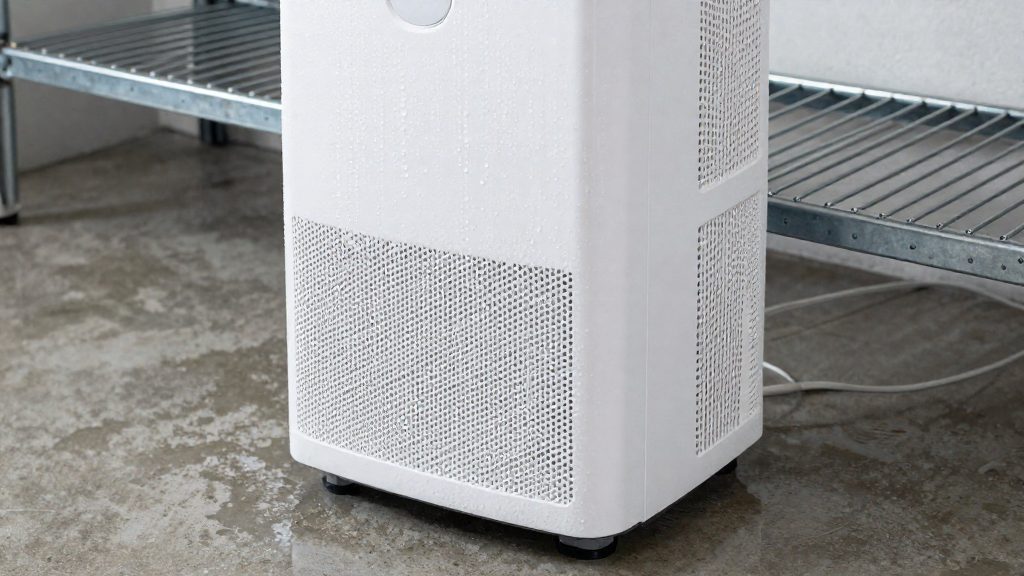
An ENERGY STAR dehumidifier is worth buying for a damp garage when moisture is a recurring condition rather than an occasional one. According to ENERGY STAR (US EPA/DOE, 2025), certified units use about 20% less energy than conventional units of similar size that remove the same amount of moisture. That saving accumulates only when the unit runs for long periods, so the purchase case depends on where the moisture comes from and how often the unit will operate.
Is an ENERGY STAR dehumidifier worth it for a damp garage?
Where garage moisture comes from
- Moisture sources in a garage are usually continuous rather than one-off. Concrete slabs, especially those laid directly on the ground, can release moisture into the air over time, so humidity may stay high even when the garage is unused.
- Vehicles bring water in on tires and underbodies after rain, snow or washing. That water evaporates into the enclosed air after each trip.
- Stored items such as cardboard, firewood, damp rags and garden equipment add moisture to still air, and they also absorb it.
Payback logic for occasional versus daily use
The official sources consulted do not give a dollar savings figure for ENERGY STAR units, so payback has to be estimated from your own numbers. Use this method:
- Annual running cost = rated power draw × hours of operation per year × your electricity price per kWh.
- Compare that cost with the cost of the damage you are trying to prevent, such as ruined stored items or tool replacement.
| Usage pattern | Typical situation | Effect of the ENERGY STAR efficiency gain |
|---|---|---|
| Occasional | Humidity rises after heavy rain or a wash, then drops | Absolute savings are small because the unit runs for short periods |
| Daily or near-continuous | Slab moisture and stored items keep humidity high all year | The roughly 20% reduction applies to every hour of runtime, so savings build up |
For occasional use, the decision rests mainly on damage prevention. For near-continuous use, the efficiency difference becomes a meaningful part of the running cost.
Signs a damp garage needs a unit
- Relative humidity above 60%. The US EPA advises keeping indoor humidity below 60%, ideally between 30% and 50%.
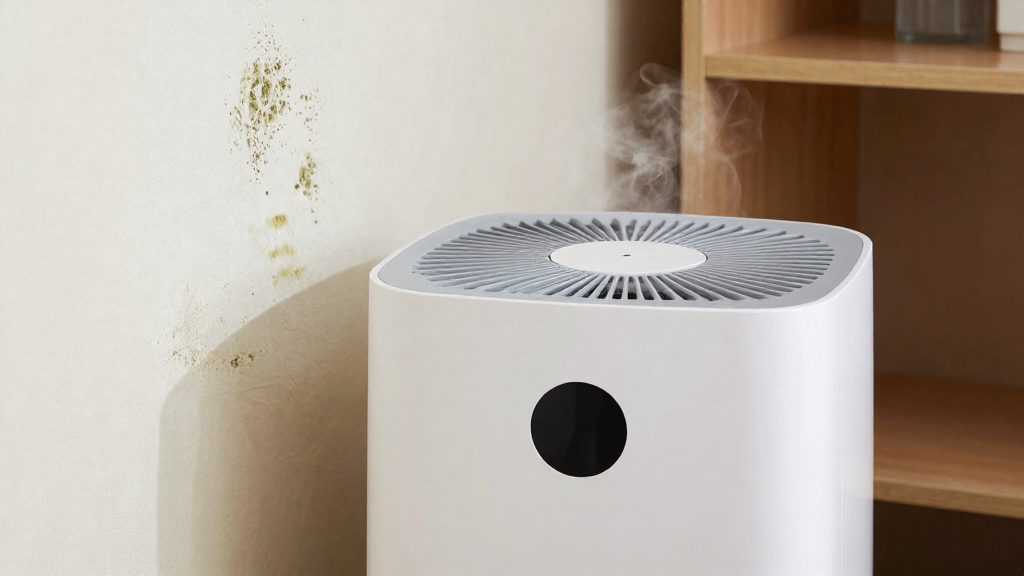
- Musty odor or visible mold on walls, cardboard boxes or stored fabrics.
- Stored items that stay damp for more than 24–48 hours.
- Condensation or rust on tools and metal parts.
What the ENERGY STAR label actually guarantees
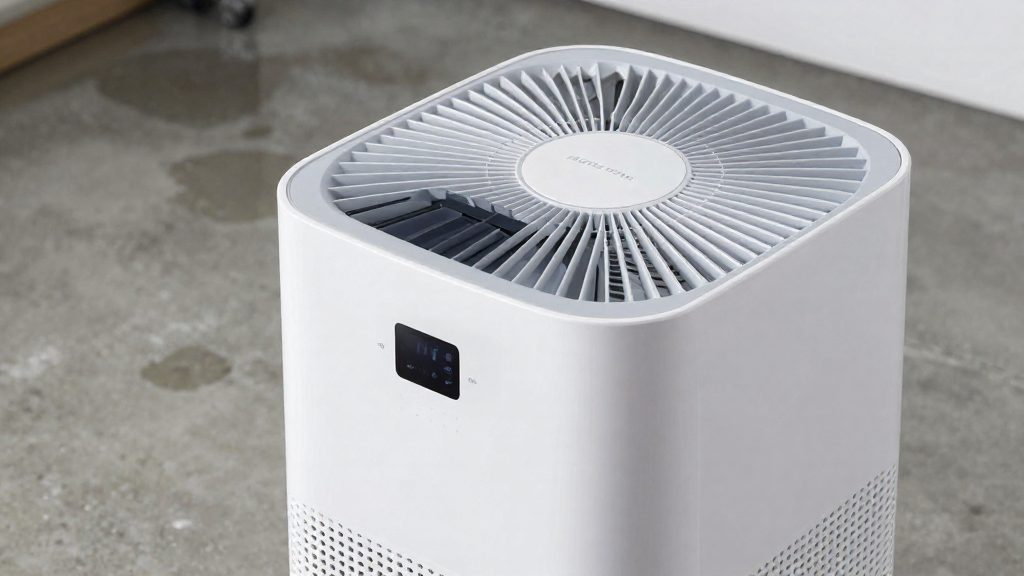
The ENERGY STAR label for dehumidifiers certifies that a unit meets a minimum Integrated Energy Factor (IEF), expressed in litres of water removed per kilowatt-hour (L/kWh). According to ENERGY STAR (US EPA/DOE, 2025), the current requirements are Version 6.0, effective October 1, 2025. The label sets an efficiency floor for each unit type. It does not promise a specific drying result in a given room.
Portable unit minimums
Portable units are assessed by their rated capacity in pints per day:
| Capacity band (pints/day) | Minimum IEF (L/kWh) |
|---|---|
| Up to 25 | 1.70 |
| 25.01 to 50 | 2.01 |
| 50 and above | 3.30 |
Whole-home unit minimums
Whole-home units use a different scale, based on size as ENERGY STAR defines it:
| Size band | Minimum IEF (L/kWh) |
|---|---|
| 8.0 ft³ or less | 2.22 |
| Above 8.0 ft³ | 3.81 |
How to read the thresholds
- Minimum threshold: A certified unit must reach at least the IEF value for its band. A higher IEF means more water removed per kWh consumed.
- Capacity band: The minimum rises with capacity. A unit rated at 30 pints/day falls in the 25.01 to 50 band and must reach 2.01 L/kWh, not 1.70.
- Like-for-like comparison: IEF values are only comparable within the same band. A 50-pint unit at 3.30 and a 25-pint unit at 1.70 are not directly ranked against each other by the threshold alone.
What the label does not promise
- Drying performance: The IEF measures efficiency, not how quickly a unit dries a space. The official sources consulted do not specify a removal rate tied to the label.
- Cold-temperature operation: ENERGY STAR notes that frost can form on coils when air drops below 65°F (2025). The official sources consulted do not specify how the IEF is measured at low temperatures, so a certified rating does not confirm performance in an unheated space.
- A humidity outcome: Certification does not guarantee that a unit will hold any particular relative humidity in the room where it operates.
How much energy can you really save?
ENERGY STAR states that certified dehumidifiers use about 20% less energy than conventional units of similar size that remove the same amount of moisture (ENERGY STAR (US EPA/DOE), 2025). This is a comparison at equal moisture removal, not a guaranteed cut on your electricity bill. The official source gives no dollar savings figure, so the actual saving in a damp garage depends on the unit’s power draw, its running time, and your electricity tariff.
Running-cost formula
Energy use is power multiplied by time. Calculate it in three steps:
- Energy per day (kWh) = power (kW) × hours running per day
- Cost per day = energy per day × tariff (price per kWh)
- Cost per month = cost per day × days in the month
Convert watts to kilowatts by dividing by 1,000. The power figure comes from the nameplate or the manufacturer’s specification sheet, and the tariff comes from your electricity bill.
| Input | Where to find it | Role in the calculation |
|---|---|---|
| Rated power (W) | Nameplate or specification sheet | Divided by 1,000 to give kW |
| Running hours per day | Runtime log or plug-in energy meter | Multiplied by kW to give kWh |
| Electricity tariff | Utility bill | Multiplied by kWh to give cost |
Estimating operating hours
Runtime is not fixed, because a dehumidifier cycles to hold its target. The hours to enter in the formula are the hours the unit actually runs, not the hours it is plugged in.
To obtain that figure:
- Log the unit’s on-time over a typical week in the damp season.
- Repeat the log in a drier period to capture the lower load.
- Average the daily hours and apply the formula to each period.
Seasonal totals
Add the monthly costs for each damp month to obtain a seasonal total. The official sources consulted do not specify typical garage runtimes, so the logged figures are the only reliable input. A plug-in energy meter provides a direct reading of kWh, which removes the need to combine wattage and hours yourself.
Will it work in a cold garage?
A standard dehumidifier works in a cold garage only down to a certain temperature. According to ENERGY STAR (US EPA/DOE, 2025), frost can form on the coils when the air drops below 65°F (about 18°C). Frost on the coils is a risk ENERGY STAR flags for unheated garages, so the unit’s temperature limits matter alongside the humidity reading.
Temperature thresholds
| Temperature | What it means | Source |
|---|---|---|
| Below 65°F (about 18°C) | Frost can form on the coils | ENERGY STAR (US EPA/DOE, 2025) |
| About 60°F (about 16°C) | Manufacturers advise against running the unit below this point | Garage Transformed |
The two thresholds are different. Frost is the risk at 65°F, while the manufacturer caution applies at about 60°F. For a cold garage, treat 65°F as the level where you need a plan.
Anti-frost sensors and how to select one
ENERGY STAR recommends choosing a unit with an anti-frost sensor for unheated garages. When checking a model, use these criteria:
- Sensor presence: Confirm the spec sheet lists an anti-frost sensor or equivalent frost protection.
- Rated minimum operating temperature: Find the lowest temperature the manufacturer states for operation. The official sources consulted do not give a universal minimum, so use the figure printed for the specific model.
- Low-temperature design: Garage Transformed says cold garages need a low-temperature model, so prioritise units marketed for that use.
A sensor reduces frost risk, but it does not remove the need to check the rated minimum temperature against your garage’s typical winter readings.
Heating options that keep the space above the threshold
ENERGY STAR’s first recommendation is to keep the space warmer. Practical approaches include:
- Use a thermostat-controlled heat source: Set the thermostat so the air stays above 65°F. The official sources consulted do not specify heater types or output, so choose one sized for your garage.
- Keep the dehumidifier clear of dust: ENERGY STAR warns that dust, such as from woodworking equipment, can clog coils and grills. Clogged coils reduce airflow and make frost more likely.
What size dehumidifier does a garage need?
Sizing a garage dehumidifier depends on two inputs: the moisture load, meaning how much water vapour enters the space from the floor, walls, open doors and stored items, and the unit’s pints per day rating, which is the amount of water it can remove in 24 hours. Matching the rating to the moisture load, rather than to the floor area alone, avoids both an undersized unit that never catches up and an oversized one that cycles inefficiently.
Pints-per-day tiers
| Rating | Reference point |
|---|---|
| Up to 25 pints/day | ENERGY STAR’s first portable-unit tier |
| 25.01 to 50 pints/day | ENERGY STAR’s middle portable-unit tier |
| 30 pints/day | Garage Transformed says this is enough for most garages under 1,000 sq ft, even when very wet |
| 50 pints/day | Garage Transformed’s author used this size for a 460 sq ft garage and calls it overkill |
Estimating the moisture load
Measure the floor area (length × width) and the volume (area × height), then note the factors that add moisture:
- Openings: a garage with frequently opened doors or unsealed vents takes in more humid outside air than a closed, sealed one.
- Attachment: a garage connected to a heated, humid living space may receive moisture through shared walls or doors.
- Stored and wet items: damp wood, wet clothing and recently washed vehicles add water to the air. Removing the source often reduces the load more effectively than adding capacity.
A small, closed, mostly dry garage sits at the low end of the scale. A large garage with frequent door openings and a persistently damp slab sits at the high end.
Consequences of oversizing and undersizing
- Oversized unit: it reaches the target humidity quickly, shuts off, and restarts often. This short cycling wears components without removing much additional moisture.
- Undersized unit: it runs continuously during humid periods and still cannot reach the target. Since ENERGY STAR notes that higher humidity levels can promote mold, a persistently overloaded unit leaves the garage at risk.
Setup tips for better results
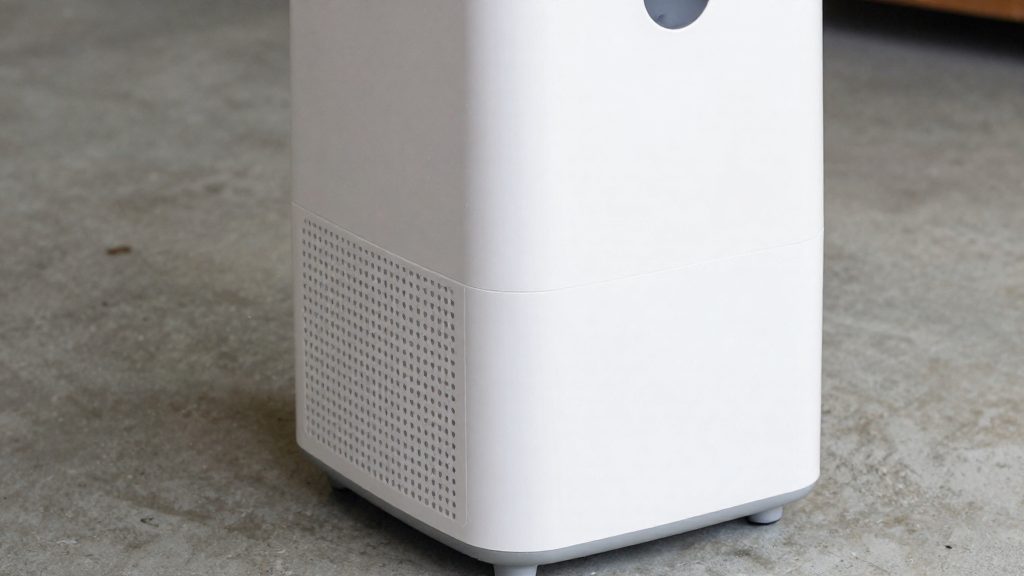
Physical placement controls how much of the damp air in a garage actually reaches the unit’s intake and how safely the water and power connections run. ENERGY STAR (US EPA/DOE, 2025) gives placement rules that cover sealing the room, airflow, dust protection, power and drainage.
Seal the room while the unit runs
Close the doors and windows for the whole run time. Any gap lets humid outside air enter, so the unit keeps pulling in new moisture while it tries to dry the space.
Leave air space around the cabinet
The top-mounted discharge design is the deciding factor for wall clearance:
- Units with top-mounted discharge can be placed close to a wall, since their air exits upward.
- Units without it must be kept away from walls, so the intake and outlet have open air to move through.
Keep the unit clear of dust sources such as woodworking equipment. ENERGY STAR notes that dust can clog the coils and grilles, which reduces airflow over time. Garages where sawdust or shavings are produced are the most common case, so keep the unit away from those tools.
Route the drain hose and power cord separately
A grounded outlet is the recommended power connection. Plug the unit directly into one, and avoid extension cords where you can, since they add connection points for a load that runs for hours.
For the drain hose, keep it away from electrical cords. A hose routed alongside a cord can be snagged, pulled, or pressed against wiring, and standing water near electrical connections is a hazard in any garage. Route the hose so it runs downhill to a floor drain or a suitable outlet without crossing walkways or power leads.
Humidity targets and when to use a hygrometer
A dehumidifier needs a target humidity to work toward. The US EPA advises keeping indoor humidity below 60%, ideally between 30% and 50%. ENERGY STAR (US EPA/DOE, 2025) gives the same 30–50% band for relative humidity (RH) and warns that higher levels may promote mold. For a damp garage, the working goal is to bring RH under 60% and then hold it inside the 30–50% band.
| Relative humidity | Source and meaning |
|---|---|
| Below 60% | US EPA upper limit for indoor humidity |
| 30–50% | Ideal band cited by the US EPA and ENERGY STAR (2025) |
| Above 50%, sustained | ENERGY STAR (2025): higher levels may promote mold |
Why sustained humidity matters for mold
Mold risk depends on how long humidity stays high, not on a single reading. A garage that spends long periods above the band creates the conditions ENERGY STAR associates with mold growth. Wet materials are a separate trigger: the US EPA advises drying wet items within 24–48 hours to prevent mold, so a dehumidifier cannot replace prompt drying of soaked floors, boxes or clothing.
Built-in humidistat versus a separate hygrometer
ENERGY STAR suggests using the unit’s built-in humidistat to hold the target. The humidistat switches the unit according to a set point, so the set point should sit within the 30–50% band. The official sources consulted do not specify how accurate built-in humidistats are, so a reading from the unit should be treated as an approximate control value.
A separate hygrometer is needed in two cases:
- The unit shows no RH. ENERGY STAR recommends a separate hygrometer when the dehumidifier does not display humidity.
- You need to verify the band. Comparing the unit’s setting with an independent reading shows whether the garage actually sits between 30% and 50%.
When a dehumidifier is not enough
A dehumidifier removes water vapour that is already in the air. It cannot stop moisture from entering the garage. When the source is the ground, a leak, or wet objects stored inside, the unit runs continuously and the air stays damp. In these cases, the source has to be identified and reduced before the dehumidifier can work as intended.
Ground moisture and vapour barrier limits
A concrete slab can draw moisture up from the soil, and that vapour spreads into the room regardless of what the dehumidifier does. Signs of this are damp patches on the floor after rain, or a dark, slightly raised film on bare concrete. The official sources consulted do not specify performance figures for slab vapour barriers, so the presence of one under an existing garage floor is best checked during construction or renovation.
To reduce ground moisture, keep stored items off the floor using shelving, pallets, or raised racks. Avoid storing cardboard or fabric directly on the slab.
Venting moist air with exhaust fans
A dehumidifier recirculates the air in the room and does not replace it. In a closed garage, moisture from drying laundry, wet gear, bicycles, and vehicles accumulates faster than the unit can remove it. Moving wet objects outdoors or into a dry area is a direct way to lower the load.
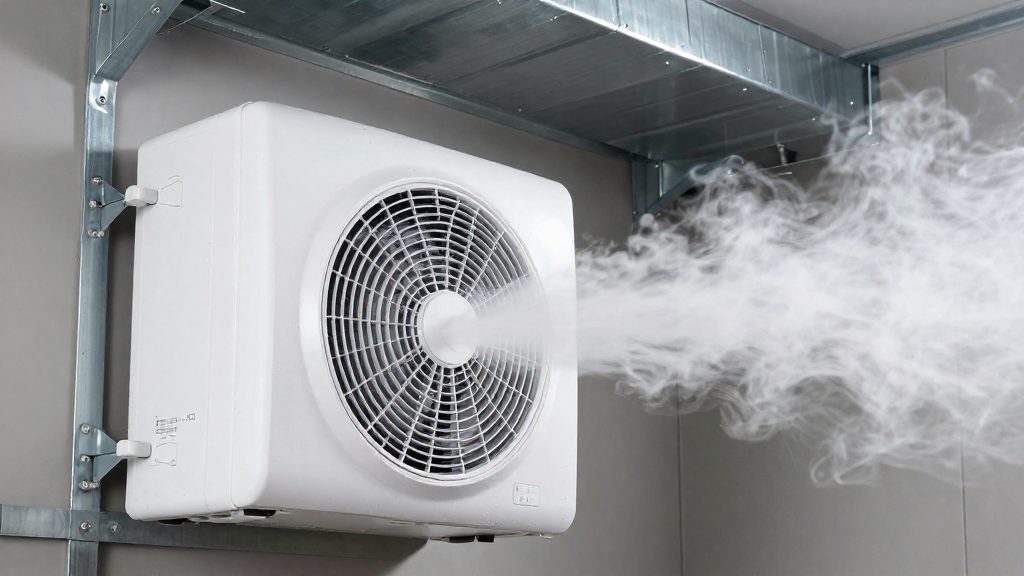
Where the garage has no regular air exchange, an exhaust fan that vents to the outside removes humid air at its source. Fans are typically mounted in a wall or window, and they should be sized to the garage. The air exchange brings in outdoor air, which is not always drier, so the fan should be paired with the dehumidifier rather than replaced by it.
Water intrusion and condensation from leaks
A dehumidifier collects vapour, not liquid water. If water enters through a roof gap, a blocked gutter, a door threshold, or a window frame, the floor stays wet and the dehumidifier cannot prevent it. Inspect these points after rain and look for staining on walls near the top of the room.
Condensation also forms on cold surfaces, such as uninsulated exterior walls or cold water pipes, when warm moist air touches them. This is a surface problem that a dehumidifier does not fix. Insulating the surface or improving airflow around it is more effective.