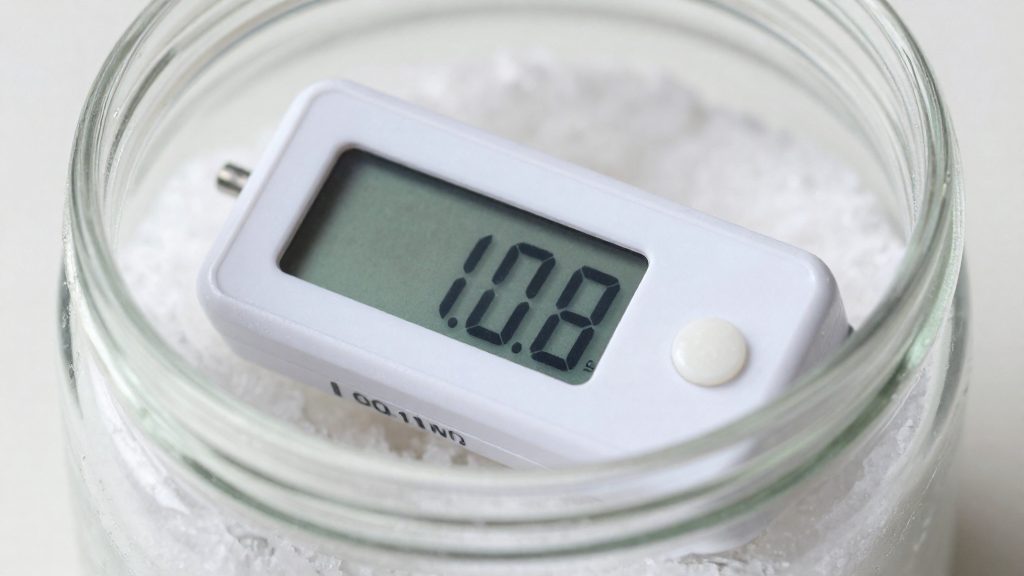
A saturated salt solution produces a known humidity level of about 75% relative humidity (RH), so the reading can be checked against a fixed point instead of being accepted by default.
Why salt-test a humidity sensor?
How unverified readings lead to wrong decisions
A humidity sensor reports one number, and people act on it. If the display reads too high, a dehumidifier switches off before the room is dry enough, and damp air can persist on cold surfaces where condensation and mould form. If the display reads too low, the dehumidifier keeps running longer than needed, and a humidifier may add moisture the room does not require. Both errors look normal on the screen, so they go unnoticed until the air quality problem appears.
The test answers a practical question: is the sensor close enough to its specification to guide daily control decisions?
A fixed reference point for accuracy
A saturated salt solution gives a stable humidity level that can serve as a reference point. The published sources agree on the target value, but they differ on how strictly to judge the result:
| Source | Reference point | Acceptance criterion |
|---|---|---|
| Ambient Weather (2026) | About 75% RH from saturated table salt with no standing water | Reading within the sensor’s rated tolerance: 70–80% for a ±5% sensor |
| Ruuvi (2023) | Target reading of 75% RH | — |
| Vigilant Inc. (2021) | Hygrometer should read 75% | If it does not, repeat the test and average the two readings to find an offset |
The rated tolerance is set by the manufacturer. A reading inside that band is consistent with the specification, while a reading outside it should be repeated; if it persists, the sensor needs correction or replacement before it is used for control.
Trusting the reading before control decisions
Once the reading has been checked, it can be trusted as an input for setpoints. If a sensor reads 75% at the reference point, no correction is needed. If it reads consistently away from 75%, the difference becomes an offset to apply to later readings, as Vigilant Inc. (2021) describes. Applying the offset can bring dehumidifier and humidifier targets closer to the true air condition, but it was measured at 75% RH only and may not hold at other humidity levels.
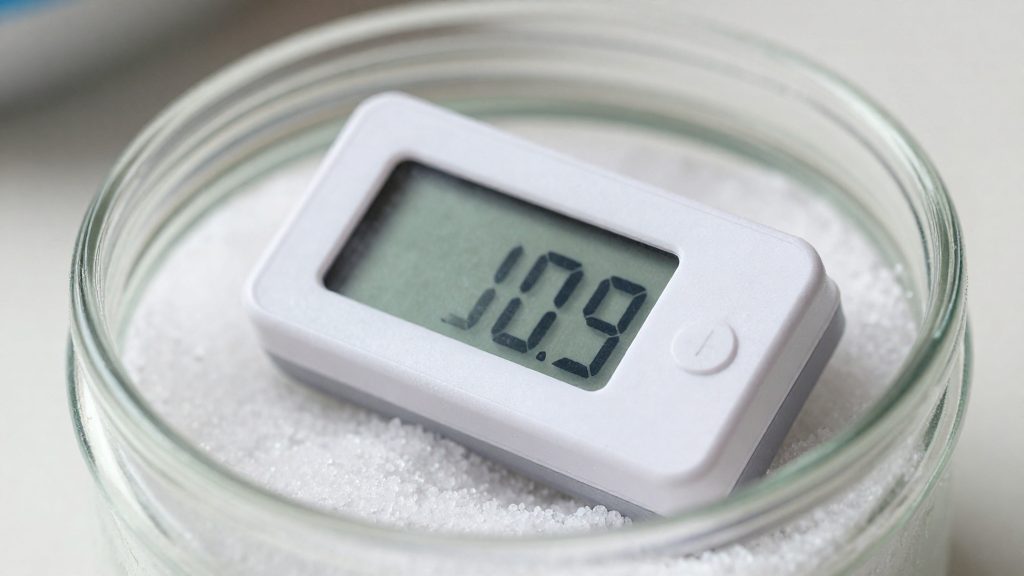
How often should you calibrate a humidity sensor?
Two manufacturers set a yearly check as the baseline: a humidity sensor should be checked at least once every 12 months. Ruuvi recommends calibrating its humidity sensor at least once a year (Ruuvi, 2023-05-09). Ambient Weather, a US weather-station manufacturer, advises repeating the saturated salt test once per year (Ambient Weather, 2026). Both manufacturers give a yearly cycle, even though their test methods differ.
Ambient Weather ties the yearly repeat to electronic drift caused by contamination of the sensor. Contamination of the sensor gradually alters how it responds, so a reading that was accurate when the device was new can slowly move away from the true relative humidity. Because the change is gradual, a yearly check is meant to detect it before the readings become unreliable.
Ruuvi presents the annual interval as a minimum, not a ceiling: harsh conditions, high humidity or critical applications may call for more frequent checks.
Interval after first installation or replacement
For a newly installed or replaced sensor, the practical approach is a baseline check: run one reference test when the device enters service, then record the reading and the offset it shows. Later checks can be compared against that record, which reveals whether drift is developing between annual cycles. A replacement sensor needs its own baseline, because its offset is not the same as that of the sensor it replaces.
| Source | Recommended interval | Stated reason |
|---|---|---|
| Ruuvi (2023-05-09) | At least once a year | Harsh conditions, high humidity or critical applications may call for more frequent checks |
| Ambient Weather (2026) | Once per year | Electronic drift from sensor contamination |
| New or replaced sensor | Not stated | Baseline check advised as good practice |
How does the salt test work?
The salt test relies on a physical property of saturated salt solutions. When salt is in contact with a small amount of water and some crystals remain undissolved, the salt holds a fixed equilibrium with the air above it. The water vapour in the enclosed air adjusts until its relative humidity matches that equilibrium, so the salt acts as a reference humidity source. The method works because this reference is set by the chemistry of the salt, not by the sensor, which makes it a practical way to check a hygrometer against a known value.
The salt-to-water ratio is what matters. Ambient Weather (2026) specifies a saturated table salt solution with no standing water, meaning no free liquid pooled at the bottom of the container. Ruuvi (2023-05-09) describes the same principle as damp salt with some salt left undissolved. Vigilant Inc. (2021-07-22) uses about 1 tablespoon of table salt with a few drops of water, forming a wet pile.
| Source | Salt preparation | Water | Container |
|---|---|---|---|
| Ambient Weather (2026) | Saturated table salt solution | No standing water | Sealed zip-lock bag |
| Ruuvi (2023-05-09) | Damp salt, some undissolved | Minimal, salt stays damp | Airtight container |
| Vigilant Inc. (2021-07-22) | About 1 tablespoon table salt | A few drops | Ziploc bag |
Sensor placement completes the setup. The sensor is placed inside the sealed container alongside the salt, not in contact with the liquid. It must sit in the enclosed air, so it measures the vapour equilibrium rather than moisture from the salt itself. The container must be airtight, because any exchange with room air would pull the reading toward ambient humidity.
How long should the sensor stay in the sealed container?
The sealed period is the time the hygrometer must remain in the closed container with the salt before its reading can be trusted. During this time, the air inside the container and the sensor need to reach equilibrium, meaning the humidity around the sensor stops changing. A reading taken before that point reflects the room air the sensor was in before it was sealed, not the saturated salt atmosphere the test is meant to create.
Manufacturers do not agree on a single duration:
| Manufacturer | Sealed duration | Stated condition |
|---|---|---|
| Ruuvi (2023) | About 24 hours | Airtight container, salt and sensor together |
| Ambient Weather (2026) | 96 hours (4 days) | Sealed zip-lock bag, described as stabilization time |
| Vigilant Inc. (2021) | At least 5 hours | Sealed Ziploc bag, room temperature |
The gap is large. The Ambient Weather figure is four times Ruuvi’s 24 hours and about 19 times Vigilant’s 5-hour minimum. Vigilant’s wording sets a floor, not a fixed time, so a longer wait is consistent with its instructions. Ruuvi’s figure is approximate, and Ambient Weather presents its 96 hours as the time the sensor needs to stabilize, which is the longest of the three. Read the difference as what each manufacturer requires, not as a verified measurement of how fast a sensor settles.
For a practical approach, follow the stated duration of the procedure you use and do not read the sensor earlier. If the manual gives no duration, the sources do not say which is best. Choosing the longest documented period (96 hours) is a cautious option, not a verified requirement.
What reading should you expect at 75% RH?
A saturated table salt solution with no standing water gives a relative humidity of about 75% at room temperature, which is why 75% RH is the reference value for this test. Ambient Weather (2026) describes this setup in its procedure. Ruuvi (2023-05-09) and Vigilant Inc. (2021-07-22) also use 75% as the target reading.
The result is judged against the sensor’s rated accuracy, not against an exact figure. Ambient Weather (2026) states that the reading should fall within the tolerance window the manufacturer specifies. For a sensor rated ±5% RH, that window runs from 70% to 80%. A reading of 69% or 81% falls outside it, while 70% and 80% are the limits of an acceptable result.
Some sensors can be adjusted. According to Ambient Weather (2026), an adjustable sensor should be set to 75% RH during calibration, so the display matches the salt reference rather than sitting at its factory offset. A non-adjustable sensor cannot be corrected this way, so its reading is only checked against the window.
| Sensor type | Target reading | Acceptable result | Source |
|---|---|---|---|
| Rated ±5% RH | 75% RH | 70% to 80% | Ambient Weather (2026) |
| Adjustable | 75% RH | Set the sensor to 75% | Ambient Weather (2026) |
When should you test more often?
Three situations justify testing sooner.
Harsh environments and high-humidity locations
Humid spaces such as bathrooms, cellars or crawl spaces can count as the harsh or high-humidity conditions for which Ruuvi advises more frequent checks. In these locations, the timing is a judgement based on how the sensor has behaved.
Critical applications that need tighter accuracy
Where a few points of relative humidity matter, the salt test should only be a first check. Test more often in these cases, and compare the sensor against a reference instrument when the readings drive a decision.
Sensors that have been moved or knocked
A sensor that has been relocated or physically struck may read differently than before. As a practical rule, repeat the salt test after moving or dropping a sensor and before relying on its readings for a decision.
What if your sensor reads off?
When a hygrometer reads something other than 75% RH in a salt test, repeat the test before changing any setting. Vigilant (2021-07-22) recommends repeating the test and averaging the two readings to get an offset. A single run can be an outlier, so a second run gives a more reliable basis for correction.
Repeat the test and average the two readings
- Set up a second saturated salt test with fresh table salt, a few drops of water, and the sensor sealed in a bag, under the same conditions as the first run.
- Wait until the reading is steady, then record it.
- Add the two readings and divide by two to get the average.
Calculating the offset from the 75% reference
The offset is the difference between the average reading and the 75% reference:
- Offset = average reading minus 75
- Correction = 75 minus average reading
For example, if two runs average 78% RH, the sensor reads 3 points high. Its correction is −3, so 45% displayed would be read as 42%. Apply the correction to later readings only if the offset stays consistent across tests.
Use the outcome to choose the next step:
| Result after averaging | Action |
|---|---|
| Average falls within the sensor’s rated tolerance of 75% (for example, 70–80% for a ±5% sensor, per Ambient Weather, 2026) | The sensor reads within its rated tolerance at this 75% RH point only, which says nothing about other humidity levels; record the offset (Vigilant Inc., 2021) and apply it only if it stays consistent |
| Average falls outside rated tolerance | The sensor is outside its rated accuracy: correct it if it is adjustable, or replace it if the error is not consistent |
Sensors still outside tolerance after repeated tests
An offset assumes the error stays constant. If results remain outside the rated band across repeated tests, a single correction cannot make the sensor reliable. A sensor that drifts over time may need replacement rather than repeated correction.
Limits of the salt test
The salt test checks one thing: whether a sensor reads close to 75% RH at a single moment, inside one sealed container. According to Ruuvi (2023), the method is adequate for everyday use but not accurate enough for scientific purposes. A passing result shows that the reading at this reference point is plausible. It does not certify the sensor as a laboratory instrument.
One humidity point only
A saturated salt solution fixes the relative humidity near 75% and nothing else. The test therefore provides no full-range check. A sensor can read correctly at 75% and still be off in the drier or more humid parts of its range, and the test cannot reveal that. This matters most for decisions that depend on other humidity levels, such as judging whether a dehumidifier is working or assessing condensation risk on a cold wall.
Temperature effects
The equilibrium humidity of a saturated salt solution depends on temperature. The 75% target therefore shifts slightly with the room temperature during the test, and the test cannot separate that shift from the sensor’s own error. A result obtained in a cold or warm room should not be treated as a precise correction.
Properties the test cannot verify
| Sensor property | Checked by salt test? | Reason |
|---|---|---|
| Reading near 75% RH at one moment | Yes, approximately | Single equilibrium point |
| Accuracy at other humidity levels | No | Only one salt and one target |
| Linearity across the range | No | Requires several reference points |
| Sensitivity to temperature | No | Equilibrium humidity moves with temperature |
| Response time | No | The test waits for equilibrium and does not time the sensor’s reaction |
| Scientific-grade accuracy | No | Ruuvi (2023) states the method is not accurate enough |
For work that needs confirmed accuracy across the range, a reference hygrometer or a sensor calibrated at several points gives information that the salt test cannot provide.