How to tell if a bathroom exhaust fan is working
Start outside. The exhaust outlet sits on an exterior wall or the roof, and it is a common point where airflow is blocked. According to Air King (manufacturer), you should check the vent for debris such as bird nests and confirm that the louvers open and are not frozen shut.
Exterior vent and louvers
| Check | What to look for | Problem if it fails |
|---|---|---|
| Vent opening | Bird nests, leaves, or other debris in or over the opening | Air is restricted before it leaves the building |
| Louver movement | Flaps that open freely when the fan runs | Frozen or stuck louvers keep the outlet closed |
With the fan running, check from outside that the louvers open. A louver that stays shut or sticks means the fan is pushing against a closed outlet, which reduces airflow even if the motor is healthy. A louver that stays shut or sticks in one position means the fan is pushing against a closed outlet, which reduces airflow even if the motor is healthy.
Whether the fan starts and runs
Switch the fan on at its control and confirm three things:
- Start-up: The fan starts promptly and does not stall or hesitate.
- Running condition: The blades spin steadily.
- Sound: Note any change in noise. A louder, rougher sound than usual is a warning sign.
These symptoms signal a problem but do not identify its cause, so inspect the outlet and the unit first.
Does the tissue test really work?
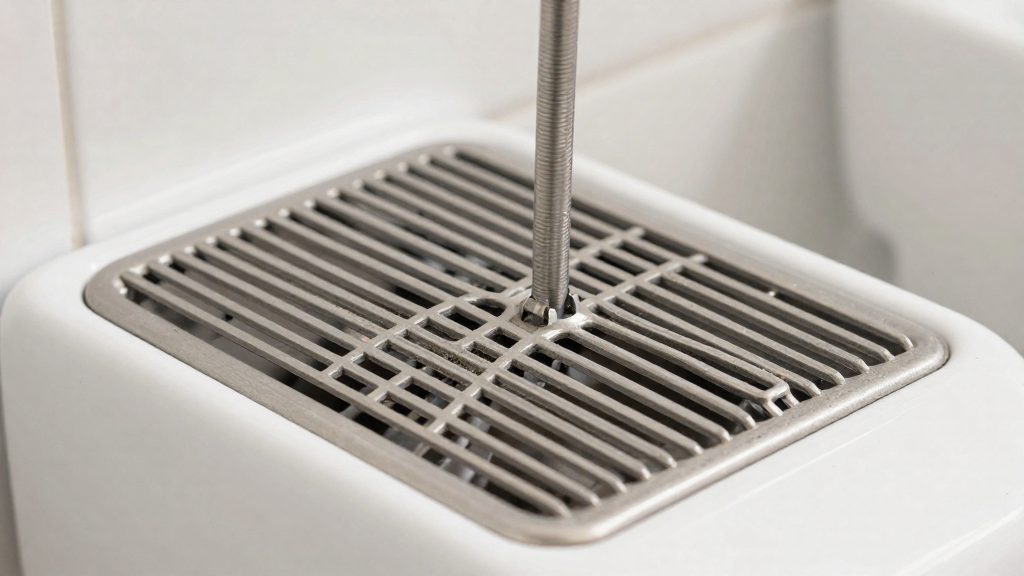
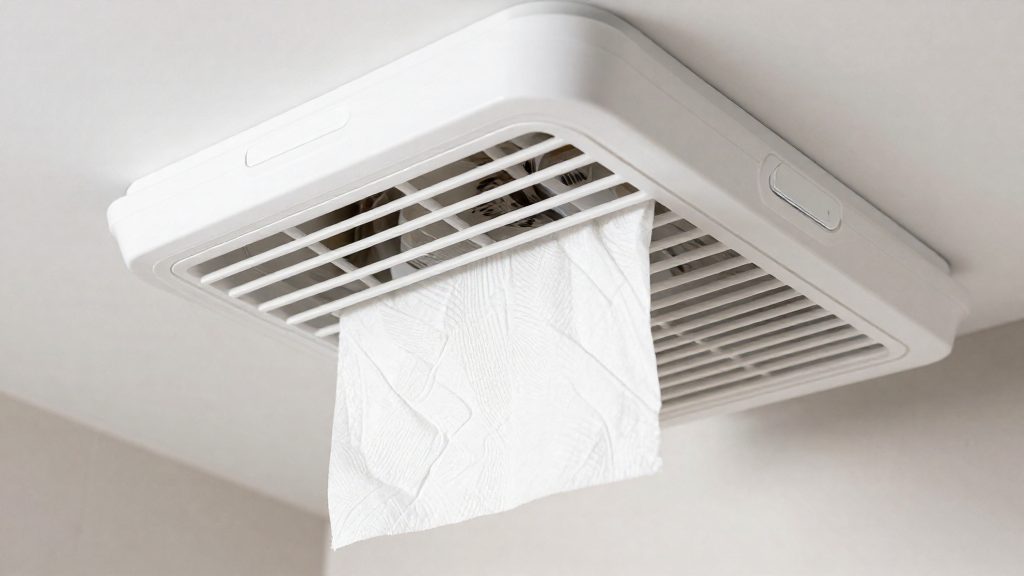
The tissue test checks suction at the grille. With the fan running, hold a single square of toilet paper against the vent. According to Healthy Building Science (2015-06-17), if the fan holds the tissue in place, it is working. This is only a rough check of suction at the grille. The check takes under a minute and needs no tools, but it answers one narrow question: whether air is being pulled into the grille at that point.
How to run the test
- Switch the fan on and wait until it reaches full speed.
- Hold one square of toilet paper flat over the grille, covering part of the opening.
- Let go of the tissue and observe whether it stays held against the grille.
Reading the result
| Result | What it indicates |
|---|---|
| Tissue stays pinned to the grille | Suction is present at the vent, consistent with the fan working properly (Healthy Building Science, 2015-06-17) |
| Tissue falls away | Suction at the grille is weak. Clean the fan and retest, then check the ductwork before concluding the fan has failed |
What the test proves and what it cannot
- Proves: that air is drawn into the grille at the contact point.
- Cannot prove: the volume of air the fan moves per minute. A tissue responds to pull at one spot and gives no reading of total flow, so it cannot confirm that a fan meets its rated CFM.
- Cannot prove: that the ductwork beyond the grille is open and connected. The test samples suction at the vent only.
- Cannot prove: that the fan runs long enough after a shower. Healthy Building Science (2015-06-17) recommends running the fan about 15 minutes after a shower, but a momentary tissue check does not measure run time.

Is your fan moving enough air?
A bathroom exhaust fan can only be judged against its rated airflow, measured in cubic feet per minute (CFM). According to Air King, a bathroom fan should be sized at about 1 CFM per square foot of bathroom floor area, so a 10 ft × 10 ft (100 sq ft) bathroom needs at least 100 CFM. A fan rated well below that figure is undersized for the room under the guideline, so confirm the rating first.
Sizing the fan to the room
The sizing method uses floor area only:
- Measure the length and width of the bathroom in feet at floor level.
- Multiply length by width to get the floor area in square feet.
- Multiply the floor area by 1 to get the minimum CFM rating.
Worked example: 10 by 10 ft
A 10 ft × 10 ft bathroom has 100 sq ft of floor. At about 1 CFM per square foot, the minimum rating is 100 CFM. A fan rated at 80 CFM falls short of that guideline for this room, even if it runs normally. A fan rated at 100 CFM or more meets it.
Locating the CFM rating
The CFM rating is printed on a sticker inside the fan housing. If the sticker is worn, faded, or unreadable, use the HVI lookup: search for the fan’s model number on the HVI database, which lists the rated airflow for each model.
Once the rating is confirmed, compare it with the figure from the room measurement. A rating that meets the floor-area guideline suggests the fan is adequately sized. Real airflow can still fall short because of dirt, blocked outlets or ductwork problems.
What do lingering steam and returning mold mean?
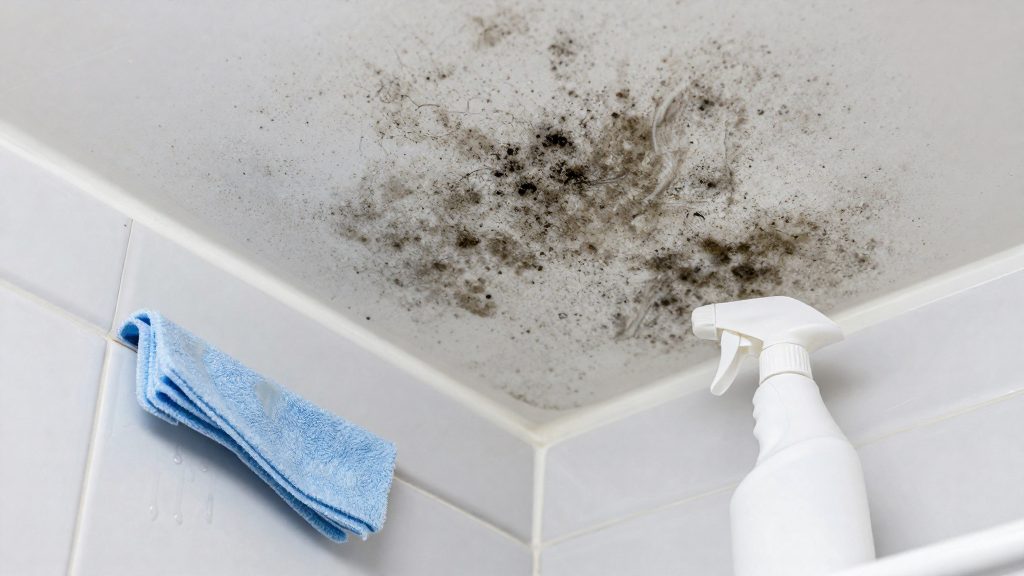
Lingering steam, mold that returns quickly, and fan noise are the most common everyday signs that a bathroom exhaust fan is not removing moist air effectively. According to Air King (manufacturer), a room that stays steamy long after showers and mold or mildew that comes back soon after cleaning both indicate weak ventilation. These symptoms usually reflect reduced airflow rather than a dead fan, so it is worth diagnosing them before assuming the unit must be replaced.
Steam that stays after showers
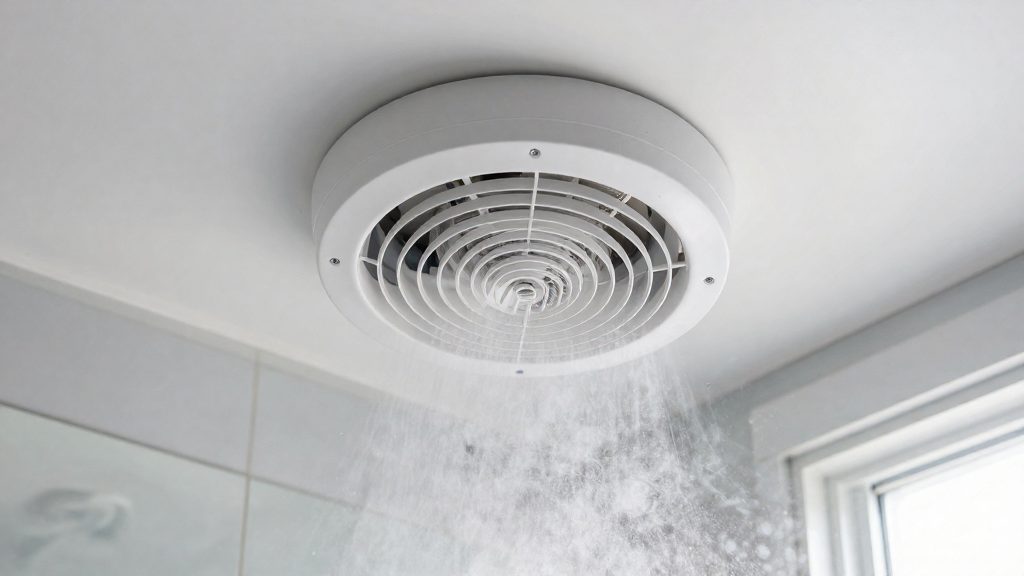
When the fan clears moisture properly, mirrors and walls dry within a reasonable time after a shower ends. A room that stays humid well after showering means moist air is not leaving fast enough.
Mold and mildew that return quickly
Cleaning removes visible growth but does not lower the humidity that allowed it to form. If mold or mildew reappears soon after cleaning, the surfaces are staying damp, which again points to insufficient ventilation.
Common causes of reduced airflow
Airflow losses are often mechanical and simple to check:
| Cause | Check |
|---|---|
| Dirt on the blades or blower | Clean the fan according to the manual |
Noise as a reason fans go unused
Noise often keeps people from running the fan at all. This creates a practical problem: an unused fan removes no moisture, so the steam and mold symptoms return. Noise still signals that the fan should be checked for the debris and dirt described above before it is abandoned.
How long should you run a bathroom fan?
Run the fan for about 15 minutes after each shower, according to Healthy Building Science (2015-06-17). The right time varies with bathroom size and windows, because the right run time depends on the bathroom’s size and windows. The post-shower run is meant to remove the moisture the shower leaves in the air, so the variables below determine whether 15 minutes is enough for a given room.
Variables that change run time
- Bathroom size: Healthy Building Science says the right time varies with room size. Check after a shower whether the room has cleared, and adjust the run time if it has not.
- Fan rating: The fan must be sized for the room. Air King recommends about 1 CFM per square foot of bathroom floor area, so a 10 ft × 10 ft (100 sq ft) bathroom needs at least 100 CFM. The rating is printed on the sticker inside the fan housing, or it can be looked up on HVI.
- Windows: Healthy Building Science notes that windows also affect the required run time, but the sources do not specify how. Use the room’s condition, not a fixed count, to judge the result.
Automating the run
Two practical measures make the post-shower run consistent:
- Door position: Keep the bathroom door open while the fan runs. Healthy Building Science advises this so make-up air can enter the room. A closed door restricts the air that replaces the air being exhausted.
- Timer switch: Healthy Building Science suggests considering a timer switch. A timer keeps the fan running for the full post-shower period without relying on someone to remember to turn it off.
How do you fix a weak or failing fan?
Fixing a weak bathroom exhaust fan follows a fixed order: cut power, clean the blades and blower, retest, then check the attic ductwork and only after that consider the motor. According to Air King (manufacturer), dirt on the blades or blower reduces airflow, so cleaning is the first corrective step, not a replacement decision. Many weak fans need only maintenance, and this sequence avoids disassembling a unit that was simply dirty.
Cut power and clean the unit
Switch off the breaker that feeds the fan before touching anything inside the housing. Air King (manufacturer) advises cleaning the fan according to the manual with the power off. Remove the grille cover, vacuum loose dust, then clean the blower wheel and the fan blades, where dust builds up and slows airflow.
Retest after cleaning
Restore power and run the fan. Repeat the tissue check described by Healthy Building Science (2015-06-17) to see whether airflow has returned. If the tissue is held in place, the cleaning was enough.
| Stage | Action | Expected result |
|---|---|---|
| Power off | Switch off the breaker | Fan does not start |
| Cleaning | Clean blades and blower per the manual | Dust removed from blades and blower |
| Retest | Run the fan and repeat the tissue check | Tissue held at the vent |
Check the attic ductwork
If the tissue still falls after cleaning, turn off the breaker again and check in the attic that the attic ductwork is connected. Do this before concluding that the fan itself has failed, because a disconnected duct can produce the same weak result as a faulty fan.
Motor or unit diagnosis
If the fan still fails the retest after the ductwork check, the motor or the whole unit may need replacing, according to House Digest. Diagnosis stops at this point: the cleaning, the retest and the duct check have already ruled out the simpler causes.
When should you replace the fan?
A bathroom exhaust fan generally lasts about 10 years, according to House Digest. Replacement depends on three things: the fan’s age, the symptoms it shows, and whether the fault is confined to the motor or affects the whole unit. A fan that is still young and fails in one component may need only a new motor, while an older fan or one of unknown age is usually better replaced as a complete unit.
Lifespan as a threshold
- About 10 years: the typical service life of a bathroom fan.
- Newer fan: may only need a new motor if the fault is limited to the motor.
- Older fan or unknown age: better replaced whole, because the other components are likely near the end of their life too.
Failure signs that call for replacement
| Sign | What it can indicate | Recommended action |
|---|---|---|
| Burning smell | Possible electrical or motor fault, which is a fire risk | Turn off the fan at the breaker immediately, do not use it, and have a qualified electrician inspect or replace it |
| Noise that increases over time | A warning sign that the fan may have a problem, although noise alone does not confirm a fault | Turn off the breaker, clean the fan and retest, then assess motor or whole-unit replacement if the noise persists |
| Blades that don’t spin properly | A possible motor fault | After cleaning and the duct check, replace the motor on a newer fan or the whole unit on an older one |
Deciding between motor and full replacement
Check the age of the fan first. If it is well within its expected lifespan and the symptoms point to the motor, a motor-only repair may be enough. If the fan is near or past about 10 years, or you cannot establish its age, replacing the entire unit is the more reliable choice, since a failing motor often signals wear in the rest of the assembly.
Frequently asked questions
Does a fan that holds the tissue prove the whole ventilation system works?
No. According to Healthy Building Science (2015-06-17), the tissue check measures suction at the grille only. Dirt, a closed outlet or a disconnected duct can still reduce the airflow that actually leaves the building, so the test cannot confirm full performance.
How do I know if my bathroom fan is the right size?
Use the guideline of about 1 CFM (cubic feet per minute) per square foot of floor area. Air King (manufacturer) applies it to a 10 ft × 10 ft (100 sq ft) bathroom, which gives 100 CFM. Find the CFM rating on the sticker inside the fan housing, or look up the model in the HVI database.
How long does a bathroom fan last, and when should it be replaced?
According to House Digest, bathroom fans generally last about 10 years. A newer unit may need only a motor replacement, while an older fan or one of unknown age is usually better replaced as a whole unit.