What CO2 level is too high for sleeping?
Researchers suggest that CO2 from sleeping occupants should stay below 1,000 ppm as a minimum, and ideally below 800 ppm. According to DTU Orbit (Akimoto et al., 2025), these levels treat CO2 as an indicator of ventilation adequacy rather than as a pollutant. A bedroom that regularly exceeds 1,000 ppm at night may be receiving too little outdoor air for the number of people sleeping in it, which is worth investigating.
What the 800 ppm and 1,000 ppm targets mean in practice
The 1,000 ppm figure is the upper limit to aim for, and 800 ppm is the more demanding target. According to the study, meeting these levels would require at least doubling bedroom outdoor air supply relative to current standards.
Peak readings versus overnight average
A single peak can occur when occupants first enter a closed room or when a door is shut at bedtime. To assess a bedroom properly, log CO2 from bedtime to waking, then compare the sustained plateau over several hours with the brief spikes. Short spikes alone are less informative.
Sleep disruption and morning symptoms
To check for a connection between CO2 and how you feel in your own bedroom, record how you feel on waking alongside the overnight log, and look for a repeated pattern across several nights.
Why bedroom CO2 builds up overnight
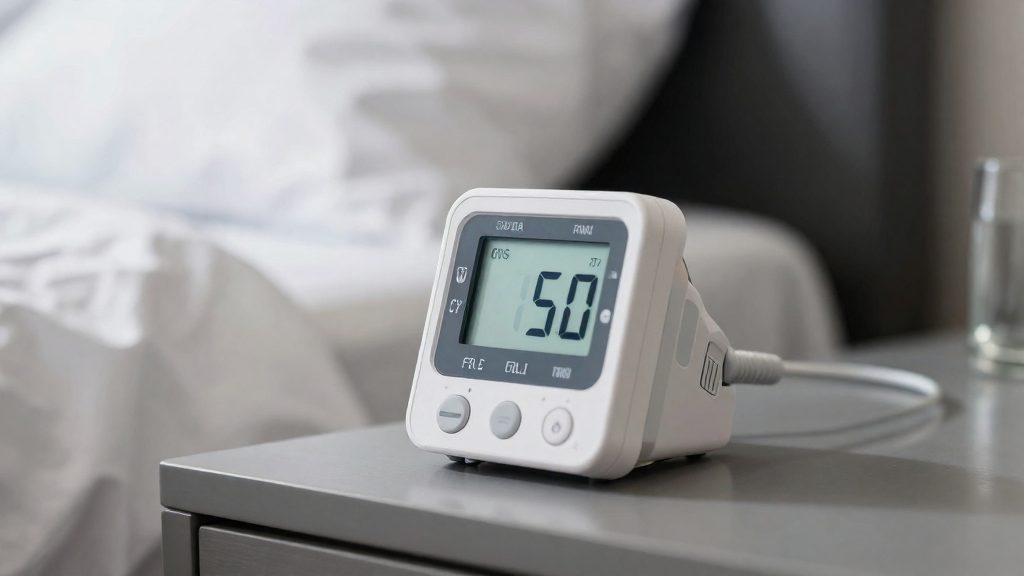
Carbon dioxide in a bedroom comes almost entirely from the occupants. Each person exhales CO2 with every breath, and the gas has no other significant indoor source while the room is occupied. Through the night, that output accumulates whenever fresh outdoor air cannot replace the exhaled air quickly enough. The result depends on two factors: how much CO2 people produce, and how fast the room exchanges its air with the outside.
Occupant respiration is the constant input. A sleeping adult exhales continuously for eight hours or more, so the concentration rises steadily unless air is exchanged. Each additional person in the room adds to the input.
Room volume and air exchange set the rate of rise. A larger room holds more air to dilute the CO2, so its concentration climbs more slowly than in a small room with the same occupancy. The governing relationship is simple:
- Concentration change per hour = (CO2 produced per hour ÷ room volume) − (CO2 removed by air exchange)
- Air exchange removes CO2 only when the air leaving the room is replaced by outdoor air with lower CO2
When the air exchange term is small, the concentration keeps rising for as long as people remain asleep.
Closed doors and sealed rooms reduce exchange to whatever leaks through gaps, window trickle openings, or a mechanical system. A closed door cuts the supply of air from the rest of the home, so the bedroom effectively operates as a closed box. Occupancy overnight then runs the concentration upward with little offset.
| Reference point | Value | Source | Context |
|---|---|---|---|
| Sleep-environment minimum | 1,000 ppm | DTU Orbit (Akimoto et al., 2025) | Proposed minimum for sleeping occupants |
| Sleep-environment ideal | 800 ppm | DTU Orbit (Akimoto et al., 2025) | Proposed ideal for sleeping occupants |
| Occupational PEL and NIOSH REL | 5,000 ppm | OSHA (US Dept. of Labor) | Workplace limits, 8-hour and 10-hour TWA |
| IDLH | 40,000 ppm | OSHA (US Dept. of Labor) | Immediately dangerous to life or health |
Is 1,000 ppm the right limit?
The 1,000 ppm figure is the minimum standard to meet (the concentration should stay below it), not a comfort target. A bedroom above 1,000 ppm therefore falls short of the study’s baseline, and the lower value of 800 ppm marks the level the authors consider preferable for sleep.
How the two thresholds differ
| Threshold | Status in the study | How to read it |
|---|---|---|
| Below 1,000 ppm | Minimum | The baseline the authors set for sleeping occupants |
| Below 800 ppm | Ideal | The level the authors consider preferable |
The study presents these as two tiers, not a single pass or fail value. A reading between 800 and 1,000 ppm meets the minimum but not the preferred level.
CO2 as a ventilation indicator, not a toxicant
The concentration reflects how well outdoor air dilutes what occupants exhale: a higher reading signals that air exchange is insufficient. A monitor reading above the threshold therefore points to a ventilation problem to investigate. It does not, on its own, establish that the CO2 level is harmful in itself.
What the figure implies for outdoor air supply
According to the same study, meeting these levels would require at least doubling bedroom outdoor air supply relative to current standards. The gap the study identifies lies in the air supply to the room, not in the sensor. Because the threshold is set by the air exchange it implies, the 1,000 ppm figure works as a proxy for how much fresh air a sleeping occupant receives.
Are OSHA limits relevant to bedrooms?
No. The carbon dioxide limits set by OSHA and NIOSH are occupational limits for workplaces. They are not sleep-comfort targets and should not be used to judge whether a bedroom has adequate air.
According to OSHA (US Department of Labor), the agency’s permissible exposure limit for carbon dioxide is 5,000 ppm, averaged over an 8-hour time-weighted average (TWA). NIOSH sets a recommended exposure limit (REL) of the same 5,000 ppm, applicable to up to a 10-hour TWA. The OSHA chemical data page also lists an immediately dangerous to life or health (IDLH) value of 40,000 ppm.
| Limit | Value | Averaging basis | Intended use |
|---|---|---|---|
| OSHA permissible exposure limit | 5,000 ppm | 8-hour TWA | Enforceable workplace limit |
| NIOSH recommended exposure limit | 5,000 ppm | Up to 10-hour TWA | Recommendation for occupational exposure |
| IDLH (listed by OSHA) | 40,000 ppm | Not an averaging limit | Level posing immediate danger to life or health |
Why occupational thresholds differ from sleep comfort
These limits are built around the question of whether a worker can be exposed for a full shift without harm. They answer a narrow question: at what concentration does a healthy adult in a regulated workplace face unacceptable risk over a defined working period? They do not ask whether the air supports restful sleep.
The gap between these two questions is large. A bedroom is a closed space where an occupant remains still for many hours and CO2 can build up steadily overnight. Ventilation, room volume, and the number of occupants all shape the result, which is why a room can sit far below 5,000 ppm and still fall short of what sleeping occupants need.
How to measure bedroom CO2
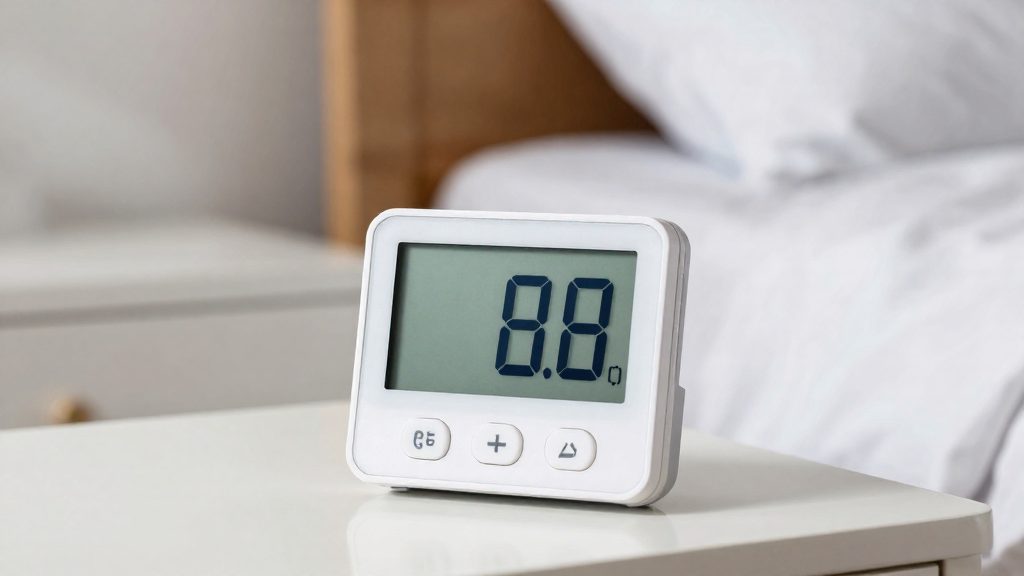
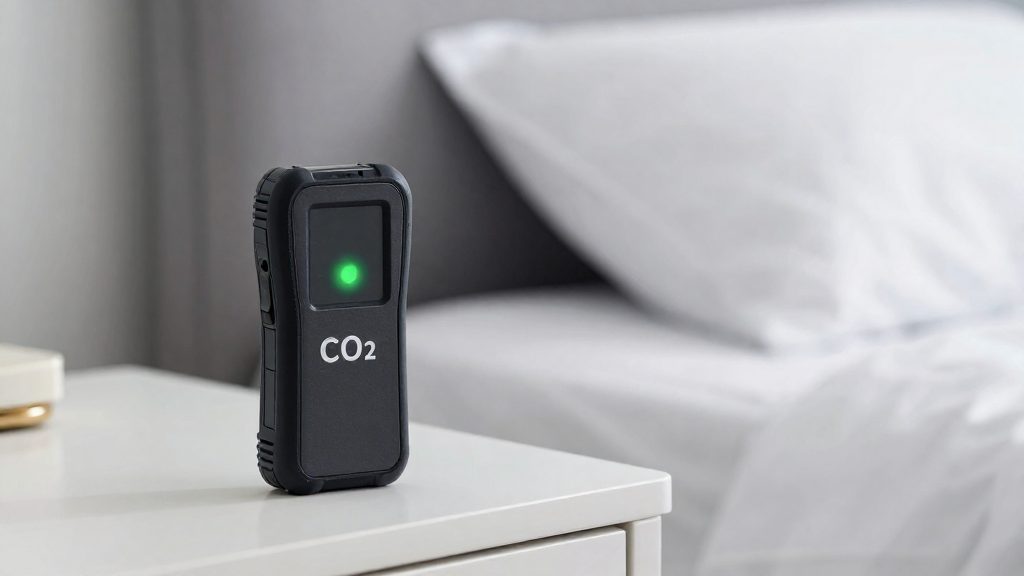
A bedroom CO2 reading is only useful if the sensor measures the air you breathe during sleep. Most consumer monitors use NDIR sensing (non-dispersive infrared). The sensor passes infrared light through a gas chamber toward a detector. CO2 absorbs infrared at a specific wavelength, so higher CO2 concentrations let less light reach the detector, and the monitor converts that reduction into a ppm value. NDIR responds specifically to CO2, which is why it is generally preferred over lower-cost sensing methods that react to several gases. When comparing monitors, check the manufacturer’s specification to confirm the technology is NDIR.
Sensor height and distance from the occupant
Place the monitor at approximately breathing height with the occupant lying in bed, rather than on the floor or on a high shelf. Keep it a short distance from the pillow so that the sensor does not sit directly in the exhaled breath, but inside the same room and at about the height of the sleeper’s head. Avoid positions near:
- Windows, doors, and external vents, where incoming air is not representative of the room
- Fans, radiators, and direct airflow, which mix or dilute the air around the sensor
- Humidifier or purifier outlets, which can alter local readings
Logging intervals for overnight monitoring
Use a monitor with data logging or a companion app so readings are recorded across the whole sleep period. Choose a logging interval short enough to show how levels change when the occupant falls asleep or the door opens, and check the manufacturer’s manual for the available interval options. Note the door and window status for each session, since these events explain most changes in the trace. Review the morning readings alongside the start-of-night values to see how much CO2 accumulated during the night.
Do CO2 monitors need calibration?
Most consumer CO2 monitors use non-dispersive infrared (NDIR) sensors, and their optical components change slowly with age, temperature and humidity. Many units therefore include automatic baseline calibration (ABC) to correct this without user input. ABC works by recording the lowest reading over a set period and treating it as the outdoor reference. Manual checks remain useful because ABC depends on that assumption, and the assumption can fail.
How automatic baseline calibration works and where it fails
ABC assumes the room is ventilated often enough that the lowest reading in the window approximates outdoor air. When that happens, the sensor shifts its offset to match. The limit is that a bedroom, especially one that is occupied overnight and rarely aired, may never reach outdoor-like levels. In that case ABC then treats those occupied-air values as the outdoor reference, and the monitor under-reports CO2. A monitor whose reading does not fall toward outdoor levels after the room has been well aired may be drifting or faulty and should be checked against a second monitor.
Reference checks with outdoor air
The simplest verification compares the monitor with a known reference:
- Place the monitor outdoors, away from people, vehicles and exhaust vents, and let it stabilise for several minutes.
- Compare the reading with a second, independently verified monitor placed next to it.
- Repeat the test indoors after opening a window, so the room’s readings can be seen moving toward the outdoor value.
Outdoor CO2 varies by location and time, so use the comparison, not a fixed number, as the test.
Reference gas calibration
A true calibration uses a gas cylinder of certified concentration, fed into the sensor under controlled conditions. This is normally a service procedure carried out by the manufacturer or a laboratory. Home users should not attempt it.
Sensor ageing and drift
Drift is the gradual change in readings over time while the true concentration stays the same. It is not always visible in a single reading, so track consistency: if two monitors in the same room start to diverge, one of them is drifting. Replace or service the unit according to the manufacturer’s guidance rather than assuming a long-running device is still accurate.
When manual verification is worth doing
| Situation | Recommended action |
|---|---|
| New monitor, before relying on it | Compare side by side with a second monitor |
| Readings never fall after the room is aired | Test outdoors and compare with a second monitor to check for drift or a faulty sensor |
| Two monitors disagree in the same room | Run an outdoor comparison to identify the drifting unit |
| Unit has been in service for a long period | Repeat the side-by-side check and follow the manufacturer’s service guidance |
Ways to lower CO2 while you sleep
Lowering CO2 overnight in a bedroom comes down to one lever: moving more outdoor air through the room. Since most bedrooms do not deliver enough outdoor air by default, the measures below focus on increasing exchange and making sure fresh air actually reaches the sleeping space.
Opening a window or a trickle vent before bed
A fully opened window is the fastest way to bring in outdoor air, but it is hard to control. It brings in cold air and noise, and most people close it again once they are cold. A trickle vent, the small adjustable slot built into many window frames, gives a smaller, steadier airflow that can stay open all night. Set it open before bed and check that the air inlet is not blocked by curtains or furniture.
Mechanical ventilation extraction settings
In a mechanical exhaust ventilation system, the bedroom usually has an air inlet and the extraction happens in wet rooms such as the bathroom or kitchen. Overnight CO2 control depends on the fan running at an adequate speed and on the room’s inlet staying clear. Check the following:
- The bedroom inlet is open and not covered by furniture, curtains or tape.
- The extraction fan in the wet room is not switched off or left on its lowest setting overnight, unless the manufacturer’s instructions say otherwise.
- Grilles and filters are clean, since dust reduces the airflow the fan can deliver.
Door undercuts and cross-room airflow paths
A closed bedroom door cuts off the path between the sleeping space and the extraction point. An undercut, a gap under the door, or a transfer grille lets air move between the bedroom and the room where air is extracted or where a window is open. If you test with the door closed and then ajar, compare the two overnight logs. Keeping the door slightly ajar achieves a similar effect. Where the layout allows, arranging the bed so that air passes across the sleeper before reaching the outlet also helps.
Comparison by practicality and effect
| Action | Practicality | Effect on overnight CO2 |
|---|---|---|
| Fully open window | Simple to do, but brings cold air and noise | Strong while open, short-lived |
| Trickle vent left open | Simple and quiet, can stay open all night | Moderate and steady |
| Mechanical exhaust ventilation checked and running | Requires checking settings and grilles | Continuous, depends on the system |
| Door undercut or door left ajar | Free, depends on the layout | Moderate, moves air toward the extraction point |
Ventilation and humidity: what to balance
Ventilation that lowers CO2 also moves water vapour, so it can raise or lower indoor relative humidity (RH) and change the risk of condensation.
Moisture load in a bedroom
Sleeping occupants release water vapour continuously through breathing, and showering adds a shorter but much larger pulse. Vapour stays in the room until air is exchanged or extracted.
| Moisture source | Effect on indoor air | Practical implication |
|---|---|---|
| Breathing during sleep | Continuous vapour release that accumulates overnight in a closed room | Keep air exchange running through the night |
| Showering in or beside the bedroom | Short, intense vapour pulse | Extract vapour at source, then ventilate afterwards |
| Outdoor air exchange | Cold outdoor air usually holds less vapour; warm, humid outdoor air adds moisture | The direction of the effect depends on the season |
Dew point and surface condensation
Condensation forms when a surface falls below the dew point of the air touching it. Window panes, the frames and external wall corners are usually the coolest surfaces in a bedroom, so they show condensation first. Ventilation lowers the dew point of the room air only when the outdoor air carries less vapour than the room. If the outdoor air is humid, the same airflow may not reduce condensation on cold surfaces. Ventilation therefore cannot be judged by CO2 alone; the surface temperatures and the vapour content of the incoming air also determine the outcome.
Relative humidity target band for bedrooms
The practical check is observational: water droplets on glass in the morning, damp patches on walls, or a persistent musty smell indicate that RH near cold surfaces is too high for the current ventilation rate. A hygrometer provides a number to track across several nights.
Frequently asked questions
Is 1,000 ppm of CO2 a danger limit for sleeping?
No. According to DTU Orbit (Akimoto et al., 2025), 1,000 ppm is a minimum target for CO2 from sleeping occupants, with 800 ppm as the more demanding goal. Exceeding it signals ventilation adequacy problems rather than acute toxicity.
Does a reading under 5,000 ppm mean my bedroom is safe?
Not necessarily. The 5,000 ppm figure from OSHA (US Dept. of Labor) is a workplace occupational exposure limit for an 8-hour shift, and the IDLH value of 40,000 ppm marks immediately dangerous conditions. Neither figure is a sleep-comfort target, so a bedroom can sit far below 5,000 ppm and still be under-ventilated.
If my bedroom regularly exceeds 1,000 ppm, will an air purifier fix it?
Usually not. Standard air purifiers filter particles and some gases but do not remove CO2, so the study’s framing points to outdoor air supply as the lever. Increasing fresh air exchange, through a window, a mechanical ventilation system, or a reduced number of occupants, addresses the cause directly.