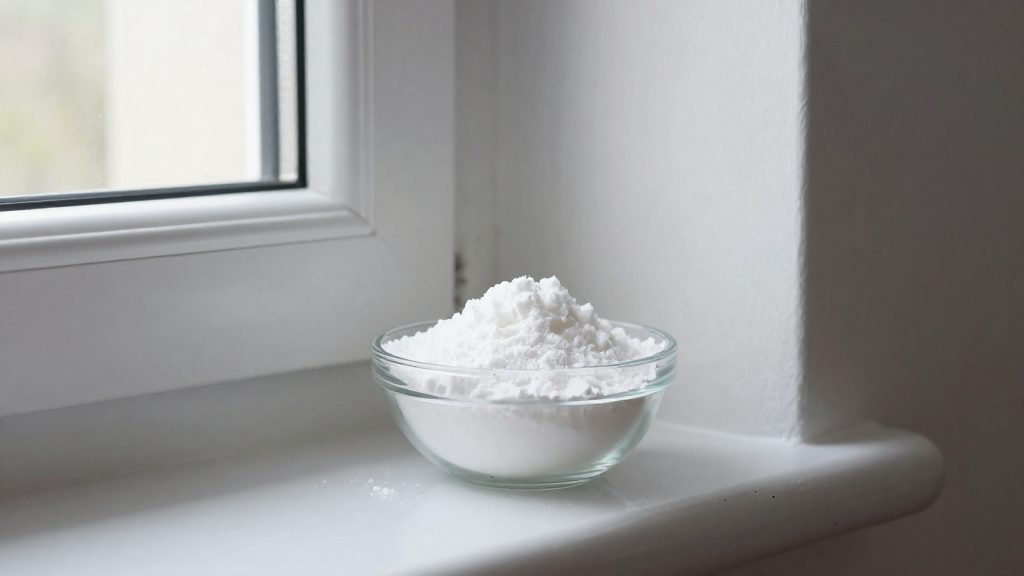
A musty bedroom after the windows are closed usually comes from moisture and stale air that build up overnight with no exit route. Occupants release moisture and carbon dioxide (CO2) while they sleep, bedding and soft furnishings absorb that moisture along with odors, and closed doors and airtight construction stop the air from being exchanged. Under these conditions, microbial growth on damp fabrics produces the musty smell.
Why does my bedroom smell musty after the windows are closed?
Where the musty odor comes from
The smell is a biological signal. When moisture settles on organic material such as fabric, paper or dust, microbes grow and release microbial volatile organic compounds (MVOCs), gases that people perceive as a damp, earthy or stale odor. Growth is more likely where moisture stays for hours, which is the situation in a sealed bedroom overnight.
Bedding and soft furnishings
Mattresses, pillows, duvets, curtains and upholstered chairs hold moisture and odors for long periods. The Rise publication notes that bedding and soft furnishings trap moisture and odors, so the same textiles that absorb sweat and breath vapor overnight also keep those smells in the room. Because the surfaces are soft and porous, the moisture they retain is harder to release than moisture on a hard surface.
Stale air from closed doors and airtight construction
Rise reports that closed bedrooms become stale overnight because of closed doors, missing return or transfer paths, and airtight construction. Without an air path, the air in the room is not replaced, so its gases and humidity stay concentrated. The EPA states that tightly sealed buildings can lack adequate ventilation, and that without it moisture can build up indoors and mold may grow.
| Contributor | What it adds or retains overnight | Source |
|---|---|---|
| Occupants | CO2 and moisture from breathing and sleeping | Rise (building-industry publication) |
| Bedding and soft furnishings | Moisture and odors held in fabric | Rise (building-industry publication) |
| Closed doors, missing transfer paths, airtight construction | Stale air that is not replaced | Rise (building-industry publication) |
| Tightly sealed construction | Moisture buildup that can support mold | U.S. EPA (archived snapshot, 2025-01-19) |
How sleeping adds moisture to a closed room
Sleeping occupants are a continuous source of water vapor and carbon dioxide (CO2) in a bedroom. Breathing releases both, and perspiration adds moisture through the skin during the night. When the door and window stay shut, nothing exchanges this air with the outdoors, so the loads accumulate over the hours instead of dispersing. According to Rise (building-industry publication), occupants add both CO2 and moisture to closed bedrooms, which is one reason these rooms feel stale by morning.
Where the overnight load comes from
| Source | What it adds to the room | Effect in a closed bedroom |
|---|---|---|
| Breathing | Water vapor and CO2 | Raises indoor humidity and CO2 levels steadily through the night |
| Perspiration | Water vapor | Adds moisture directly to the air around the bed |
| Bedding and soft furnishings | Moisture and odors held in the fabric | Keeps moisture and smell in the room after the occupant leaves the bed |
Each occupant contributes to these loads. The effect grows with the number of people in the room and with the time the room stays sealed.
Tracking the CO2 rise overnight
A CO2 monitor placed in the bedroom shows the build-up directly. Recording the reading at bedtime and again on waking gives a clear before-and-after comparison for the same night.
Why the moisture stays in the air
Breathing and perspiration keep adding water vapor and CO2 for as long as the room stays closed.
Condensation and hidden mold: when the smell is a warning
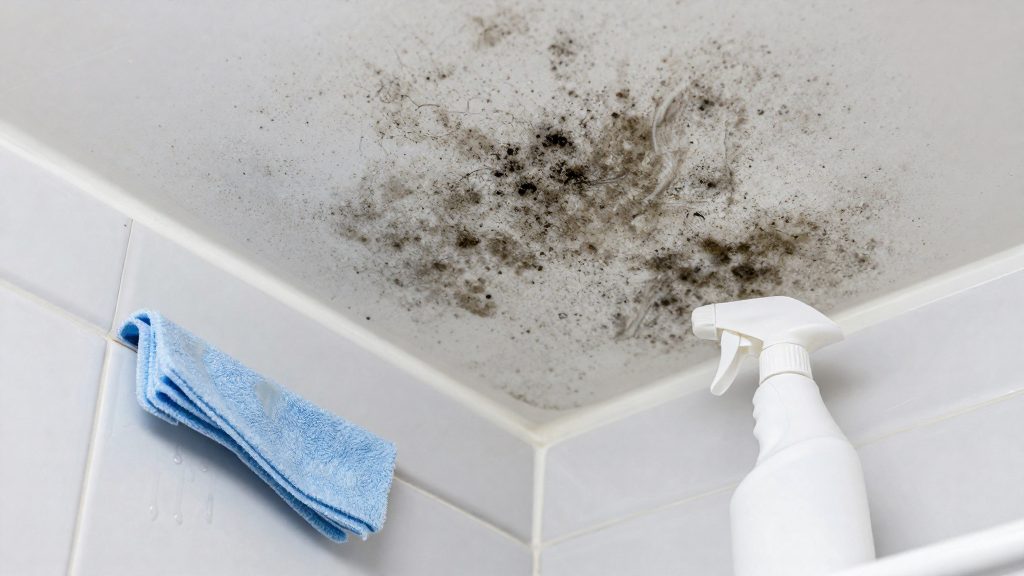
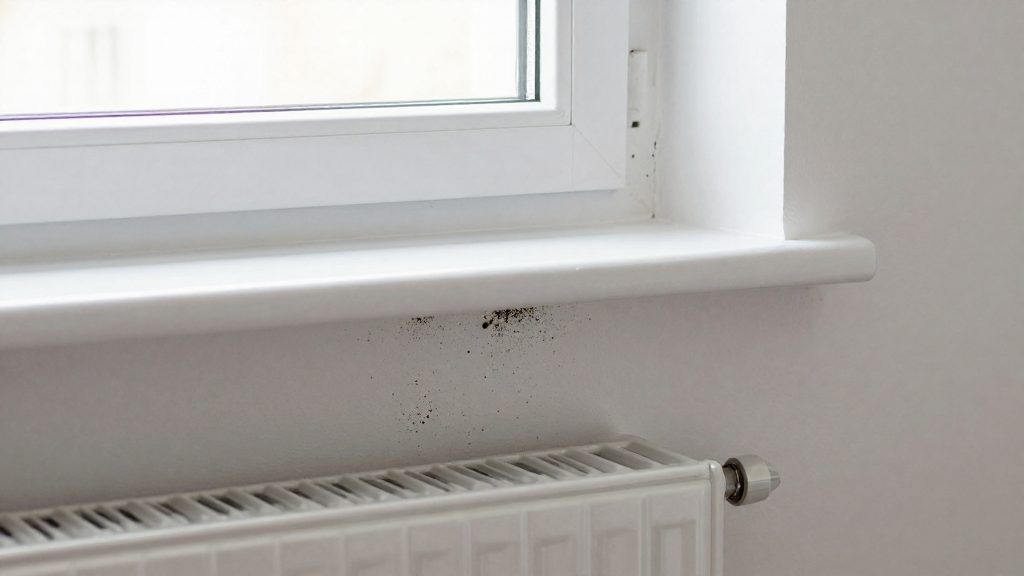
According to the U.S. EPA (2025), condensation forms when warm, humid air contacts a cold surface, and it signals high indoor humidity. A musty bedroom smell after the windows have been closed overnight can come from stale air or from moisture. If humidity is high or condensation is present, moisture may be settling on surfaces where mold can establish. Condensation on cold surfaces signals high indoor humidity, and mold often grows where it forms, so the room should be inspected and not only aired.
How condensation forms overnight
Overnight the room cools while occupants keep adding moisture. The humid air stays in the room until it meets a surface colder than itself, such as an exterior wall, a window glass or the back panel of a wardrobe. The moisture then condenses on that surface.
Cold corners behind furniture
The EPA states that mold often grows on cold corners behind furniture, where condensation forms. Furniture pushed against a wall blocks the air movement that would otherwise keep that wall surface closer to room temperature, and the trapped moisture has no route out. Check these spots first, especially where a bed or wardrobe stands against an outside wall.
Hidden mold behind wardrobes and headboards
Hidden mold often shows no visible sign until it is well established. Locations to inspect:
| Location | Why it is at risk | What to inspect |
|---|---|---|
| Wardrobe back panel against an outside wall | Cold surface with little airflow | Dark spots on the panel and on the wall behind it |
| Headboard against an outside wall | Cold surface, with bedding trapping moisture | Staining on the wall and the back of the headboard |
| Window frame corners | Glass and frame are cold surfaces where condensation forms | Water beads and dark staining on the sill or frame |
To inspect, pull the furniture a short distance from the wall and use a flashlight at a low angle to show surface texture. A musty smell that is stronger near one piece of furniture than elsewhere in the room points to the likely source. If the wall feels damp, or paint or wallpaper lifts or bubbles, the moisture source is probably behind the surface. Find and fix it promptly, and call a qualified building or mold professional if the area is large or the cause is unclear.
What humidity level should a bedroom have?
According to the U.S. EPA (2025), indoor relative humidity should stay below 60 percent, with an ideal range of 30 to 50 percent. For a bedroom, the 60 percent figure is the ceiling to hold at all hours, including overnight, when moisture is most likely to build up. The EPA’s guidance sets the 30 to 50 percent band as the target and 60 percent as the upper limit.
| Threshold | Value | Source |
|---|---|---|
| Upper limit | Below 60 percent relative humidity | U.S. EPA (2025) |
| Ideal range | 30 to 50 percent relative humidity | U.S. EPA (2025) |
Relative versus absolute humidity
Relative humidity expresses how much water vapor the air holds compared with the maximum it could hold at its current temperature. Absolute humidity measures the actual mass of water vapour in a given volume of air, regardless of temperature. Consumer hygrometers and combined temperature and humidity meters display relative humidity, so the EPA’s 30 to 50 percent and below-60-percent figures apply to that reading.
Why readings vary with temperature
Because relative humidity depends on air temperature, the same amount of moisture can produce different readings. Cooler air holds less water vapour, so it reaches saturation sooner and the relative humidity rises even when no moisture has been added. Warmer air produces the opposite effect. A bedroom that cools during the night can therefore show a higher reading in the morning than at bedtime without any new moisture entering the room.
Overnight sources of moisture
Occupants add moisture while sleeping, and this is one reason a closed bedroom gains humidity overnight. Readings taken at night are likely to be higher than daytime readings in the same room.
How do I tell if the air is stale or damp?
Stale air and damp air can produce a similar musty smell, but they have different causes and different measurable signatures. Stale air means carbon dioxide and body-generated odors have built up because the room has no fresh air exchange. Damp air means water vapor is high enough to condense on cold surfaces, which is where mold tends to start. A simple set of checks, using a meter and a few symptoms, usually separates the two.
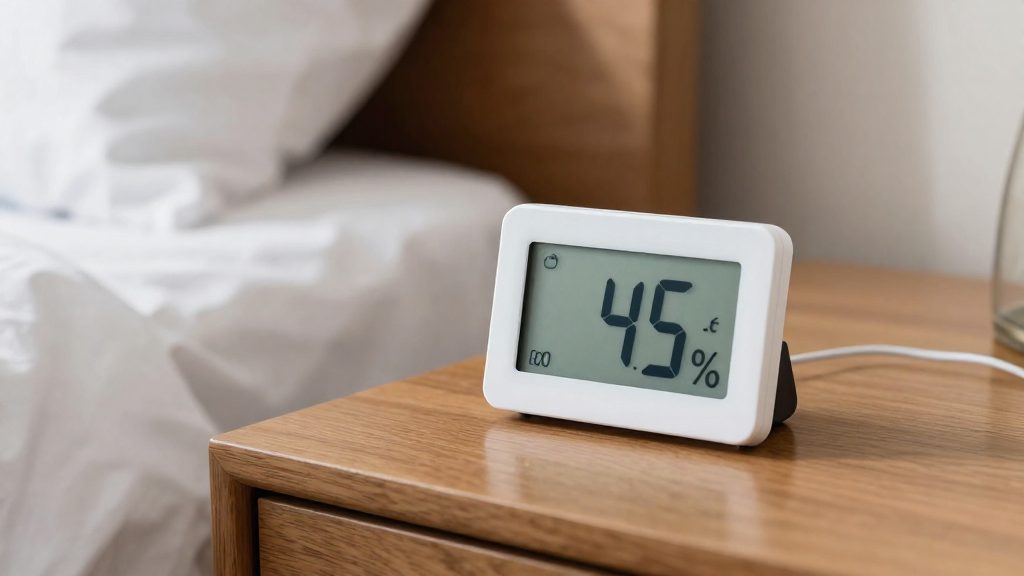
Measure humidity with a combined temperature and humidity meter
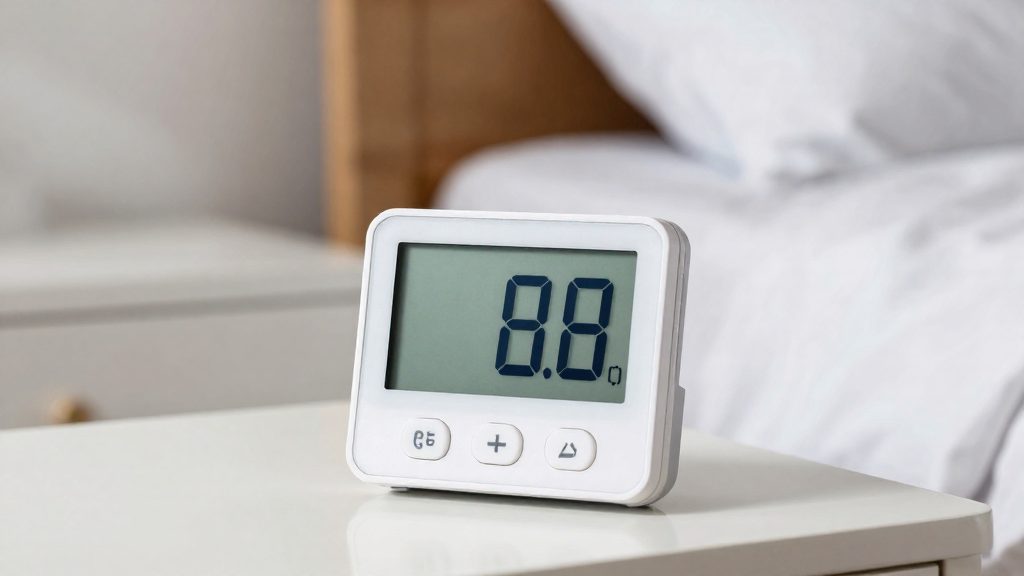
A combined temperature and humidity meter is the first diagnostic tool. According to the U.S. EPA (2025), these meters are generally available for under $50, so a bedroom check does not require professional equipment. Take readings at bed height and near the coldest wall or window. Consistently high relative humidity, especially when readings are higher near the cold surfaces, points to a damp problem rather than a purely stale-air problem. A normal humidity reading does not rule out moisture, because a meter measures room air and not damp fabrics or hidden mold. If the smell persists, check the CO2 trend and inspect cold surfaces and furniture.
Track CO2 overnight as a stale-air signal
A CO2 monitor shows whether the room is ventilating while the door and windows are closed. According to Rise (building-industry publication), a CO2 monitor that shows levels rising overnight until a window or door is opened points to a ventilation problem. This is the clearest stale-air signature: the reading climbs through the night and drops quickly once the room is opened. A room where CO2 stays flat overnight but still smells musty may have a moisture source. Check humidity and inspect cold surfaces, and do not treat the flat reading as proof that the air is fine.
Compare symptoms that separate the two
| Check | Points to stale air | Points to damp air |
|---|---|---|
| CO2 monitor overnight | Reading rises through the night and falls when a window or door opens | Reading does not show a clear overnight rise |
| Humidity meter | Readings are not persistently high | Readings are high, especially near cold surfaces |
| Visible condensation | None on windows, walls, or behind furniture | Water droplets on cold surfaces |
| Cold corners behind furniture | Dry surfaces | Dark spots or mold, since the EPA notes mold often grows where condensation forms |
| Odor source | Odor from bedding and soft furnishings that have trapped odors in a closed room | Odor that strengthens near cold walls and corners |
Check the room’s moisture sources
Damp air often has an identifiable source. According to the U.S. EPA (2025), indoor humidity can come from humidifiers, steam radiators, dryers, stoves, cooking, and showering. Confirm whether any of these run near the bedroom before deciding the cause is stale air.
Easy ventilation fixes for tonight
A closed bedroom gets stale overnight because air has no route out and no route in. Three adjustments need no tools or structural work: creating an air path at the door, opening a window in a controlled way, and running existing extraction fans on a low setting.
Create an air path at the door
Closed doors cut the bedroom off from the rest of the home. Rise lists door undercuts and transfer grilles as fixes for this. An undercut is a gap cut at the base of the door, and a transfer grille is a vented panel fitted into the door or the wall above it. Both let air move between rooms so the bedroom is not sealed overnight.
Steps for tonight:
- Keep the bedroom door ajar instead of fully closed.
- Remove anything blocking the gap at the bottom of the door, such as a draught excluder or a thick rug.
- If a transfer grille is already installed, make sure furniture or curtains do not cover it.
Crack a window with a controlled opening
Cracking a window is the simplest response. A narrow, controlled opening lets stale air out and fresh air in without opening the window fully. Place the opening away from the bed so that the incoming air does not blow directly on sleepers. A window opened only slightly is also easier to keep stable overnight than one left wide open.
Run existing extraction fans on a low continuous setting
If the bedroom or an adjoining bathroom already has an extraction fan, a continuous low setting keeps air moving through the room instead of only during short bursts. Rise suggests a low continuous fan setting as a fix for stale bedrooms. An extraction fan only removes air if replacement air can enter, so pair it with an undercut or an open door.
| Adjustment | What it addresses | Tonight’s setup |
|---|---|---|
| Door undercut or transfer grille | Isolation caused by closed doors | Door ajar, gap at the base clear |
| Controlled window opening | CO2 and moisture build-up | Narrow opening, away from the bed |
| Low continuous extraction fan | Trapped moisture and odors | Lowest continuous setting, with a replacement air path |
When to use a dehumidifier, purifier or ventilation system
Each device targets a different problem, so the right choice depends on what is building up in the room. A dehumidifier removes water vapour from the air and suits a bedroom where moisture exceeds what ventilation can control. It does not supply fresh air, so Rise recommends pairing it with ventilation. Without airflow, the carbon dioxide and odours that accumulate overnight remain in the room.
For a bedroom that stays closed all night, the more direct fix is continuous fresh air. Rise lists an ERV (energy recovery ventilator) or HRV (heat recovery ventilator) among its suggested fixes for this, along with a low continuous fan setting. An ERV or HRV addresses the lack of air exchange by moving air continuously rather than only when a door or window is opened.
An air purifier removes particles from the air. It does not remove water vapour, so it will not reduce a damp, musty smell caused by humidity. Choosing a purifier for a moisture problem wastes effort on the wrong target.
Before buying equipment, measure the room. Relative humidity above 60 percent (EPA) points to a moisture problem. A CO2 reading that rises overnight points to a ventilation problem.
| Problem in the bedroom | Device or fix | What it does |
|---|---|---|
| Excess moisture that ventilation cannot control | Dehumidifier, paired with ventilation | Removes water vapour; adds no fresh air |
| Continuous fresh air in a tightly sealed room | ERV or HRV | Moves air continuously through the room |
| Airborne particles | Air purifier | Captures particles; does not remove water vapour |
| Unclear cause (humidity or CO2) | Combined temperature and humidity meter, CO2 monitor | Shows whether humidity or CO2 rises overnight |
Frequently asked questions
How do I know if the smell comes from humidity or stale air?
Measure both. A hygrometer shows relative humidity, and a CO2 monitor shows whether stale air is accumulating. The U.S. EPA (archived snapshot, 2025) advises keeping indoor relative humidity below 60 percent, ideally between 30 and 50 percent. Rise (undated) links a CO2 level that keeps rising overnight to a ventilation problem.
Is cracking a window enough to fix a musty bedroom?
Cracking a window is one option, but not the only one. Rise (undated) also lists door undercuts or transfer grilles, a low continuous fan setting, and an ERV or HRV as ways to move air while the window stays closed.
Will a dehumidifier alone remove the musty odor?
Not on its own. Rise (undated) states that a dehumidifier should be paired with ventilation. It lowers moisture, but it does not bring in fresh air to replace the stale air that builds up overnight.