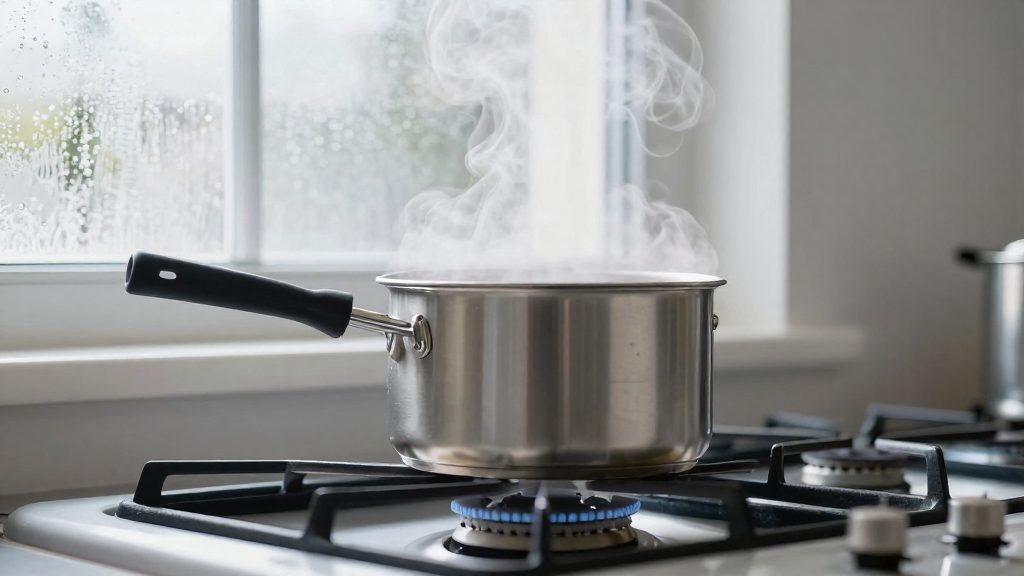
Cooking on the stove raises indoor humidity because water in pots and pans changes from liquid to vapour, and that vapour enters the room air as fast as it forms. Boiling releases more vapour than simmering, and the effect shows up mainly as relative humidity, which climbs faster than the actual amount of water in the air.
Why cooking on the stove spikes humidity
Latent heat and the water released while cooking
Turning liquid water into vapour requires a large amount of energy, known as the latent heat of vaporisation. Once water reaches its boiling point, most of the burner’s energy goes into evaporation rather than raising the water’s temperature further. Water that evaporates from a pot enters the kitchen air as water vapour (part of it is later exhausted, absorbed by materials or condensed on surfaces), so the total amount released depends on:
- the volume of water in the pot and how long it stays hot
- the exposed surface area of the water
- whether a lid is in place during heating
- the number of pots or pans on the burners at the same time
Boiling versus simmering
Vapour output depends strongly on how vigorously the water moves at the surface. An open pot at a rolling boil breaks its surface across the whole area, so evaporation is at its highest. A simmer produces only occasional bubbles, so the same pot releases less vapour while it stays at a lower temperature.
| Condition | Surface activity | Vapour output from an open pot | Typical stove use |
|---|---|---|---|
| Rolling boil | Bubbles break the surface across the pot | Highest | Pasta, boiling vegetables |
| Simmer | Occasional bubbles, mostly calm surface | Lower | Sauces, stews, reductions |
Reducing a pot from boiling to simmering after it reaches temperature cuts the rate of vapour release without stopping the cooking process.
Why relative humidity rises faster than absolute moisture
Absolute moisture is the mass of water vapour in a given volume of air. Relative humidity compares that mass with the maximum the air can hold at its current temperature:
relative humidity = (water vapour present ÷ maximum vapour capacity at that temperature) × 100
Because the maximum capacity falls as air cools, the same amount of added vapour gives a higher relative humidity in cooler air. Vapour added by cooking therefore raises relative humidity sharply, even when the absolute amount of water in the air has changed only moderately. This is why a kitchen can feel damp and register a high humidity reading quickly, even while the overall moisture load is moderate.
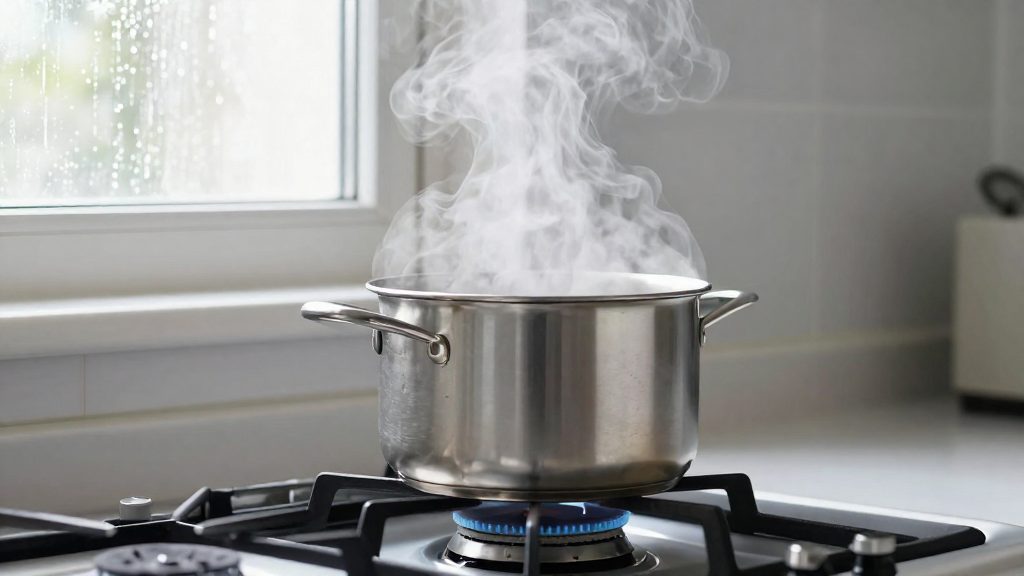
Where does the cooking steam go?
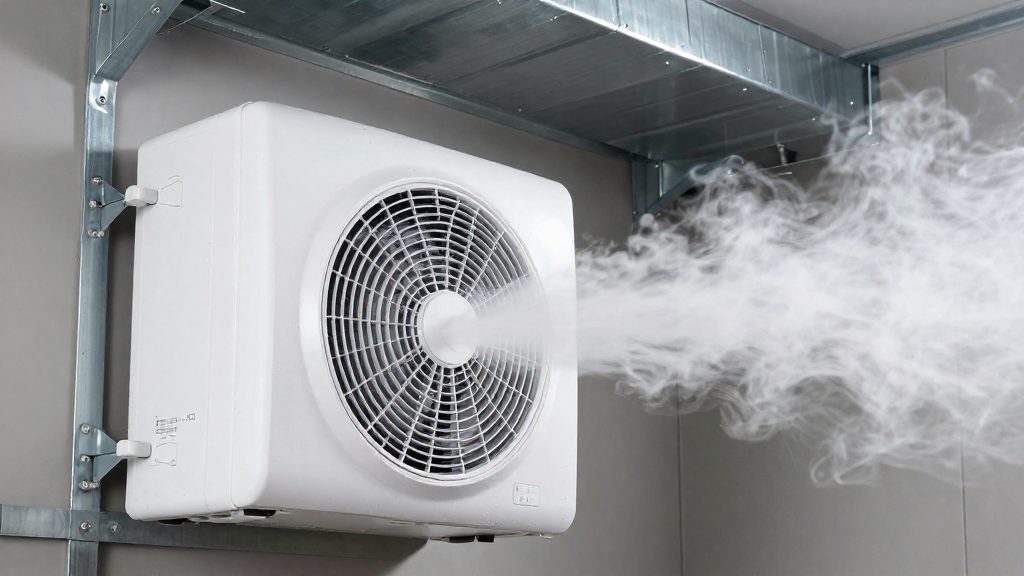
Water vapour leaves the pot as warm, humid air, which is lighter than the air around it. This makes a convection plume that rises from the cooking zone toward the ceiling and the hood. The plume’s path depends on the heat source and the room’s air currents, so the moisture usually reaches the upper part of the kitchen within minutes of the water coming to a boil.
Once the plume reaches the ceiling, it spreads sideways and drifts with any air movement, such as open windows, doorways, ceiling fans, or a forced-air system. In open-plan layouts, where the kitchen shares air with a living or dining area, the moist air moves into those spaces without a barrier. A closed door slows this transfer. An open one does not.
Along the way, the vapour meets solid materials. Walls, cabinets, curtains, upholstery, and rugs absorb part of the moisture as the air passes over them. This is moisture buffering: materials hold water while the air is humid and release it as the room dries. The humidity reading can therefore fall after cooking stops while the surfaces still hold moisture. Cabinet interiors and textiles near the stove are the most exposed, because they sit directly in the plume’s path.
Why do surfaces and hoods drip?
Dripping from hoods and nearby surfaces happens when warm, moist air from cooking reaches a surface cool enough to drop the air below its dew point, the temperature at which water vapour turns back into liquid. Novy, a cooker hood manufacturer, states that cooking humidity spikes because warm, moist air from pots meets cooler surfaces such as the backsplash or the hood and condenses on them. Novy also says this condensation cannot always be completely avoided, so the practical goal is to reduce where and how much water collects.
Dew point and cold surface temperatures
A surface collects water when its temperature falls below the dew point of the air touching it. The dew point depends on the air’s temperature and relative humidity, so steam from a pot raises the local humidity and therefore the dew point. To check condensation risk in your own kitchen, measure:
- Record the air temperature and relative humidity near the cooking area.
- Look up or calculate the dew point for those two values using a dew point table or calculator.
- Measure the surface temperature of the backsplash, window and hood underside with an infrared thermometer.
- Any surface reading below the calculated dew point is a likely condensation point.
| Surface | Why it can be colder than the air | Typical result |
|---|---|---|
| Hood underside | Closest surface to rising vapour, where moisture first meets a cooler surface | Droplets that fall back toward the hob |
| Backsplash tiles | Surfaces behind the cooking zone receive the rising plume | Film of water mixed with cooking residue |
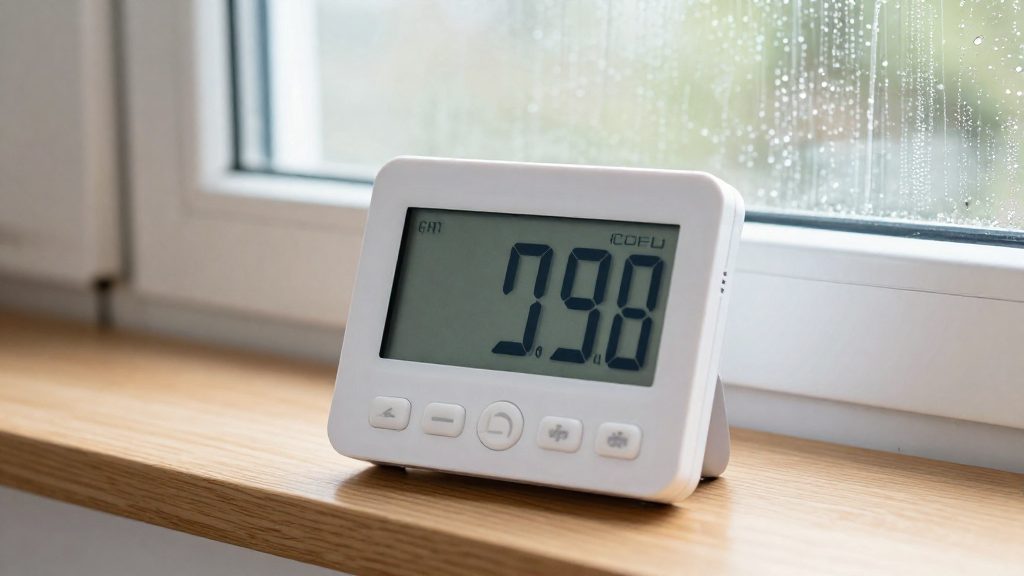
| Window glass | Glass is a cold surface when outside temperatures are low | Condensation running down the pane |
Grease and water droplets falling from hood filters
Hood filters trap grease particles, and the vapour that passes through them can condense on the cooler metal. The resulting droplets combine water with grease, so they tend to drip back toward the hob rather than evaporate. A filter that is saturated with grease holds more residue to mix with condensed water, which makes the drips heavier and dirtier.
Thermal bridges in cabinets and external wall corners
A thermal bridge is a path where heat escapes more easily than through the surrounding material, leaving that spot colder. Cabinets with poorly insulated back panels, and external wall corners, often have such paths. Their interior surfaces run cooler than the wall around them, so vapour from cooking condenses there even when the open wall looks dry. Inspection with an infrared thermometer is the reliable check.
Does a range hood really remove moisture?
A range hood removes moisture only when it captures the plume rising from the pot and exhausts it. Capture depends on the hood’s size, its mounting position, and the airflow of its fan. According to the Building America Solution Center (PNNL, US DOE, 2022), a kitchen exhaust fan should remove moisture and odors from cooking. A useful test is whether the fan captures the plume and moves enough air relative to the room, not just whether it runs.
Air changes per hour as a benchmark
ENERGY STAR recommends that kitchen exhaust fans provide at least 5 air changes per hour (ACH), depending on kitchen volume. ACH measures how many times the fan replaces the room’s total air volume in one hour. It can be estimated as airflow in cubic feet per minute × 60, divided by room volume in cubic feet. A fan rated at the same airflow therefore gives a lower ACH in a large open-plan kitchen than in a small one, so the required airflow should be calculated from the room rather than taken as a fixed number.
Capture efficiency
Capture efficiency depends on hood width and mounting height. A hood that is narrower than the cooking area, or mounted too high above it, lets part of the rising vapor escape into the room instead of entering the duct. Check the manufacturer’s installation specifications for the model in use.
Makeup air above 400 cfm
Any exhaust fan running above 400 cfm needs a makeup air system. This system starts automatically with the fan and supplies replacement air at an equivalent rate. Extraction capacity is therefore limited not only by the hood but also by how the kitchen gets replacement air.
| Requirement | Threshold | Source |
|---|---|---|
| Minimum ventilation rate | At least 5 ACH, depending on kitchen volume | ENERGY STAR, via Building America Solution Center (PNNL, US DOE, 2022) |
| Makeup air trigger | Exhaust fan running above 400 cfm | Building America Solution Center (PNNL, US DOE, 2022) |
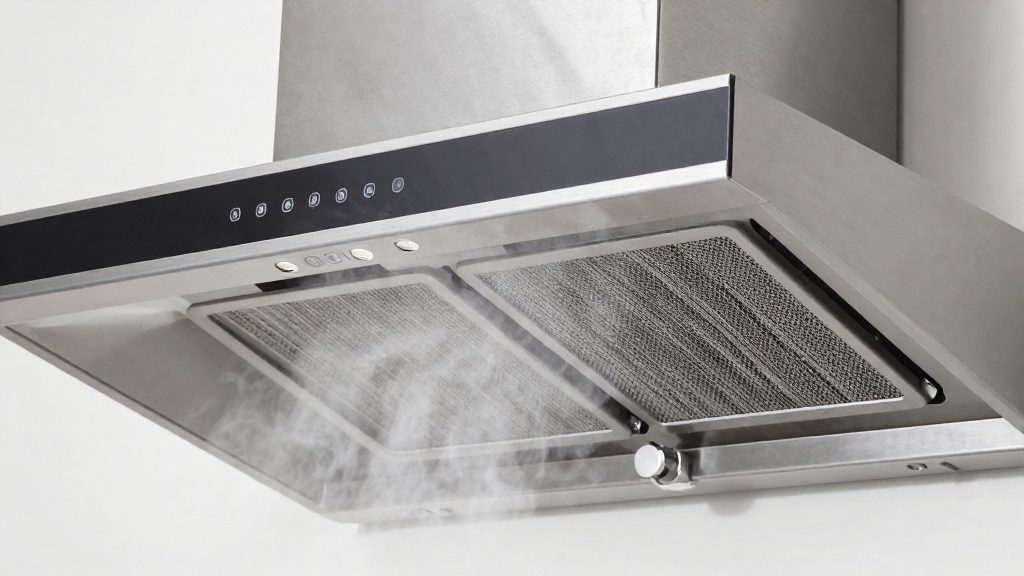
Ducted vs recirculating hoods
Ducted and recirculating range hoods differ on one point: whether the moist air they capture leaves the building. A ducted range hood carries steam through a duct to the outside, which removes the vapour it captures from the kitchen. A recirculating hood pulls air through a filter and returns it to the kitchen, so the moisture stays indoors. Ducting therefore decides whether a range hood takes vapour out of the building, not just whether it clears odours and grease. Windows and other exhaust fans also remove vapour, so a ducted hood is one route among several rather than the only one.
| Feature | Ducted hood | Recirculating hood |
|---|---|---|
| Air path | Exhaust leaves the building through a duct | Air passes through a filter and returns to the room |
| Water vapour | Captured vapour leaves the building | Remains in the room |
| Discharge point | Outdoors | Not applicable: no external discharge |
| Attic or crawlspace discharge | Not acceptable | Not applicable |
Outdoor venting requirement
According to the Building America Solution Center (PNNL, US DOE, 2022-12-06), a kitchen exhaust fan should remove moisture and odours from cooking and be ducted to the outside. Venting into an attic, crawlspace or other interior space is not acceptable. Discharging moist air into another enclosed part of the building only moves the humidity problem elsewhere.
Recirculating hoods: filters and humidity retention
A recirculating hood relies on a filter, commonly carbon, to treat odours and grease before the air returns to the room. Treat a recirculating unit as a way to clean the air, not to dry it.
Surface condensation adds to the problem. As noted above, surface condensation cannot always be completely avoided. A recirculating hood does not carry that vapour out of the kitchen, so the surrounding surfaces and the room’s overall moisture load remain.
Duct length, diameter and bends
In general terms, a longer run, a narrower diameter or more bends adds resistance to airflow, so the fan moves less air than its rated figure suggests. To keep the ducted route effective:
- Keep the run as short as the layout allows.
- Use a diameter matched to the hood’s outlet, without reducing it partway.
- Minimise elbows, and use gentle curves rather than sharp corners.
- Avoid sagging or crushed sections that trap condensation.
How long should you run the fan?
Turn the hood on before you start cooking and keep it running for about 10 minutes after cooking ends. According to Novy, a cooker hood manufacturer, this sequence clears the moist air that cooking releases into the room. The timing is simple, but a study cited by Green Builder Media found that most households do not use their mechanical ventilation consistently.
Activation and post-cooking run time
The protocol has two fixed points, and each serves a different purpose:
| Phase | Recommended action | Source |
|---|---|---|
| Before cooking | Switch the hood on before you start cooking | Novy |
| After cooking | Let the hood run for about 10 minutes | Novy |
The pre-start step means the fan is already drawing air when steam begins to rise, rather than starting after the kitchen has become humid. The 10-minute run-on addresses the moist air still present once the burners are off. For larger kitchens or cooking that produces more steam, the same 10-minute figure applies as a starting point.
Why many households skip extraction
In a study cited by Green Builder Media, 92% of participants had mechanical kitchen ventilation, but only 8% ran it every time they cooked. The gap is large: the equipment was present in nearly all homes, yet regular use was rare. Noise was the most common reason participants gave for not using it.
This makes noise the main practical barrier to the timing protocol. A pre-start and 10-minute run-on only works if the fan is switched on at all, so reducing the perceived loudness of the hood matters as much as the schedule itself.
How to track kitchen humidity with a hygrometer
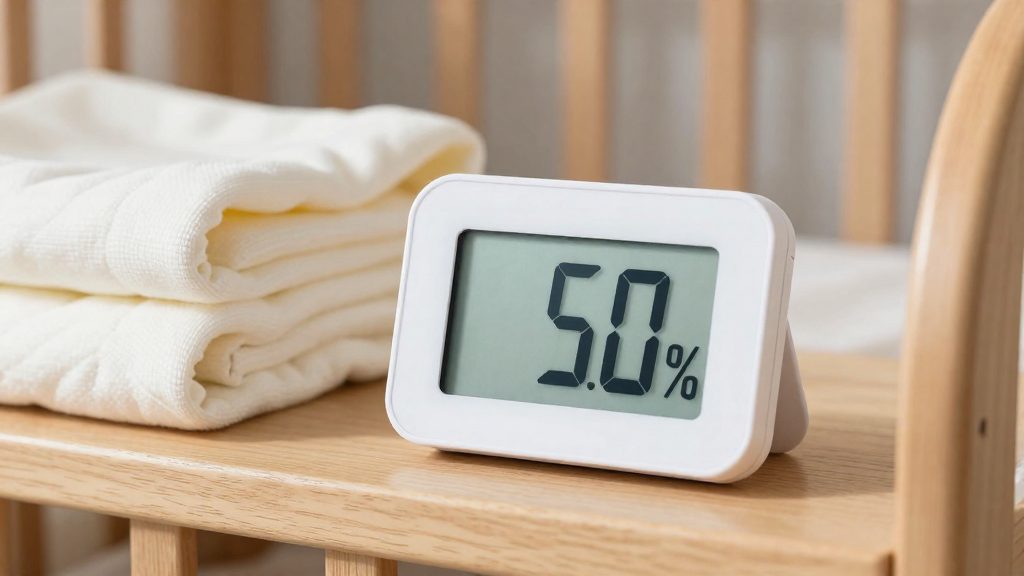
Logging relative humidity with a hygrometer turns a general impression of steam into a measurable record. A session that captures readings before, during and after cooking shows how far humidity rises, how long it stays high and whether the extraction setup brings it back down. The measurement has to start before the hob is switched on, because a spike can only be judged against a known baseline.
Sensor placement
Place the sensor in the room air, not in the plume. Keep it out of the direct path of steam from pots and clear of the inside of wall cabinets, where readings may not reflect the air in the room. Choose a spacing from the hob or cabinets and keep it fixed for every session. Moving the device between sessions can change the result as much as the cooking does, so record its exact position in the log.
Logging sequence
Use one fixed logging interval for the whole session. Choose one short enough to capture the peak of a single cooking step. Record each phase separately:
| Phase | What to record |
|---|---|
| Baseline | Relative humidity and temperature with the hob off and the room stable |
| Cooking | Peak value, time of peak, and the step that caused it (boiling, frying, steaming) |
| Extraction | Whether the hood or fan was on, and when it was switched on relative to the first step |
| Recovery | Time from peak until the reading returns to baseline |
Also note the number of pots in use and the hob setting, since these change the moisture load from one session to the next.
Interpreting readings
Judge results against your own baseline rather than a fixed figure. Calculate the rise as peak minus baseline, and calculate the spike-recovery time as the minutes between the peak and the return to baseline.
- A rise that recovers quickly may indicate the air is being exchanged effectively, though moisture absorbed by materials can also play a part.
- A rise that stays flat for a long period suggests extraction is not clearing the moist air.
- If recovery time increases across sessions run under identical conditions, something has changed, such as a clogged filter or a window that was closed.